Get Full Government Meeting Transcripts, Videos, & Alerts Forever!
Get email alerts on the Capital Plan topic
No spam. Unsubscribe anytime.
Eagle council sets planning assumptions, narrows focus for FY26–30 capital plan
Summary
Council and staff opened a multiweek process to rank and phase the city's five-year capital projects, agreed to plan using a $2 million annual capital-project placeholder, prioritize partnership-funded projects for near-term construction and restrict full reprioritization to out-year projects.
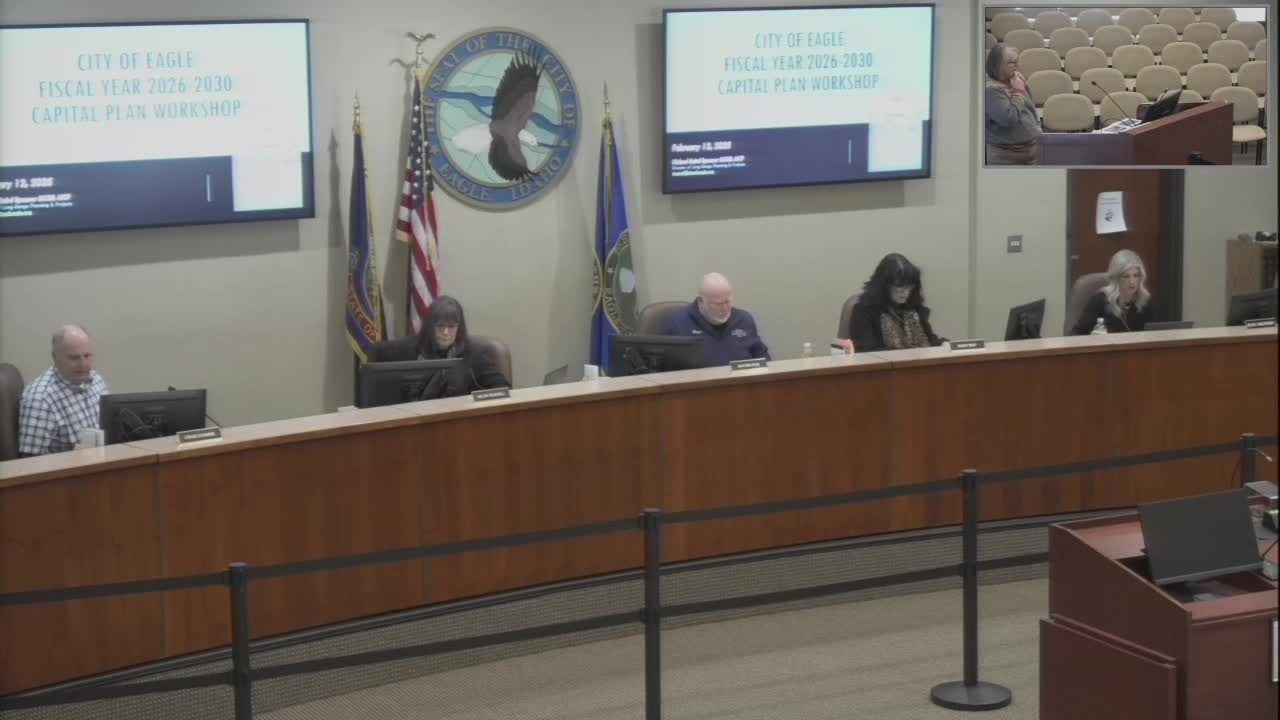
EAGLE, Idaho — City staff and the Eagle City Council met in a special workshop Feb. 12 to begin framing the FY2026–2030 capital plan, settle planning assumptions and agree on a prioritization process for projects including bridges, roads and a regional sports park.
Nicole, the city's capital planning staff lead, told council members the workshop's purpose was to align policy goals and timelines, describe funding assumptions and set a prioritization process that would feed the annual budget. She said the draft plan is intended to be fiscally constrained, to coordinate with the budget process and to capture partnership and grant opportunities that do not match the city's budget cycle.
Staff framed why a multiyear capital plan matters: many grants and partner contributions become available outside the city's fiscal cycle, so projects may need a placeholder in the multi-year plan to be eligible for outside funding. The council discussed whether to program capital projects on an annual planning assumption of $1,000,000 (the prior guideline) or $2,000,000 (a figure councilors previously directed staff to consider). After discussion, several council members said they preferred planning on the $2,000,000 placeholder so staff can show what a deeper program would look like, while noting that inclusion in the plan does not guarantee appropriation in the final budget.
The council and staff agreed on several process points: prioritization will focus on out-year (FY27–30) projects rather than altering the already-allocated FY25–26 program; projects already tied to partnerships or contractual commitments should be treated as higher priority for near-term construction; and new project requests will be ranked against the existing unfunded list rather than redoing the entire list each year. Staff offered paired-comparison ranking as the recommended method for council prioritization in future workshops.
Councilors and staff repeatedly discussed several large projects and how the plan should treat them. Staff noted the South Channel pedestrian/bicycle bridge over the Boise River could be a multi-million-dollar project (staff'estimated roughly $4,000,000, including engineering and construction) and that the North Channel bridge had been an unusual case where significant federal funding accelerated the schedule; staff warned the city should not expect identical federal funding to recur. Lindner Road, Old Park Place extension and the regional sports park were described as projects already in the program or tied to partners and thus more likely to reach construction sooner than unpartnered items.
Council members also questioned whether recurring operational or department-specific items—police weaponry and fleet expansion—should remain as capital projects. Staff explained those items are tracked in the plan because impact fees and internal savings pools were previously used to accumulate funding; councilors suggested moving annual, recurring needs back into department budgets rather than keeping them as capital projects that compete with multi-year infrastructure.
Staff outlined next steps and schedule: staff will prepare materials for paired-comparison prioritization of out-year projects, bring refined staff scoring and project-phasing recommendations to the council at scheduled prioritization workshops (mid-March through July dates were proposed), and host a public open house and outreach before a later adoption hearing. Council members confirmed meeting dates for prioritization workshops and public outreach and asked staff to produce clearer project-level scoping and the recommended funding triggers for conditional projects.
The workshop included a public-expectations discussion: staff emphasized the plan is a living document and that some large projects may take five to 10 years of project development, permitting and funding to reach construction. Staff cautioned councilors that showing a project in the plan without secured partnerships could mislead public expectations about timing.
Ending: Staff will return with a prioritized packet and scoring for FY27–30 projects, paired-comparison materials for council rankings, and refined scopes for large, unfunded proposals. Council members asked staff to flag projects that should be removed from the active list because they lack partner capacity or regional support.