Get Full Government Meeting Transcripts, Videos, & Alerts Forever!
Get email alerts on the Museum And Cultural Heritage topic
No spam. Unsubscribe anytime.
Rexburg museum staff cataloging 6,000 items as city and volunteers hunt for storage and a new exhibit space
Summary
Museum staff have archived more than 6,000 artifacts and packed roughly 3,500 as they search for 2,000–3,000 square feet of storage and a larger public exhibit space ahead of the Teton Dam flood 50th anniversary.
Alicia (Museum curator, City of Rexburg) told the council during a work session that her team has photographed and catalogued the museum collection and archived more than 6,000 artifacts, and boxed about 3,500 items as the city prepares to remove collections from the Tabernacle for upcoming HVAC work.
Why it matters: The Teton Dam flood’s 50th anniversary is next year, and staff say they need a place for a flood exhibit and for regular rotating displays. Without accessible storage and exhibit space, the museum cannot rotate objects or host interactive, family-oriented programming staff say would attract repeat visitors.
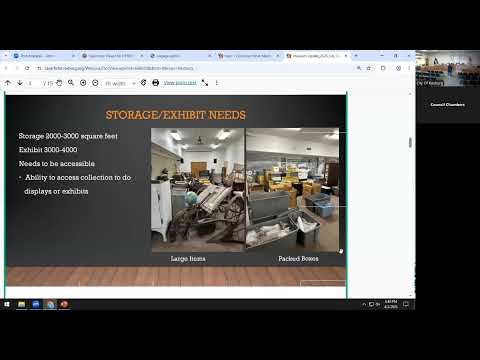
Alicia described the inventory effort and the immediate storage need. “As of Friday, we had archived over 6,000 items and have packed almost, as of today, 3,500 items,” she said. She estimated the collection needs about 2,000–3,000 square feet of climate‑treated, accessible storage now; an ideal new museum with larger exhibit space would be 5,000–7,000 square feet.
She outlined exhibit concepts under consideration: a “Day in the Life of the Frontier Woman” display, a military history display that includes a loaned bell from the USS Rexburg, a name-history gallery about the town’s early renaming, and a children’s, interactive flood exhibit called “Just Add Water.” Alicia said interactive children’s exhibits are a priority because they can be repeat draw and generate earned revenue through repeat visits and programs.
Historical Society volunteers and leaders confirmed the collection’s long community ties. Lewis Clements (Historical Society member) gave a brief history of the society and the museum, saying the society helped acquire the Tabernacle in the 1980s with a Department of the Interior grant and that the museum had been rated “first‑class” by the Idaho Association of Museums. Clements and other volunteers said they will continue to support temporary storage and programming during the transition.
Council and staff discussed short‑ and medium‑term options. Staff confirmed the HVAC work’s timing depends on a Community Development Block Grant (CDBG) the city applied for; construction was unlikely to start before October 2025 if the grant timeline holds. That means the Tabernacle basement will be unavailable for storage when restroom and other remodel phases proceed, and the council should expect the museum to need an offsite location long term.
Potential temporary and permanent options were discussed but no formal commitment was made. Ideas mentioned include: - Shipping containers (20‑ and 40‑foot) for temporary, rodent‑proof storage (quoted prices in discussion ranged from about $3,500 to $9,000 each depending on size and vendor) with concern expressed that items in containers can be forgotten or hard to access. - Using portions of the hatchery, the Romance venue lobby, the courthouse hallways/commission chambers, the former police station, the old seminary building, or fairgrounds buildings for temporary displays or storage once availability and accessibility are confirmed. - Partnering with the school district or county for space; staff reported school district storage options were limited after checks with district staff.
Staff said they will continue to catalogue and pack collections and work with volunteers to identify accessible short‑term storage that protects artifacts from pests and water while remaining retrievable for exhibit use. The mayor and council encouraged the museum staff to pursue temporary displays in publicly accessible locations for the 50th anniversary, and to return to council with concrete site, cost and timeline options.
Ending: Museum staff and historical society members said they will keep working with city officials and volunteers to secure storage and a new, more visible exhibit location, and the city will seek grant awards and community partnerships to support the museum’s long‑term needs.