Get Full Government Meeting Transcripts, Videos, & Alerts Forever!
Get email alerts on the Streets And Infrastructure topic
No spam. Unsubscribe anytime.
Rexburg leaders debate Local Improvement District policy, city share and financing for sidewalks and street reconstruction
Summary
At a March 5 work session, city staff outlined Rexburg’s street funding shortfalls and pavement lifecycle; councilors and staff discussed changing Local Improvement District (LID) participation rates, fixed internal financing rates and legal limits on subsidizing LID assessments for low‑income homeowners.
Rexburg City staff on March 5 told the City Council that current street‑reconstruction funding and Local Improvement District rules leave many older neighborhoods without sidewalks and expose homeowners to large assessment bills, and council members discussed raising the city participation rate and offering cheaper financing but were warned state law limits subsidizing LID assessments.
City Public Works Director Keith Davidson summarized the city’s pavement analysis and budget, saying the city’s available annual reconstruction funding is “roughly about 2,500,000.0 a year” for asphalt work and that, with current spending levels, full reconstruction cycles are extending well past the 20‑year design life for pavement. Davidson also described common maintenance tools—chip seals, crack sealing and overlays—to slow decline and urged drivers to avoid ponding water on streets because “that will destroy our roads faster.”
The nut graf: the discussion laid out a budget shortfall shaped by state and county revenue formulas, rising construction costs and policy choices about how much of sidewalk, curb and gutter costs the city should absorb. Councilors weighed raising the city’s standard LID participation (listed in policy at 30 percent) and using internal, lower‑cost financing to reduce homeowner payments; staff and legal counsel cautioned about the limits state statute imposes on reducing or forgiving assessments.
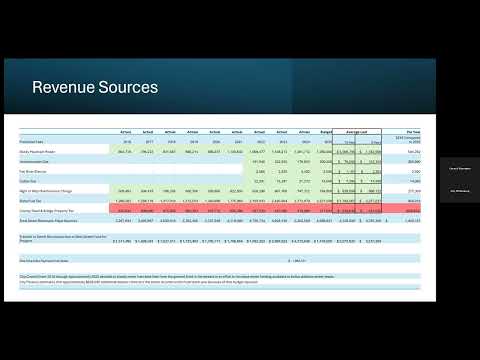
Most of the meeting focused on how the city allocates limited street funds. Staff showed that the city’s 2025 street department appropriation is roughly $4.7 million overall but that the line item for road reconstruction used in the pavement lifecycle example was about $2.5 million. Davidson and other staff also explained revenue sources that feed streets: franchise fees, impact fees, state fuel tax (which rises with population) and the county road‑and‑bridge property tax share the city receives. Staff said the county refund the city receives of the road & bridge levy has dropped sharply in recent years — from about $902,000 in 2019 to roughly $217,000 in the 2025 budget — and that change reduces funds the city can apply to reconstruction.
Council members and staff discussed several policy responses: raising the city participation for curb, gutter and sidewalk from the policy baseline of 30 percent (Council President Walker and others asked staff to show the numbers for a 35 percent city share), changing which elements (curb/gutter versus sidewalk) the city pays, and narrowing new street cross sections to reduce future maintenance costs. Staff said grants and occasional bond measures are possible but that grant dollars are generally one‑time and that a new local sales tax is a long shot given competing priorities.
Legal limits and financing options were a major topic. A staff member with the city’s legal/finance team reviewed state LID law and precedent and said the statute and Idaho assessment law treat LID charges as special assessments tied to a property’s special benefit; city counsel argued that state code does not authorize permanent reductions or broad forgiveness of LID assessments and cautioned that a program that selectively waived assessments could be challenged by both paying property owners and by non‑assessed residents. Staff cited a commonly referenced Idaho case out of Moscow (1980s precedent) describing the proportionality principle for assessments.
Rather than outright subsidy or forgiveness, staff described administrative options the city already uses or could change: offer payment plans, do in‑house financing at a lower fixed interest rate than market warrants, or set a modest, council‑approved fixed rate for internally financed LIDs. Staff said the city’s current internal practice often adds about 1 percentage point to market borrowing; as an example, staff modeled a $10,000 LID financed internally where a higher internal rate produced roughly $13,025 in total annual principal+interest, and a municipal fixed rate of about 3.5 percent (instead of a higher market rate) would save a homeowner roughly $1,100 over a 10‑year payment plan in that example.
Council members repeatedly raised fairness and equity concerns: several said older, lower‑income neighborhoods without sidewalks are the most affected by the current policy, while others said property prices historically reflected missing improvements. Staff repeatedly clarified that changing policy to help one group can raise concerns about “unjust enrichment” or create legal risks if assessments are not proportional to the special benefit derived from the improvement.
Council direction and next steps: members asked staff to circulate the LID spreadsheet with updated scenarios (35 percent city share, alternative splits for curb/gutter versus sidewalk, and a fixed internal financing rate option) and to present those numbers in the public open house staff scheduled for next Wednesday at 5 p.m. The council did not adopt a new policy at the meeting; members asked staff to return the analysis for a future agenda item if the council wishes to change the city participation percentage or the financing terms.
Ending: the discussion left two clear takeaways for residents facing potential LIDs: (1) state law constrains the city’s ability to offer permanent subsidies or forgiveness for LID assessments, and (2) the council is actively weighing whether to increase the city’s LID participation rate (council members asked staff to model 35 percent) or to formally set a lower fixed financing rate to reduce annual payments. Staff will circulate the updated spreadsheet and expected policy options ahead of any formal vote.