Get Full Government Meeting Transcripts, Videos, & Alerts Forever!
Get email alerts on the Fifth Avenue Design topic
No spam. Unsubscribe anytime.
City presents all-ages-and-abilities bicycle network and design options for Fifth Avenue reconstruction
Summary
City transportation staff reviewed the all-ages-and-abilities bicycle network and described design options for Fifth Avenue between William and Madison during a March 19 briefing; engineers said the corridor’s traffic volumes allow removing a vehicle lane in places to make space for safer bicycle facilities and parking alternatives.
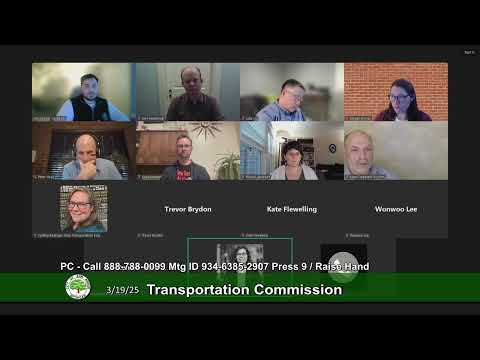
City transportation staff reviewed Ann Arbor’s all-ages-and-abilities bicycle network and presented design options for the Fifth Avenue reconstruction between William and Madison at the March 19 Transportation Commission meeting.
The network and project: Cynthia Redinger, a city transportation engineer, described the transportation plan’s goals to build an accessible bicycle network and the toolkit of treatments for local, minor and major streets. For Fifth Avenue, the project includes water-main replacement and pavement resurfacing; staff said the section between William and Packard currently has two southbound vehicle lanes and one southbound bike lane, while the block from Packard to Madison has one southbound vehicle lane with intermittent parking.
Design data and proposed revisions: Staff presented collected traffic data for a location between Liberty and William: average speed 23 mph, 80th-percentile speed 28 mph, and average daily traffic about 3,491 vehicles. Based on those volumes and safety objectives, staff said a single travel lane can service much of Fifth Avenue’s demand south of William. Staff discussed a design that would narrow vehicle lanes (for example, 10-foot vehicle lanes), provide dedicated bike lanes (6 feet where feasible), and create a floating parking lane or protected space for bicycle users on one side, with a small buffer on the opposite-side bike lane to reduce dooring conflicts.
Why it matters: Staff said lane reductions or reassignments are being considered to slow traffic, improve pedestrian crossings and provide higher-comfort cycling connections into downtown. Redinger noted downtown-circulation analysis may affect two-way conversion timing and that speed-management measures need to be in place to avoid negative impacts on transit operations. She also said two-way cycle tracks carry higher design and maintenance burdens.
Public engagement and next steps: Staff said they will finalize internal stakeholder coordination, complete feasibility checks, create an Engage Ann Arbor project page and communicate the final design to the public. No formal decision or vote on a final Fifth Avenue cross section was recorded at the March 19 meeting.
Quotes in context: "Miller is considered to be a major street, all ages and abilities connection," Redinger said when discussing corridor classification and how constrained rights-of-way influence facility choice. The commission discussed sidewalk versus on-street options and suitability for children and people with different abilities during the presentation.