Get Full Government Meeting Transcripts, Videos, & Alerts Forever!
Get email alerts on the Miller Road Cycle Track topic
No spam. Unsubscribe anytime.
Council member and residents urge re-evaluation of Miller Road two-way cycle track after safety concerns
Summary
Council member Kathy Griswold and other callers told the Transportation Commission they have raised safety concerns about the planned two-way cycle track on Miller Road and asked staff for a traffic-engineering re-evaluation; staff and a transportation engineer described Miller as a major street with constrained right-of-way.
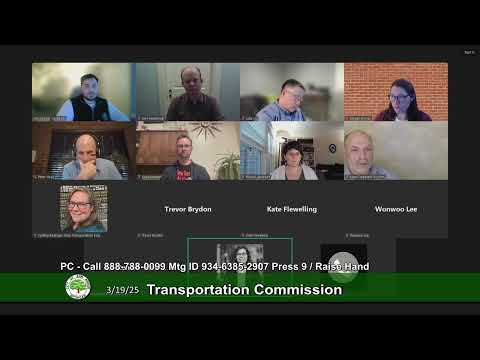
At the March 19 Ann Arbor Transportation Commission meeting, Council Member Kathy Griswold and several residents urged city staff to re-evaluate the planned two-way cycle track on Miller Road, citing potential conflict points and recent serious crashes elsewhere in the city.
Griswold said she had repeatedly raised issues about the proposed two-way cycle track and asked that staff place the item on the commission agenda; she said that had not happened and that she planned to contact the state to flag the project if the city did not address her concerns. Griswold also cited Chapter 40, Section 3.14, which she said requires clearing vegetation in public walkways and corners to provide sight distance, and asked the commission to consider vegetation sight-line enforcement.
Why it matters: Griswold called for a traffic-engineering re-evaluation before advancing the Miller design, arguing the two-way cycle track creates conflict points. Adam Juskiewicz and other callers also said the city should reduce speeds and reconfigure lanes on other corridors where recent pedestrian fatalities and serious-injury crashes have occurred.
Staff response and technical context: Cynthia Redinger, a transportation engineer with the city, confirmed Miller is classified as a major street under the department’s all-ages-and-abilities network and explained that the corridor’s constrained right-of-way and limited pavement width influenced the decision to propose a two-way cycle track rather than parallel protected lanes. Redinger described trade-offs that inform facility selection on constrained corridors and noted that two-way cycle tracks carry higher design and maintenance requirements and pose particular challenges for getting users into and out of the facility.
What was not decided: The commission did not adopt a new position or direct staff to change the Miller design during the March 19 meeting. Griswold said she planned to contact state staff the following day if the city did not place the matter on an agenda for further evaluation.
No formal vote pertained to Miller during this meeting.