Get Full Government Meeting Transcripts, Videos, & Alerts Forever!
Get email alerts on the Library Collections topic
No spam. Unsubscribe anytime.
Parent tells Sheridan County School District 2 board library collection lacks balance on transgender resources
Summary
At a district board meeting, parent Dwight Stanislaw told trustees the high school library collection is heavily weighted toward trans-affirming materials and asked the board to enforce policy IJL's requirement for a "broad diversity of opinion."
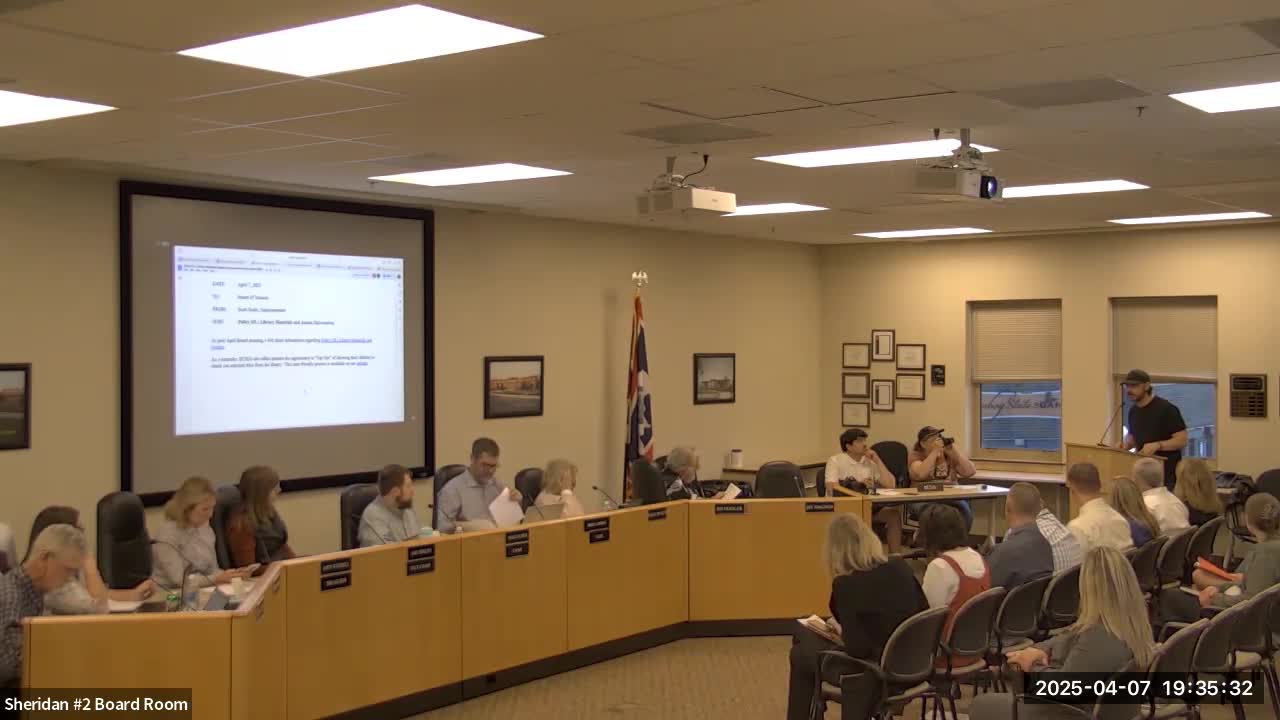
Dwight Stanislaw, a Sheridan parent, told the Sheridan County School District 2 Board of Trustees that the Sheridan High School library collection does not meet the district's stated selection standards and leaves students without balanced material on gender issues.
"When the district decides it wants to wade into the waters of a contentious cultural issue and carry resources at all, there exists an obligation to follow district policy closely and provide a robust collection of resources that present a broad diversity of opinion," Stanislaw said during public comment. He told trustees he had read the district's collection and documented a disparity of materials on transgender topics.
Stanislaw said he found 22 trans‑affirming nonfiction titles, one neutral title and one title he classified as opposing or body/biology affirming, and that library staff resisted adding additional countervailing material he recommended. "Throughout the entire process, I've been told repeatedly that additional resources will be added only to remain disappointed," he said.
The concern was presented in the context of Board policy IJL, Library Material Selection and Access, which Stanislaw quoted at the meeting: "the school district will allocate suitable funds for the maintenance of a robust library collection on an annual basis" and that library materials should "represent a broad diversity of opinion and appeal." He also cited the American Library Association's Library Bill of Rights in arguing librarians and the district should not allow any single viewpoint to dominate a school collection.
During the public discussion, board members asked clarifying questions about Stanislaw's review and his evidence. "Can you explain the handout? Like, where did these comments come from for each book?" asked Trustee Perkins. Stanislaw said he had checked out and read the books and summarized each one himself; he also provided a color‑coded chart for trustees showing the distribution he observed.
Trustee Moore asked whether Stanislaw had raised the issue earlier during the policy review cycle; Stanislaw said he had worked through staff channels first and had not come directly to the board earlier because he was following administrative review procedures. Trustee Fessler and Trustee Lansing said they supported the board's reliance on peer‑reviewed and curricular standards where available but also acknowledged the need to confirm that selection processes were consistent with IJL.
Superintendent Stultz and district staff did not propose changes to IJL during the meeting. The board allotted time for a staff presentation and then moved into an executive session for personnel matters related to the topic; no formal action to change policy IJL was taken in open session.
Stanislaw urged the trustees to correct the collection disparity or direct staff to apply IJL selection criteria in a way that yields materially balanced resources. "The policy then goes on to quote from the American Library Association: 'the school library plays a unique role in promoting, protecting, and educating about intellectual freedom,'" he said.
The board did not vote on changes to library policy during the meeting. Trustees said they would consider the information provided and proceed through the district's review procedures.
Ending
Stanislaw concluded by asking the board to decide whether "the existing disparity of resources should be corrected or if this topic should continue to receive special privilege by being permitted to avoid the standards set forth in IJL." Trustees did not announce a specific timetable for follow‑up in open session.