Get Full Government Meeting Transcripts, Videos, & Alerts Forever!
Get email alerts on the Speed Limits topic
No spam. Unsubscribe anytime.
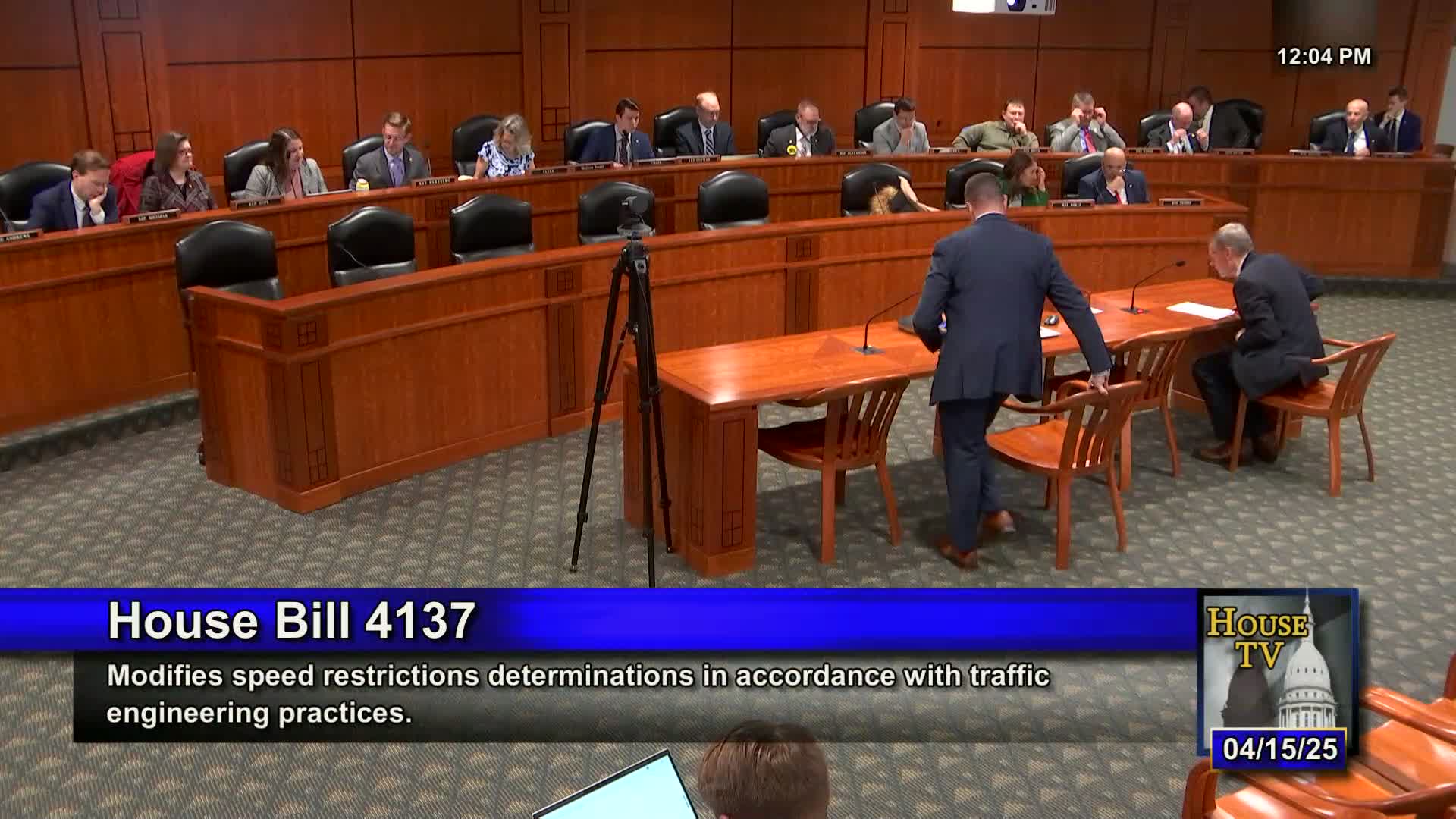
Committee hears bill to clarify application of Public Act 33 of 2024 for local speed limits
Summary
The House Transportation and Infrastructure Committee heard testimony on a bill from Representative Slaw that would clarify how Public Act 33 of 2024 is applied when setting local speed limits, including allowing limits below the measured 80th-percentile speed within a five-mile-an-hour range without additional engineering studies.
Representative Brad Slaw testified before the House Transportation and Infrastructure Committee in favor of House Bill 4137, saying the bill would clarify how Public Act 33 of 2024 is applied when local road authorities set speed limits.
Slaw said the law enacted last session "gave the road agencies more leeway in setting speed limits by reducing the need to conduct engineering and safety studies" but that Michigan State Police have interpreted PA 33 to still require those studies. "This bill clarifies the intent of PA 33 and makes it crystal clear that a speed limit can be set under the 80 fifth percentile without the need to conduct the additional speeds or engineering study," Slaw said, adding the change would apply "so long as that speed is within 5 miles per hour of the 80 fifth percentile speed limit."
The bill would, in the sponsor's view, restore the range of local discretion that lawmakers intended when the governor signed PA 33. John LaMakia of the Michigan Municipal League backed the clarification in brief remarks and described the proposal as providing local flexibility without requiring repeated state-level fixes: "What the representative is talking about…when we went to correct something a few years back…was the intention of it," LaMakia said, adding that the change aims to avoid forcing speed limits above the measured percentile because of rounding rules.
Committee members pressed for detail about how that flexibility would play out locally. Representative Reggie Miller asked whether the change would produce a ‘‘patchwork’’ of adjacent limits (for example, 50 mph vs. 55 mph) and was told it would be no worse than existing jurisdictional transitions and is aimed primarily at secondary roads rather than downtown "Main Street" corridors. Slaw and LaMakia explained the bill preserves the existing practice of setting limits to the nearest 5-mile-per-hour increment and allows jurisdictions to round up or down when the measured speed falls between increments.
Several lawmakers asked whether the measure would allow large swings on unpaved roads or permit reductions well below measured speeds. Slaw replied that jurisdictional control matters: townships cannot unilaterally set limits on county roads but can petition county road commissions. He noted the bill’s second subsection would permit consideration of the 50th-percentile in limited circumstances but that typical differences between the 80th and 50th percentiles are small (often about 5 mph). "You couldn't necessarily get it down 15 miles an hour," Slaw said.
Representative Andrews recounted township requests delayed more than a year because of procedural obstacles and asked whether the bill addresses review timelines or county unwillingness to act. Slaw said the proposal does not change who has jurisdiction or the statutory petition process; instead, it clarifies how to set a speed once a study is completed, which could reduce some implementation delay caused by inconsistent interpretations of PA 33.
The committee also heard from the Michigan State Police’s role in practice: staff said the department has interpreted the new law as still requiring engineering and safety studies in some cases, which the bill seeks to remove as a mandatory step for the limited flexibility described by the sponsor.
No formal committee vote on the bill was taken at this hearing; testimony was received and committee members asked questions. The sponsor and municipal league representative said they are available for follow-up as the bill moves through committee.
Ending: The committee moved on to the next agenda item after reading supporting cards from groups and municipalities; staff and lawmakers indicated further technical questions and local implementation issues would be addressed in subsequent deliberations.