Get Full Government Meeting Transcripts, Videos, & Alerts Forever!
Get email alerts on the Land Division Hb4081 topic
No spam. Unsubscribe anytime.
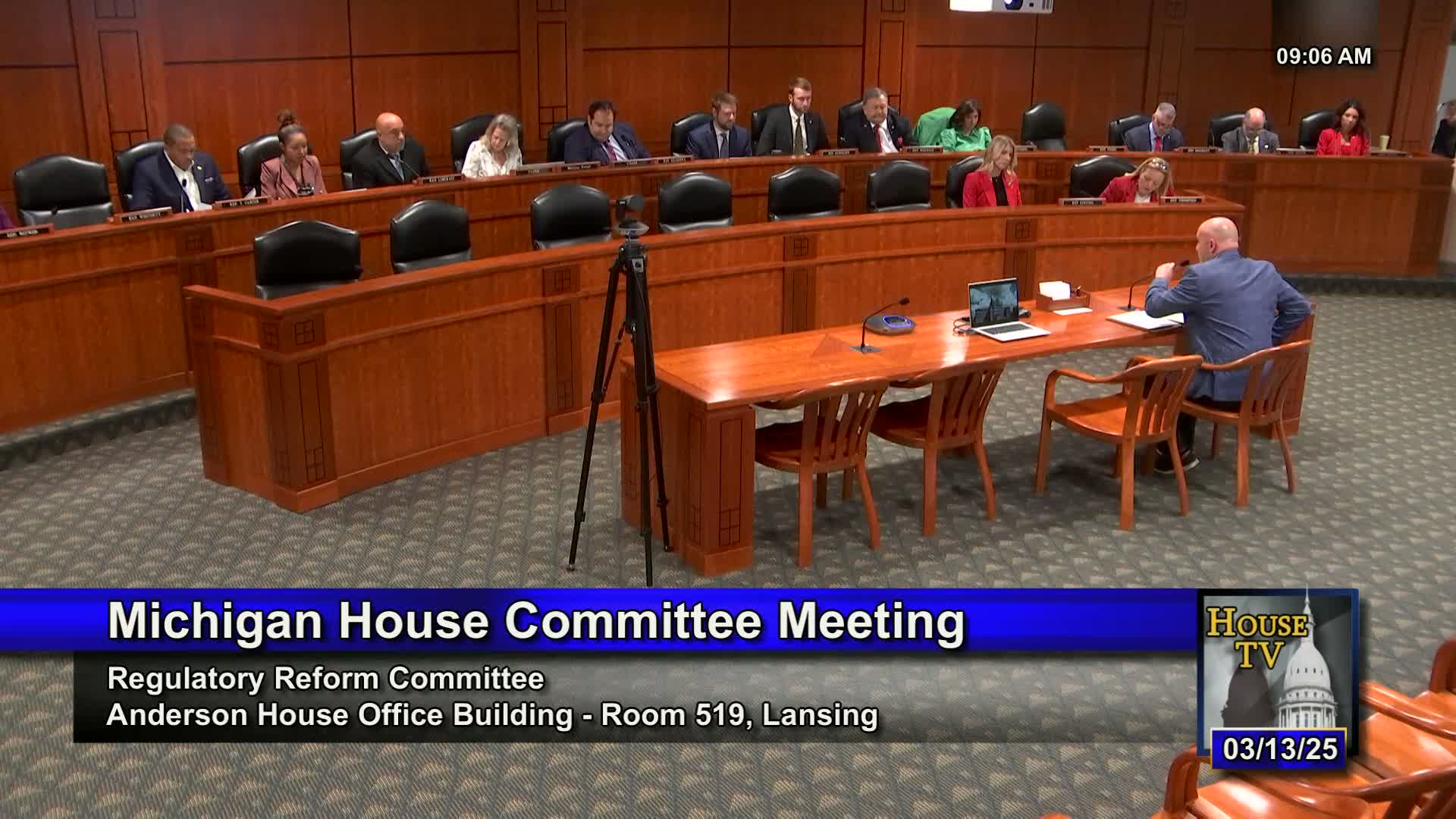
House committee hears testimony on bill to allow up to 10 land divisions per parcel (HB4081)
Summary
Representative DeBoer told the House Committee on Regulatory Reform that House Bill 4081 would amend Michigan’s Land Division Act to increase allowable parcel splits from four to ten and give local jurisdictions discretion to allow more.
Representative DeBoer introduced House Bill 4081 to the House Committee on Regulatory Reform as an amendment to Michigan’s Land Division Act that would increase the number of allowable parcel splits under section 108 from four to ten and give local jurisdictions authority to permit additional splits by ordinance. DeBoer and proponents described the change as a limited, local-option tool to create more buildable lots and ease housing supply constraints; the bill includes an effective date provision of July 1, 2026 to give communities time to adopt ordinances.
The bill drew sharply contrasting testimony. Brett Hollingsworth of the Michigan Society of Professional Surveyors (MSPS) told the committee HB 4081 raises “significant unintended consequences,” citing risks that the bill’s expansion could produce ambiguous parcel legal descriptions, gaps and overlaps in parcel boundaries, urban sprawl, strained infrastructure and shifted costs to taxpayers. MSPS emphasized that current land-division applications allow only tentative maps and nonstandard legal descriptions; surveyors and some municipalities require surveys but the Land Division Act does not mandate them. Hollingsworth warned that increasing splits without consistent survey or easement requirements would increase post‑sale boundary disputes and costly corrections.
Trade groups representing sellers, owners and managers of housing testified in favor. Sean Cecil of Michigan Realtors said the bill “creates flexibility” and is a local tool to reduce development costs; he stressed that zoning controls (lot size, setbacks, use, height) would remain in place. Erica Farley of the Rental Property Owners Association of Michigan described the statewide shortage of housing stock, rising construction and insurance costs, and the difficulty small owners face in adding units; she and other supporters said easing land-division rules could help produce more housing. Andrew Kuhn of the Apartment Association of Michigan similarly urged steps to increase supply and reduce regulatory delay, adding that insurance and prolonged development timelines are among the biggest cost drivers for housing providers.
Committee members pressed witnesses on technical issues. Representative Wozniak asked about differences between the Subdivision Act and the Land Division Act; witnesses explained the Subdivision Act involves platting and more complex regulation while section 108 of the Land Division Act allows a streamlined division process. Committee members asked whether surveys would be required and whether municipalities could deny applications; MSPS said the statute’s current language requires “adequate and accurate” legal descriptions but does not designate who prepares them, creating inconsistent practice across municipalities. MSPS also noted that some land grid monuments remain to be re‑monumented and that historical survey imprecision can compound problems when many small lots are created; a witness estimated remonumentation at roughly 75–80% complete.
Representative Hoadley and others discussed whether the bill would simply make the option available or would mandate local governments to approve splits; MSPS said its reading of the bill suggests municipalities would have to allow ten splits (subject to local parcel size limits), which MSPS says could create undevelopable parcels in floodplains or wetlands and bypass county-level technical review reflected in subdivision or condominium processes. Proponents replied that local zoning, lot-size controls and other local regulations would still govern buildability and that title companies and local ordinances can require surveys or other conditions.
No committee vote on HB 4081 was recorded in the transcript. Witnesses and committee members indicated a willingness by proponents and some organizations (MSPS) to continue working on language; committee members posed technical questions and sought clarifications but took no formal action on the bill during the recorded session.
Ending: The committee heard extensive testimony for and against HB 4081 and did not take a vote in this hearing. The bill remains under committee consideration; proponents argued it would create more buildable lots to help the state’s housing shortage, while surveyors and planners urged additional safeguards to avoid boundary errors, infrastructure shortfalls and other long-term costs.