Get Full Government Meeting Transcripts, Videos, & Alerts Forever!
Get email alerts on the Tourism Marketing topic
No spam. Unsubscribe anytime.
Pure Michigan officials tell House committee campaign supports jobs, draws tourists; minutes approved
Summary
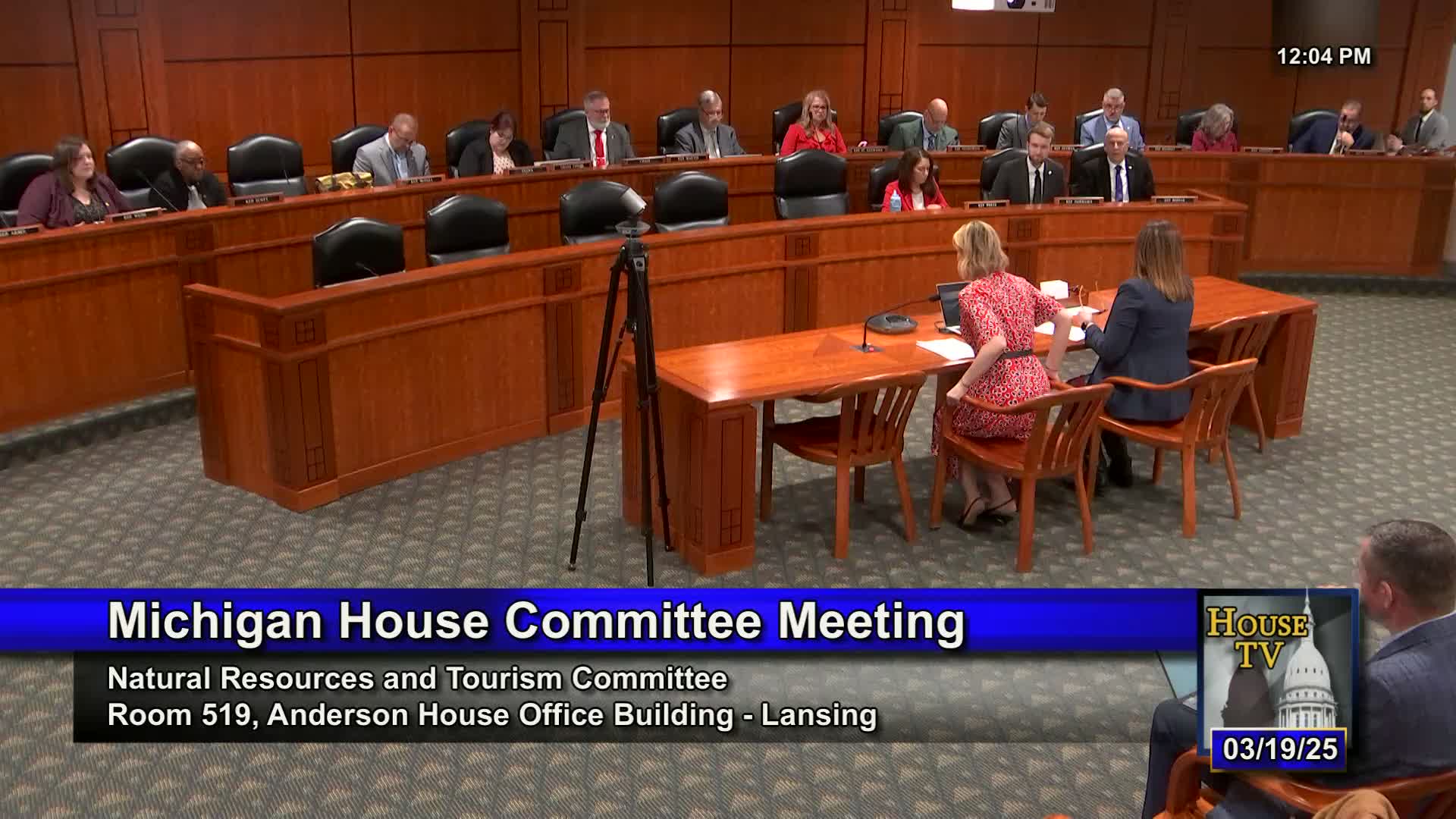
Presenters from Pure Michigan and the Michigan Economic Development Corporation told the House Committee on Natural Resources and Tourism that the campaign supports millions of visitors and hundreds of thousands of jobs, and outlined 2025 marketing plans. The committee approved minutes of a prior meeting by unanimous consent.
Hillary Doe, chief growth and marketing officer at the Michigan Economic Development Corporation (MEDC), and Kelly (vice president, Pure Michigan) briefed the House Committee on Natural Resources and Tourism on the Pure Michigan campaign’s economic impact and 2025 plans, saying the program helps attract visitors, supports jobs and produces tax revenue across the state.
The presentation updated lawmakers on 2023 campaign-attributed figures, partner and creative efforts for 2025, and the campaign’s 20th anniversary plans, and prompted questions from committee members about regional promotion, research vendors and budget allocation. Earlier in the meeting Representative Preston made a motion to approve the minutes from the previous meeting; the minutes were approved by unanimous consent.
The MEDC presenters said independent economic analysis attributes more than 28 million visitors and about $53 billion in total economic impact to Michigan travel in 2023, including roughly $29 billion in direct visitor spending and support for “over 300,000” jobs statewide. “One of every 17 Michigan jobs is directly or indirectly related to or supported by tourism,” Doe said, describing those figures as core measures the campaign uses to shape its work.
Kelly (vice president, Pure Michigan) described 2025 marketing plans that rely heavily on video and a mix of connected TV, broadcast, print, digital and out-of-home advertising. She said Pure Michigan emphasizes both outdoor recreation and city experiences across the state, and highlighted partner work with destinations including Detroit, Grand Rapids, Ann Arbor and communities in the Upper Peninsula.
Presenters detailed recent campaign work and metrics: the winter campaign produced 85 million impressions and about 8 million engagements, they said, and the campaign negotiated roughly $500,000 in added-value media placements. The campaign’s industry partner program will include 28 partners for the 2025 season with a reported partner investment figure of $2,500,000 (the presentation described this as the partner program investment for the year).
Lawmakers asked about coordination with other agencies and measurement. Doe said Pure Michigan staff hold monthly calls with the Michigan Department of Natural Resources to align promotion, and that the campaign maintains a hunting and fishing presence, including a “Pure Michigan Hunt” brand used by the DNR. On measurement and attribution, presenters said the campaign contracts with third-party research firms — naming Tourism Economics/Oxford Economics and a firm the presentation referred to as Somari — and cited an advertising-research firm (“Halo”) for campaign-effect studies. The research is used to attribute trips and spending to Pure Michigan advertising, the presenters said.
Committee members also pressed for budget and return-on-investment context. Presenters said approximately 80% of the campaign budget is allocated to media placement and about 20% to production; they described recent total annual campaign budgets as in the range of roughly $16 million to $25 million in recent years, and said some funding in recent years included one-time ARPA allocations. The presenters said they could provide year-by-year line-item budget figures on request.
Several lawmakers asked how Pure Michigan supports smaller communities and off-season or low-snow years in the Upper Peninsula. The presenters said the campaign seeks to be responsive to regional partners’ needs — for example, increasing summer promotion for UP destinations in a low-snow winter — and described co-op and low-cost partner options intended for small towns and local destinations that cannot bear high advertising costs.
Representative VanderWaal and others asked about social and digital metrics. The presenters distinguished between paid media (the primary budget line) and organic social engagement figures shown in the briefing; they said organic social metrics do not represent paid-media spend. The presenters also described in-state retail and branding efforts, including a Pure Michigan store located in Concourse A at Detroit Metropolitan Wayne County Airport (DTW), opened in February and operated in partnership with the airport and Paradies Lagardère.
The committee raised procurement questions about research contracts. The presenters said the campaign runs an RFP every three years for research services, that the current research contractor is based in Indianapolis, and that they would provide contract-value details to the committee after the meeting. They said they welcome bids from Michigan companies but had not received Michigan-based bids for the niche research work mentioned.
There were no formal votes on policy items during the presentation portion of the meeting. After the presentation and a series of member questions, Chair Martin thanked the presenters and the committee adjourned. The only formal action recorded on the transcript during this meeting was Representative Preston’s motion to approve the minutes, which the committee approved by unanimous consent.
(Reporting note: figures above — visitor counts, economic-impact totals, partner-investment and campaign metrics — were reported by MEDC presenters in committee testimony and described in the Pure Michigan briefing; where presenters used phrasing such as “over” or “about,” the article retains that approximate wording rather than implying exact counts.)