Get Full Government Meeting Transcripts, Videos, & Alerts Forever!
Get email alerts on the Upper Peninsula Rice Generators topic
No spam. Unsubscribe anytime.
UP employers, utilities and labor urge carve-outs for RICE generators to avoid steep rate increases
Summary
Dozens of Upper Peninsula officials, utilities, employers and labor leaders urged the House Energy Committee to approve legislation (HB4007 and HB4283) that would allow the region’s RICE generators to remain eligible for compliance through their planned life spans, arguing the change is necessary to avoid massive rate increases and reliability problems.
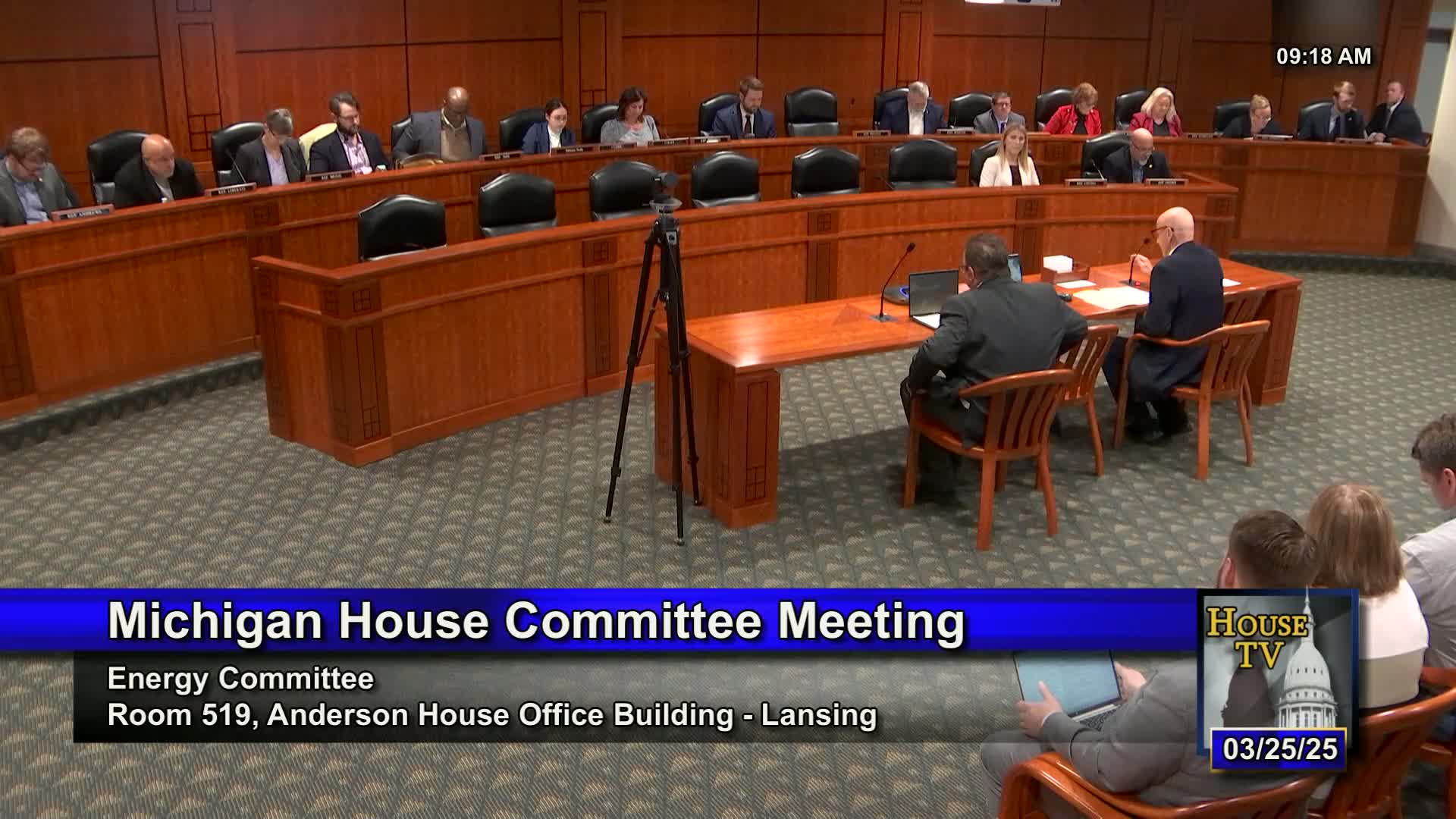
Lansing — Dozens of local officials, utilities, employers and labor representatives traveled from Michigan’s Upper Peninsula to urge the House Energy, Communications, and Technology Committee to support legislation intended to preserve the role of reciprocating internal combustion engine (RICE) generation for the UP’s grid.
Representative Bonac, the sponsor of House Bill 4007, told the committee the bill would “ensure that the 13 reciprocating internal combustion engines in the Upper Peninsula — the so called natural-gas powered RICE generators — stay online providing power to the electric grid through the end of their life cycle in 2049.” He said the RICE units were built after retirements of coal plants and provide dispatchable, on-demand power essential to mines, medical centers and other large users.
Utility executives and municipal officials said the RICE plants were the most practical, affordable and rapid solution to replace retiring coal-fired units and to avoid large system-reliability charges and potential blackouts. Tom Carpenter, executive director of the Marquette Board of Light and Power, told the committee the city invested $63 million to build a clean, dispatchable generating facility that “keeps our rates affordable.” He listed emission reductions since the conversion: sulfur dioxide down 99%, nitrogen oxides down 93% and carbon dioxide down about 75%.
Upper Michigan Energy Resources Corporation (UMERC) officials and Cleveland-Cliffs representatives warned that compliance with the state’s clean-energy statute (Public Act 235 of 2023) as currently written would require large investments in renewables and transmission and could impose unsustainable surcharges on UP customers. Pat Schillinger of UMERC said the company serves approximately 37,500 customers and that a recent amended renewable-energy plan estimated compliance could require over $3 billion in investment. Ryan Korpola, general manager for Cleveland Cliffs’ Tilden Mine, told the committee the mine uses approximately 1,100,000 megawatt-hours of electricity annually and that energy represents roughly 25% of the mine’s cost structure; Korpola said the projected surcharge increases were “not sustainable.”
Labor leaders and Cleveland-Cliffs officials said higher power costs could jeopardize thousands of jobs; United Steelworkers Local leaders representing Tilden employees said the mine supports about 1,000 hourly jobs and many additional indirect positions in the region. Dan Rockelainen, a union local president, and other labor witnesses described how higher electric costs would affect retirees, hourly wages and community stability.
Energy-policy experts and former state energy officials, including Valerie Bridal (former state energy-policy director under a prior administration), described why the RICE solution was chosen: smaller, distributed engines matched the UP’s load profile, could be sited in multiple locations to avoid single-point failures and enabled the retirement of large, coal-fired investments while reducing emissions quickly. Bridal urged lawmakers to account for the UP’s unique generation mix and large single industrial customer when drafting any state-wide compliance approach.
Several witnesses pointed to the Michigan Public Service Commission’s UP energy report and told the committee the study identified three realistic options: (1) change state law (legislative fix), (2) build extensive new transmission, or (3) significantly reduce electricity demand — each option carries substantial cost and complexity, they said.
Committee members asked clarifying questions about alternatives considered in the MPSC study, the origin and pricing of natural gas, and timing; witnesses repeatedly said the RICE units were commissioned in 2019 and were sized to meet the UP’s practical reliability needs. Senator Ed McBroom, who joined at the conclusion of the hearing, cited high regional bills and urged consideration of the legislation to avoid destabilizing the region’s economic recovery.
A range of cost estimates were offered in testimony and attributed to specific witnesses: UMERC’s filing estimates more than $3 billion to comply with the current statutory standard (Pat Schillinger); UMERC projected residential surcharges that vary in different analyses (Pat Schillinger and Mary Myers gave differing examples: one witness estimated a homeowner monthly surcharge near $90 in certain modeling, while a later economic-development witness summarized MPSC/UMERC estimates that residential surcharges could rise from about $7.28 in 2027 to $86.91 by 2040). Cleveland Cliffs estimated Tilden’s incremental electric costs could increase by nearly $16 million in 2027 and escalate through 2040 in some modeled scenarios. Committee members and witnesses noted these figures are modeling projections and not final rate determinations.
No final committee vote on HB4007 or HB4283 was held at the hearing. The chair said the committee will return to the bills for a future vote and invited members to follow up with witnesses; many attendees submitted written testimony that will be part of the record.