Get email alerts on the Nuclear Energy Smr topic
No spam. Unsubscribe anytime.
Michigan House Energy Committee hears bipartisan SMR, workforce package; no votes on bills
Summary
Lansing — The Michigan House Committee on Energy heard hours of testimony on a bipartisan legislative package, House Bills 4124 through 4129, intended to define small modular reactors (SMRs), create tax and production credits for advanced nuclear projects, and fund workforce training and retention programs — but the committee did not take a formal vote on the bills during the Jan. 30 session.
Lansing — The Michigan House Committee on Energy heard hours of testimony on a bipartisan legislative package, House Bills 4124 through 4129, intended to define small modular reactors (SMRs), create tax and production credits for advanced nuclear projects, and fund workforce training and retention programs — but the committee did not take a formal vote on the bills during the Jan. 30 session.
Chair Pauline Wenzel, who introduced the package to the committee, said the bills are meant to position Michigan as a leader in next‑generation nuclear technologies. “This package is necessary because simply having existing plants in operation won't secure our continued leadership in this quickly developing field,” Wenzel said. She described the proposal as combining incentives with workforce measures to “reward investment, innovation, and building a workforce of the future.”
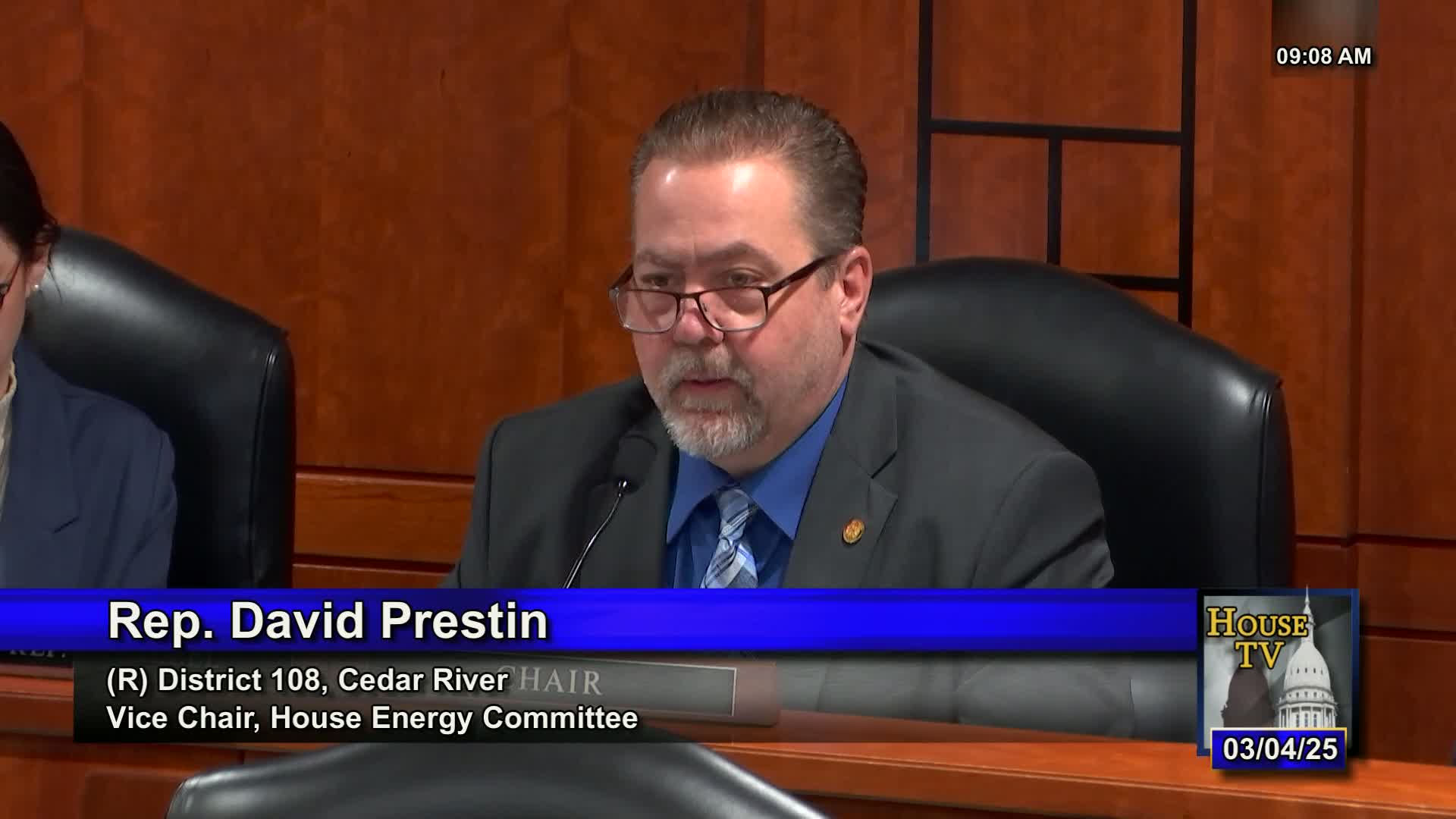
The bills were discussed after the committee completed procedural business: the panel unanimously adopted a proposed set of committee rules on a roll call vote (13–0) after Representative David Preston moved adoption, and later set Tuesday at 9 a.m. in Room 519 as the regular meeting time by a separate unanimous vote after Representative David Martin moved the motion.
Why it matters: supporters told the committee the package aims to attract manufacturing, research and construction related to SMRs, retain graduates of Michigan colleges in nuclear careers, and preserve existing nuclear capacity that supplies large amounts of carbon‑free baseload power. Testimony emphasized potential job growth, grid reliability and alignment with Michigan’s clean energy standard.
What the bills would do: committee sponsors and witnesses described the package as a multi‑part effort: - Define SMRs consistent with federal definitions (a bill attributed to Representative Thompson/Rep. Stekloff work was referenced). - HB 4124 (sponsored by Chair Wenzel) would create an R&D tax credit to support design, development and implementation of SMRs. - HB 4128 (Representative Van Workum) would provide a production credit for initial output (the sponsors referred to a production credit tied to the first 10 gigawatt‑hours of SMR output). - Other bills in the package would establish workforce attraction and retention scholarship or grant programs (including LEO‑administered scholarships or tax credits tied to multi‑year employment commitments) and a grant program to help postsecondary institutions create or expand nuclear or hydrogen credential programs.
Testimony and concerns: the committee heard from university, utility and labor representatives. - Todd Allen, chair of the University of Michigan Department of Nuclear Engineering and Radiological Sciences, described growing national and global interest in nuclear and urged the state to support R&D, workforce and siting clarity. “This legislation provides incentives to grow the use of nuclear energy and develop and keep this talent in the state and is an excellent launching device for the state,” Allen said. - Pete Dietrich, senior vice president and chief nuclear officer at DTE Energy, described Fermi Power Plant operations and safety oversight by the U.S. Nuclear Regulatory Commission, and said the package would help stimulate the state’s nuclear industry. Dietrich said Fermi employs about 760 full‑time workers and that refueling outages bring in 1,000–1,500 additional craft workers for outage work. - Jeff McLellan, managing director of engineering at the D.C. Cook plant, said bills that include scholarships, tax credits and grants would help recruit and retain engineers and skilled trades. He said Cook employs roughly 1,000 full‑time workers and that outages also bring in about 1,000 additional craft workers. - Robert George, director of government affairs for the Michigan Labor District Council (LiUNA), supported the package and described the union training that prepares workers for refueling outages and construction, noting that refueling periods can swell local employment substantially for several weeks. - Lake Michigan College officials said the college can scale training quickly for students and apprentices if funding and program authority are made available. - Clean Air Task Force and the Michigan Conservative Energy Forum also testified in support, framing advanced nuclear as a firm, low‑carbon complement to wind and solar.
Fiscal details and committee requests: during questioning Representative Kofia noted the House fiscal analysis listed only that the bills would have an impact on the Department of Labor and Economic Opportunity (LEO) but lacked dollar estimates. Committee members and sponsors discussed preliminary figures mentioned during testimony: representatives noted the Van Workum production credit could represent up to 10,000,000 in credits (identified in committee discussion as an annual figure), and that the R&D credit in Chair Wenzel’s bill was discussed in the hearing as approximately $2.5 million annually. Sponsors said they had discussed fiscal impacts with LEO and planned to leave exact funding levels to the appropriations process; the committee asked staff to provide an overall fiscal impact estimate for the full package.
No formal action on bills: committee members did not vote on House Bills 4124–4129 during the hearing. After testimony the committee recessed; members indicated plans to continue work, request fiscal analyses, and participate in outreach (witnesses invited members to facility tours and an off‑site nuclear education event scheduled for the coming days).
Votes at a glance: - Motion: Adopt proposed committee rules. Mover: Representative David Preston. Result: 13 ayes, 0 nays, 0 pass. (Clerk announced 13 present and quorum.) - Motion: Set regular meeting day/time and location as Tuesdays at 9 a.m., Room 519. Mover: Representative David Martin. Result: 13 ayes, 0 nays, 0 pass. - Motion: Excuse absent members. Mover: Representative David Preston. Result: passed (no objection announced).
Next steps: committee sponsors said they will provide additional detail to appropriations staff, pursue fiscal impact estimates for the full package, and continue hearings and outreach. Multiple witnesses invited members and staff to plant tours and an industry education event later in the week.
Ending: With no further business the committee adjourned for the day; members will reconvene at the regularly adopted time and location for follow‑up work.
AI generated
The text on this page is AI generated. Summaries, highlights, analysis, and video transcripts are all produced from the original source material.
AI can make mistakes, so if you spot one, and we will fix it for everyone.
Note: the source content is unaltered by us. Any content source we link to, be it a video, an audio recording, or a document, is presented exactly as its publisher released it. That publisher is usually a government body, sometimes an individual official or another organisation.