Get Full Government Meeting Transcripts, Videos, & Alerts Forever!
Get email alerts on the School Policy And Finance topic
No spam. Unsubscribe anytime.
Colchester School District board advances multiple policy updates in first readings; adopts annual ethics and suspension policies
Summary
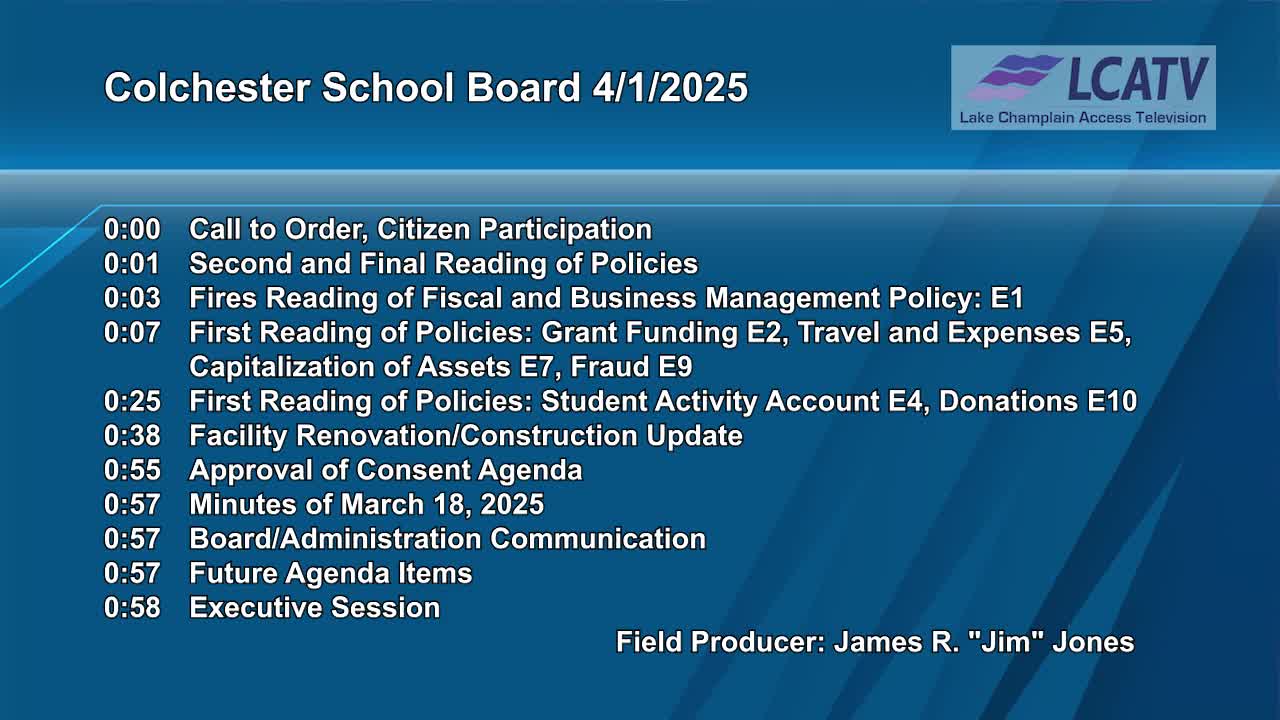
At its April 1 meeting the Colchester School District board approved second and final readings of three board governance policies and approved first readings of multiple financial and administrative policies; the board also approved the consent agenda and meeting minutes and voted to enter executive session for contract negotiations.
The Colchester School District Board of Education on April 1 approved second and final readings of three governance policies and moved forward first readings of a suite of fiscal and administrative policies, while also approving the consent agenda and meeting minutes and entering executive session to discuss contract negotiations.
Board members said the governance updates were routine housekeeping and part of a multiyear policy review cycle intended to review all policies within five years.
Board members and staff said the changes are mostly clarifications, one auditor-recommended conflict-of-interest insertion and minor housekeeping such as updating references to electronic forms. “I move that we approve the second and final readings of board policies B1, B2, and A1,” a board member said before the board voted by voice to approve those final readings.
The board then took first readings — a nonbinding step that begins the formal adoption process — of fiscal and business management policy E1 and additional policies in the financial and administrative suites: E2 (grant funding), E5 (travel and expenses), E7 (capitalization of assets), E9 (fraud), E4 (student activity accounts) and E10 (donations). Finance and district staff described the revisions as largely clarifying language and alignment with auditors’ suggestions.
On E1, described by staff as the district’s primary finance policy, staff said they changed one sentence to reflect that the budget presentation happens at the annual school board meeting while the formal vote takes place the next day on town meeting day, and added a conflict-of-interest line recommended by auditors. On E2 (grant funding) board members discussed aligning a small-dollar threshold in that policy (currently $25) with the district’s financial policy and suggested changing the amount to $100 for consistency.
Discussion of E7 (capitalization of assets) clarified the dollar threshold used for capitalizing fixed assets and cited consistency with audited financial statements (the policy references a range around $2,500–$3,000 and descriptions of straight-line depreciation). On E9 (fraud), staff said there were no recommended changes from auditors and that the district has not needed to invoke the fraud policy in the 19 years the speaker has been with the district.
Board members and staff also discussed the district practice of auditing student activity accounts internally and then sharing results with external auditors; staff said this internal auditing helps correct local mistakes and is appreciated by external auditors. Regarding donations (E10), staff said the superintendent or her designee generally manages donations and that larger or unusual donations are brought to the board for information and handling; one board member asked whether the district should set a monetary threshold above which the superintendent must notify the board.
The board approved the first readings by voice for the E1 suite and the remainder of the policies presented. Motions on the policies were approved by voice vote with all board members saying “Aye”; the transcript records voice approvals but does not include roll-call tallies.
The board also approved the consent agenda and accepted the March 18, 2025 meeting minutes by voice vote.
The meeting closed its open session business with a motion and unanimous voice vote to enter executive session to discuss contract negotiations.
Votes at a glance
- Second and final readings approved: board policies B1 (Code of Ethics for School Board Members), B2 (Code of Ethics — related policy), A1 (Management Suspension) — motion: “I move that we approve the second and final readings of board policies B1, B2, and A1.” Outcome: approved by voice vote; tally not specified.
- First reading approved: E1 (Fiscal and Business Management Policy) — motion: “I’ll make a motion to approve the first reading of the fiscal and business management policy E1.” Outcome: approved by voice vote; tally not specified.
- First readings approved (group motion): E2 (Grant Funding), E5 (Travel and Expenses), E7 (Capitalization of Assets), E9 (Fraud) — motion: “I move to approve the first readings of board policies E2, E5, E7, and E9.” Outcome: approved by voice vote; tally not specified.
- First readings approved: E4 (Student Activity Accounts), E10 (Donations) — motion: “I move that we approve the first readings of 4 policies E4 and E10.” Outcome: approved by voice vote; tally not specified.
- Consent agenda: motion to approve the consent agenda as provided. Outcome: approved by voice vote; tally not specified.
- Minutes: motion to approve minutes of 03/18/2025. Outcome: approved by voice vote; tally not specified.
- Executive session: motion to enter executive session to discuss contract negotiations. Outcome: approved by voice vote; tally not specified.
Context and what changed
District staff emphasized this is part of a planned multi‑year revision cycle designed to review entire policy sections together so related policies are consistent. Auditors review many of the fiscal and fraud policies annually; staff said auditors recommended a conflict‑of‑interest sentence and consistency of dollar thresholds. Staff also explained procedural changes such as moving travel forms to an electronic SharePoint-based workflow and clarified how donations are managed through the superintendent’s office with the board informed for larger or unusual gifts.
What board members pressed for
Board members asked for consistency across conflict-of-interest language in different policies, for aligning small-dollar thresholds in E2 with the financial policy, and whether the board should set a monetary threshold to require formal notification for larger donations. A board member asked how staff inform employees about fraud-reporting obligations; staff described onboarding materials, annual student-activity account signoffs for certain staff, and internal reviews performed by the finance office.
Next steps
These were first readings for most of the policies presented; second readings and any suggested renumbering or reformatting will return to the board later this spring or summer as part of the district’s policy-cycle timeline.