Get Full Government Meeting Transcripts, Videos, & Alerts Forever!
Get email alerts on the Gravel Pit Setbacks topic
No spam. Unsubscribe anytime.
Committee holds hearing on gravel-pit setback amendment; staff will refine language before vote
Summary
Zoning staff presented a proposed amendment to allow site-specific engineering review when applicants request reduced setbacks for excavations; the committee held a hearing and staff will revise language to exclude road corridors before the ordinance returns for a vote next month.
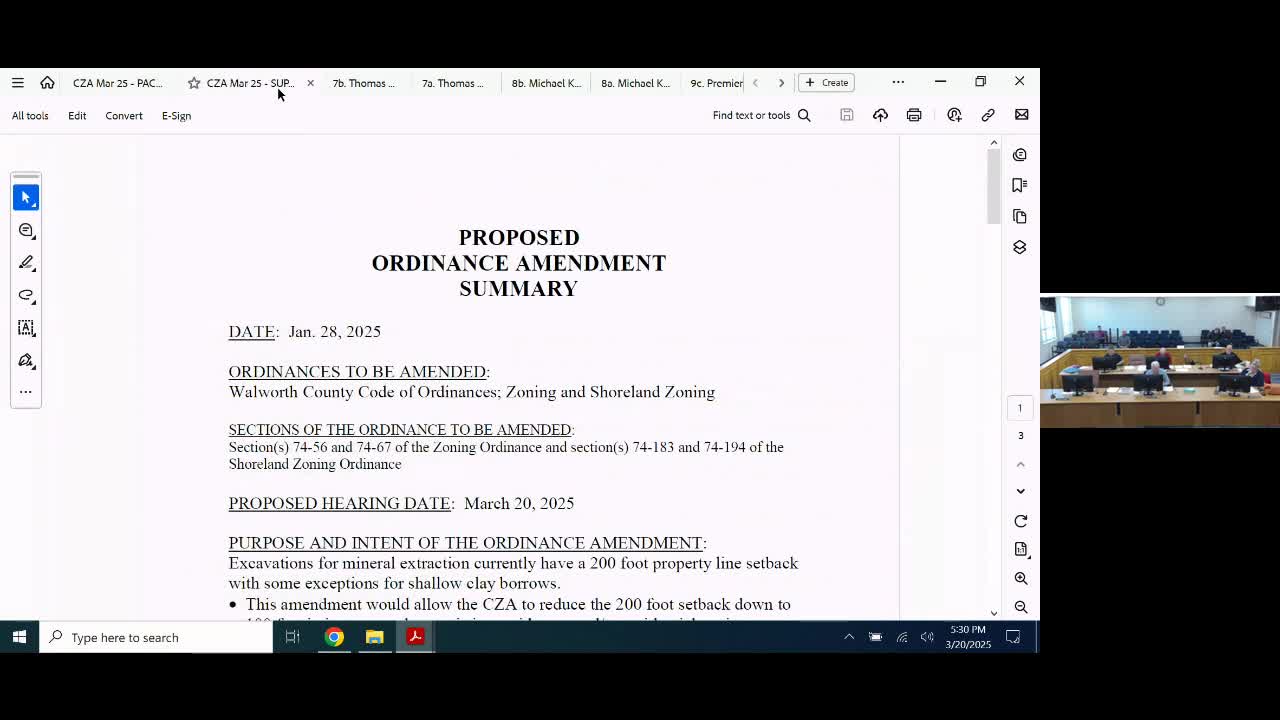
Walworth County zoning staff presented and the committee held a public hearing on a proposed amendment to the county code affecting setback reductions for mineral-extraction operations (gravel pits).
Nick (county staff) told the committee he added language allowing the committee to require a site-specific professional-engineer analysis, at the applicant’s expense, before issuing, amending or renewing a conditional-use permit when a reduced or eliminated setback is proposed for excavations. The language was added in response to committee concerns about the safety and engineering implications of reducing setback distances.
Staff also drafted a graphic to show areas where reduced setbacks would be allowed (green) and where they would not (red). During discussion staff noted an unintended consequence: some road corridors were zoned P-1 and, as drafted, the map could have prevented setback reductions near certain roads. Nick said he intends to update the language before the committee votes next month to explicitly exempt road corridor zoning from the prohibition, or otherwise clarify the rule so that road zoning does not automatically block setback adjustments.
Nick said he had consulted the Wisconsin Department of Transportation and the county public-works staff; neither expressed concern with the 100-foot setback in principle, but staff emphasized the need for engineering review when requested setbacks are large or soils are uncertain. A committee member said specific DOT or public-works concerns could trigger the requirement for engineering analysis.
The committee held the required public hearing; no members of the public spoke for or against the amendment at the hearing. The ordinance requires a one-month wait between public hearing and final action; staff will return with revised language for the committee’s vote at a future meeting.