Get Full Government Meeting Transcripts, Videos, & Alerts Forever!
Get email alerts on the Family Wellness Family Treatment Court topic
No spam. Unsubscribe anytime.
Walworth County highlights Family Treatment Court, temporary housing and school mental‑health navigators
Summary
HHS presented outcomes from its Family Treatment Court grant, a temporary housing partnership with Southeastern Monitoring, and school-based mental‑health navigators; board heard program successes and graduations.
Walworth County Health and Human Services on March 19 showcased Family Treatment Court outcomes, a housing partnership that supplies short‑term units for families, and mental‑health navigators embedded in local schools—programs HHS said reduce child removals and speed permanency.
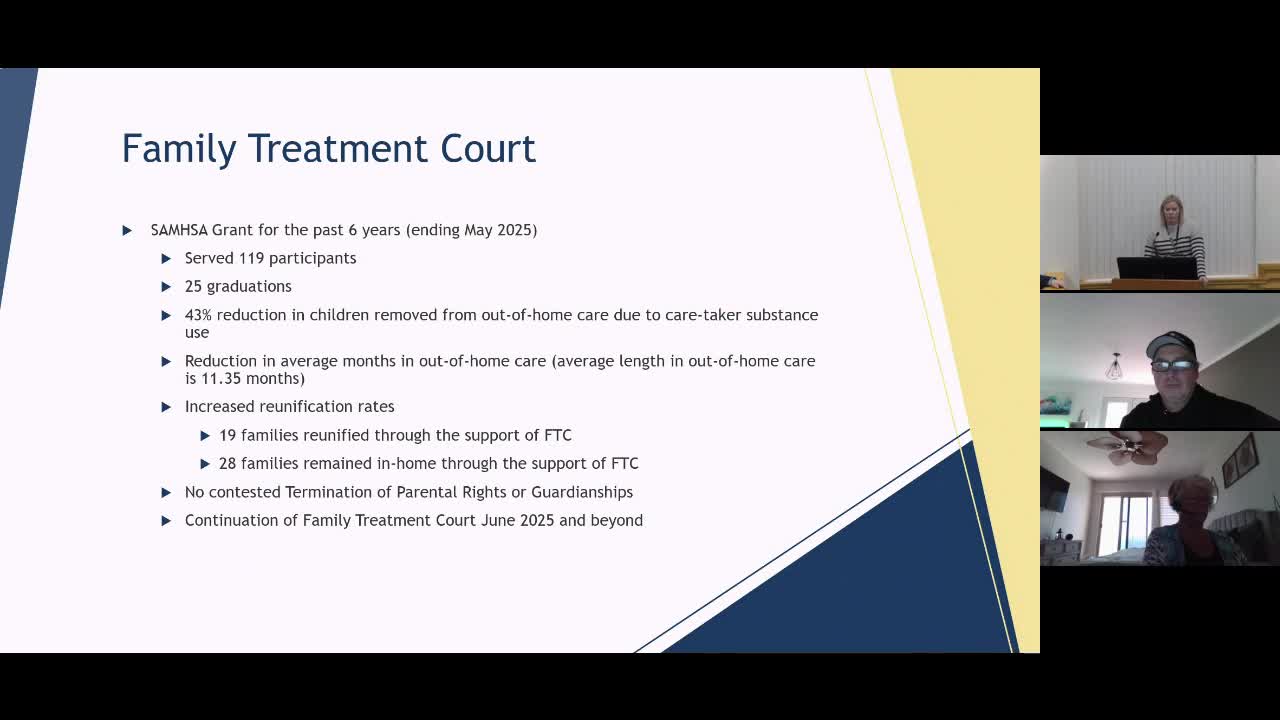
Allison Manske, Family Wellness and Preservation Division manager, told the board the Family Treatment Court funded through a SAMHSA grant served 119 participants during the grant period, produced 25 graduations and saw a 43% reduction in child removals tied to caregiver substance abuse; staff reported an average time in out‑of‑home care of 11.35 months and said nine families were reunified through the program. Manske said the five‑year SAMHSA grant supplied funds to expand the court’s services and that remaining one‑time funds extended the program into a sixth year; she said the grant will end in May 2025 but the department intends to continue Family Treatment Court practices.
Judge Dave Reddy, who presides over the court, described treatment as the program’s cornerstone and urged participant honesty: “The 3 things you need to do in order to be successful in treatment court are show up, try, and be honest,” he said. Desiree Bongard, family treatment court coordinator, described participants’ progression from intimidation to engagement and said the team sees behavioral change that contributes to case closure and reunification.
Julie Bonagowski of Southeastern Monitoring detailed a county partnership that provides three temporary housing units (one house and two apartments) to help parents working toward permanency. Bonagowski said the initiative began Feb. 2022, has served 15 families and roughly 34 children, and reported seven reunifications tied to the program; staff told the board 11 families left the program with permanent housing lined up.
School partners Kelly Demrath (Elkhorn Area School District principal) and Emily Lind (director of special education) described mental‑health navigators embedded in schools through grant funding and later sustained via partnership. Demrath said the navigator role increased enrollment in county services and improved linkage to community resources; Lind said the position enabled prevention, early intervention for truancy and restorative-practice work and has helped reduce absenteeism and support system improvements.
Ending — HHS said it will continue seeking funding and partnerships to sustain these programs after grant periods end and to track long‑term outcomes.