Committee hears budget update; full‑day kindergarten pause pending funding plan
Loading...
Summary
District leaders presented a base‑budget strategy that uses circuit breaker rollover to restore student‑facing services and manage special‑education costs. Officials said a tuition‑free full‑day kindergarten plan is paused because expected Chapter 70 reimbursements changed; families were advised about financial‑assistance options.
District leaders updated the Hanover School Committee on fiscal planning for FY26, explaining a base‑budget approach that prioritizes classroom and student services while preserving reserves against federal and state funding uncertainty.
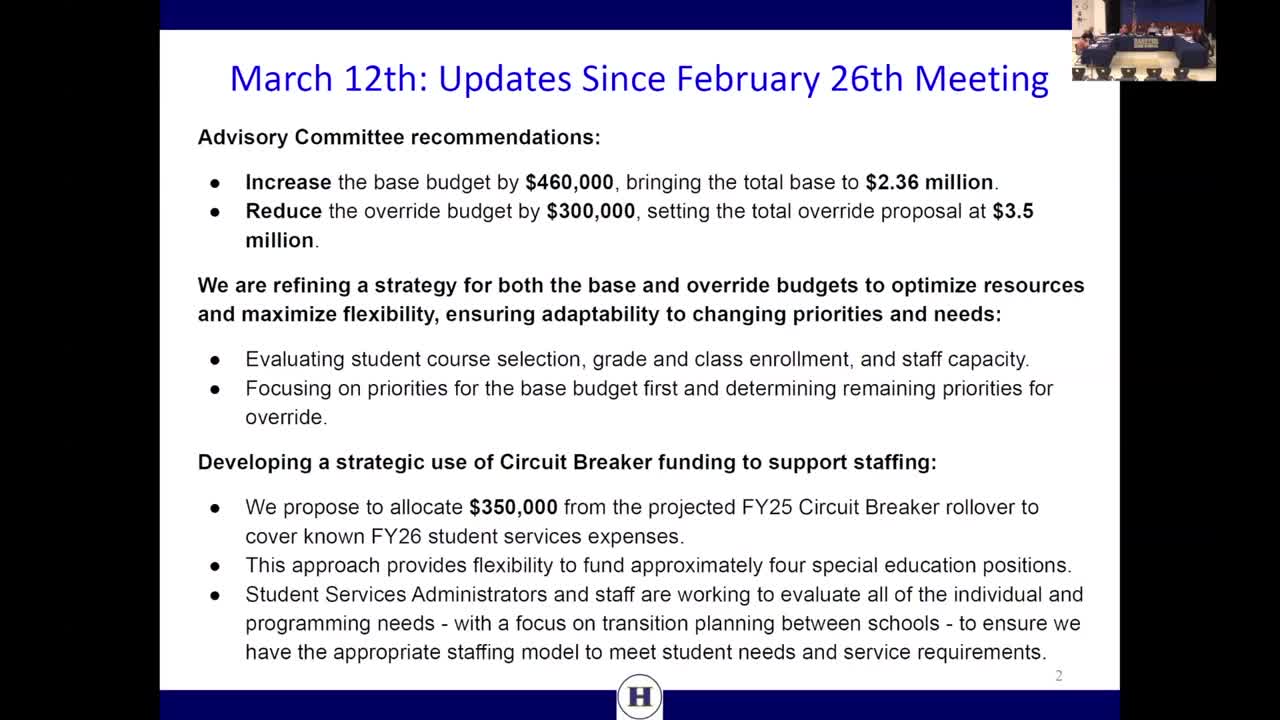
Superintendent and finance staff said the advisory committee recommended boosting the base budget by roughly $960,000 above level services, bringing the total base increase to under $2.4 million. Administrators described using an anticipated circuit breaker rollover from FY25 into FY26 (they estimated rolling roughly $500,000–$800,000 and proposed allocating $350,000 of that rollover now) to fund high‑priority student‑facing positions (speech/language, BCBA, special‑education teacher, district reading teacher) and to reduce reliance on one‑time reserves.
Officials emphasized that federal entitlements (IDEA, Title I) and state Chapter 70 aid remain uncertain; administrators noted a potential Title I reduction and said they are monitoring funding developments. They asked the committee to preserve the special‑education reserve and use circuit breaker strategically to avoid drawing down that reserve unless necessary.
Full‑day kindergarten: Administrators reiterated that a tuition‑free full‑day kindergarten model is a district priority, but said it is paused for now because anticipated Chapter 70 reimbursements used in prior planning did not materialize. The committee and staff encouraged families who need financial assistance to contact the schools directly; administrators described using federal sliding scales and direct‑certification processes to identify eligible families.
Next steps: Staff will refine enrollment projections (particularly kindergarten and grade‑1 counts), finalize a detailed position allocation for the restored base positions, and present a layered plan at future meetings showing what additional restorations the override would enable.
Ending: The committee agreed to continue outreach and public forums in April to explain budget models and impacts and to return with detailed numbers once state and federal allocations are clearer.
Speakers and quotes in this article are drawn from the meeting transcript and are attributed to the staff and committee members on the record.