Get email alerts on the Wireless Telecom topic
No spam. Unsubscribe anytime.
Planning commission backs revised wireless telecom code changes, asks more city oversight
Summary
The North Ogden City Planning Commission voted unanimously to recommend amended changes to North Ogden City Code Title 11-17 governing wireless telecommunications, after a public hearing.
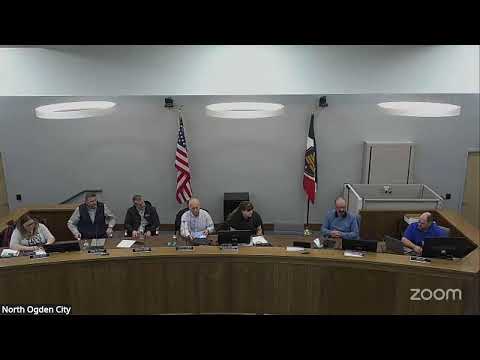
The North Ogden City Planning Commission voted unanimously to recommend amended changes to North Ogden City Code Title 11-17 governing wireless telecommunications, after a public hearing that included a Verizon representative and extended discussion over allowable setbacks, camouflage ("stealth") towers and use of city-owned property.
Scott Hess, North Ogden community and economic development director, opened the item and framed it as a legislative public hearing that would produce a recommendation to the city council. "This is a public hearing. This is a legislative item," Hess said, adding that Verizon Wireless submitted the zoning text amendment and paid the application fee.
The code amendments under consideration would (1) treat city-owned property as a priority site for locating towers and allow reduced setbacks on such property; (2) permit administrative approval of well-camouflaged towers as a building permit (the language proposed by Verizon); (3) allow existing mature landscaping to satisfy buffer requirements in some cases; and (4) change setback references so antenna setbacks apply specifically to "residentially zoned" property and leave nonresidential setbacks to be defined by zone standards.
Dakota Hawks, a Verizon site-acquisition project manager, said the company seeks to "modernize the section and not do a full overhaul" and that the largest hurdle is the current code's phrase "any property line," which often makes many otherwise-viable properties unusable for towers. Hawks told commissioners typical monopoles in the region are now about "60 to a hundred foot range" and that lease areas typically start near 1,200 square feet; starting monthly rent in the Utah market is commonly about $1,200, he said.
Commissioners focused on three core issues: how setbacks should be measured in commercial, civic and manufacturing zones; whether stealth or camouflaged towers should be administratively approved or require planning commission review; and how to prioritize city-owned parcels for siting.
Commissioner Lauren Gardner, who asked that stealth proposals come before the commission, said she was concerned that administrative approvals could leave commissioners unable to review final designs. "I think it absolutely has got to come before us so that we can look at it," Gardner said. Multiple commissioners expressed a preference to keep stealth and landscaping decisions as part of the site-plan review process rather than move them entirely to staff-level approvals.
Staff and Verizon representatives described possible compromise language: keep setbacks at a distance equal to tower height where an antenna abuts a residentially zoned lot; in commercial and manufacturing zones, apply the same setbacks as the zone's main-structure setbacks; and in the civic zone (which includes some city-owned parks and facilities) permit a reduced setback only after a planning-commission determination during site-plan review.
After extended discussion and drafting on the record, the commission voted to forward a recommendation to city council with amendments reflecting those changes and to strike the staff-proposed administrative approval path for stealth towers so that camouflage/stealth designs would be reviewed with site plans. The motion passed unanimously; Commissioners Green, Watson, Webb, Neighbour, Gardner and the chair voted yes.
Why it matters: Commissioners said better wireless coverage affects public safety and everyday connectivity for residents on the north and east sides of the city, where mountain terrain can limit coverage from neighboring jurisdictions. At the same time, commissioners said they want to protect visual character and require sufficient public review before new towers are installed. Verizon signaled a willingness to work with the city on design options (monopoles, painted monopoles, water-tank or silo-style camouflage) and prefers city-owned property where possible because of leasing stability.
The commission's recommendation will go to the City Council for ordinance drafting and final action. Staff noted that specific language and legal review will be required before council action.
AI generated
The text on this page is AI generated. Summaries, highlights, analysis, and video transcripts are all produced from the original source material.
AI can make mistakes, so if you spot one, and we will fix it for everyone.
Note: the source content is unaltered by us. Any content source we link to, be it a video, an audio recording, or a document, is presented exactly as its publisher released it. That publisher is usually a government body, sometimes an individual official or another organisation.