Get Full Government Meeting Transcripts, Videos, & Alerts Forever!
Get email alerts on the Budget Finance Sales Tax topic
No spam. Unsubscribe anytime.
Miami County finance updates sales‑tax decline, outlines conservative budget assumptions for 2026 process
Summary
Assistant county administration presented March sales‑tax distributions showing a year‑over‑year decline and proposed conservative revenue assumptions for the 2026 budget; commissioners discussed priorities including courthouse accruals, roads, and continued focus on employee retention.
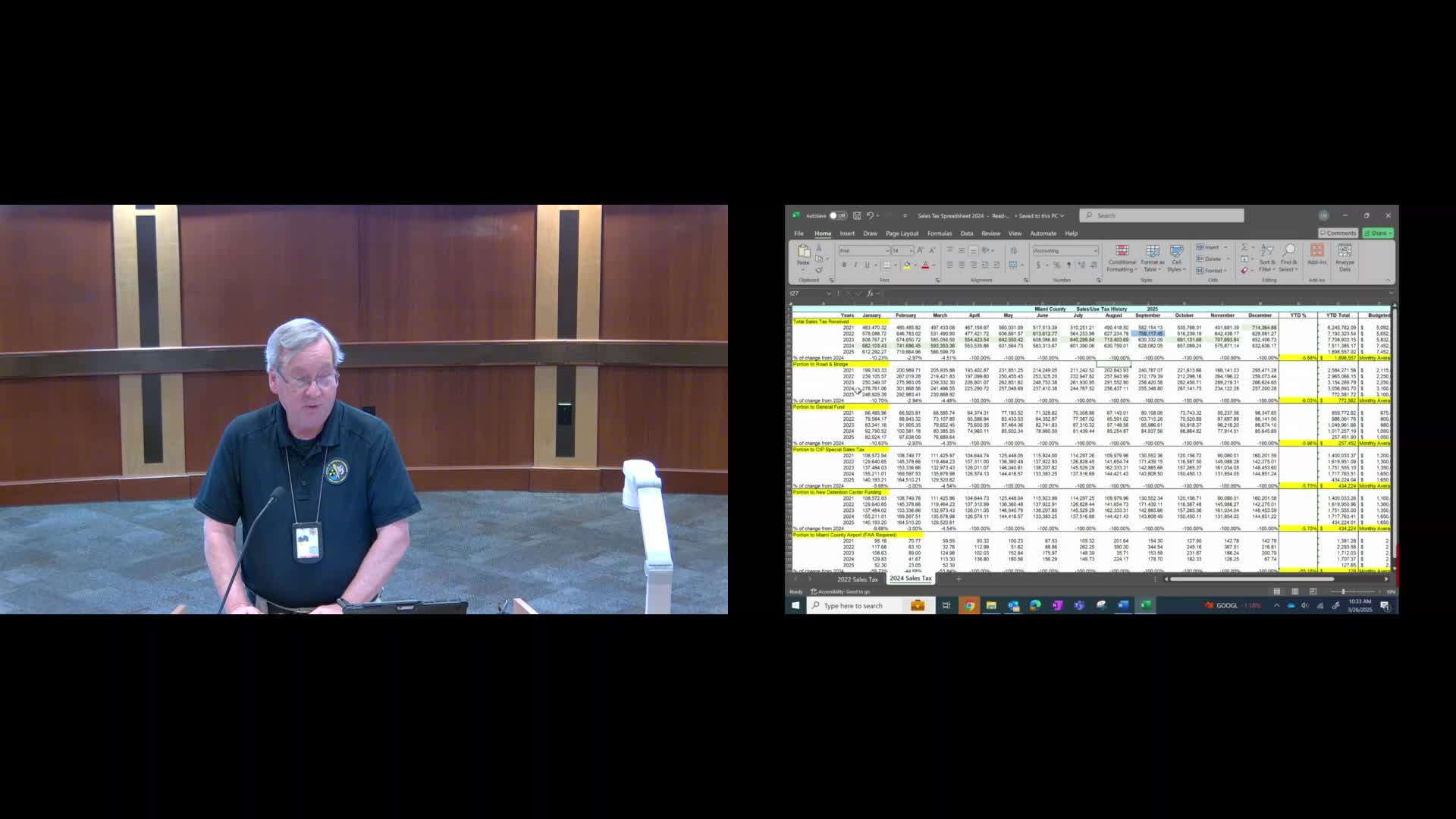
Miami County’s assistant county administrator updated commissioners on March 26 that March distributions (sales tax collected in January) marked the twelfth straight month of year‑over‑year declines in sales‑tax receipts. Staff and commissioners used that context to begin framing budget assumptions for the 2026 process.
Lucas, assistant county administrator, showed the county’s sales‑tax sheet and explained that the county’s quarter‑cent (CIP) sales tax was down about 5.7% year over year and the one‑cent distribution was down about 5.88%. He noted that the county’s share of the one‑cent has trended down as the county’s mill levy has been lowered, and that other jurisdictions that maintained higher mill levies saw a larger share of the distribution.
Budget assumptions and timeline: Staff proposed conservative assumptions for the 2026 budget cycle: a 6% increase in assessed valuation revenue based on appraiser estimates (excluding pending state-assessed utility appeals), a 98% collection rate for property taxes, a 5% decline in sales tax revenue for 2026 (staff’s working assumption), investment interest at 3.5% (reduced from 4% used previously), a 5% increase in county healthcare costs and a 15% increase for property/casualty insurance line items to reflect current market pressures. The county’s financial team emphasized the importance of prioritizing capital accruals (courthouse, radio replacement) and preserving staffing to avoid turnover costs.
Strategic priorities: Commissioners reiterated priorities recorded in prior strategic planning (community development, county infrastructure, collaboration, workforce development, health and safety). Several commissioners emphasized continued focus on roads and bridges and on accrual for the courthouse, arguing that long‑term capital needs should be addressed proactively rather than delayed.
Budget schedule: Staff proposed issuing budget materials to departments the week of April 4, collecting department request forms and holding concentrated internal budget meetings in mid‑ to late‑May. Commissioners asked staff to coordinate calendars; staff noted that pending legislative changes to 'revenue neutral' rules could affect the timeline and required public steps if enacted.
Ending: Staff will issue formal budget guidance and assumptions to departments, return with department requests and schedule the commission’s budget deliberations; staff will also monitor legislative developments that might change budget procedures.