Get Full Government Meeting Transcripts, Videos, & Alerts Forever!
Get email alerts on the Education Early Learning topic
No spam. Unsubscribe anytime.
Broward Estates school to become early learning center; Lauderhill residents press school board for alternatives
Summary
Broward County School Board representatives told the Lauderhill City Commission on April 14 that Broward Estates Elementary will be repurposed as an early learning center with community programming and is scheduled to open in that role on Aug. 11, prompting residents and commissioners to press the district for more detail about capital spending, enrollment data and alternatives.
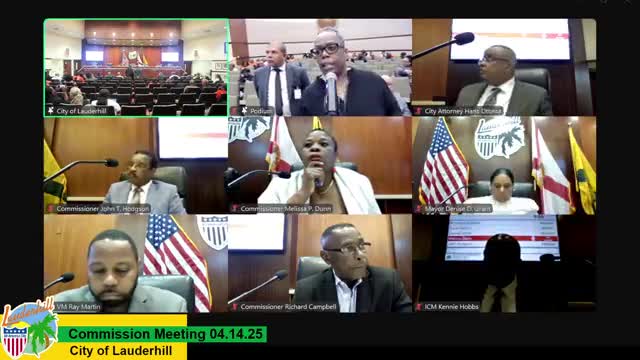
Broward County School Board representatives told the Lauderhill City Commission on April 14 that Broward Estates Elementary School will be repurposed as an early learning center with community programming and that the campus is scheduled to open in that role on Aug. 11. The district said the change is intended to improve kindergarten readiness in the surrounding area and to direct resources where per‑student funding yields greater programmatic benefit.
The school board’s District 5 representative, Dr. Jeff Holness, said Broward Estates had 222 students on the most recent roll, a capacity of about 695 and that the district’s data show roughly 35 percent of area pre‑K children are not kindergarten ready. “We believe an early learning center will help to improve those percentages,” Holness said during the presentation, adding that the board approved the superintendent’s recommendation on Jan. 22. District staff said the plan includes adult‑education programming and a partnership process to define community services at the campus.
The presentation followed more than an hour of public comment from Lauderhill residents who urged the commission to press the school board to keep Broward Estates open as a K–5 school or to offer a hybrid approach rather than a full repurposing. Speakers said the community had not requested school closure and questioned whether previously allocated capital funds were spent on the campus. “When I hear that we’re going to spend $5,000,000 renovating something that doesn’t deliver for our mission, I hear the community saying, what on earth are you thinking?” said May Smith during public comment.
Residents and community leaders raised three recurring concerns: (1) why Broward Estates was selected when other underenrolled schools exist, (2) what happened to prior capital allocations for the campus and nearby schools, and (3) whether the district had engaged sufficiently with residents before voting. Allen Brown cited documents the community has circulated showing earlier smart‑bond allocations and questioned whether funds were expended. Dr. Holness and district staff said the smart‑bond dollars earmarked for the campus would be spent within the local ecosystem and outlined the district’s transition and transportation planning for students moving to Plantation Elementary and Martin Luther King (MLK) schools.
District chief strategy officer Valerie Wanzer and enrollment director Joe Beck described steps the district has taken: community meetings held in fall 2024 and in March 2025, a visit to Gulfstream Early Learning Center in Hallandale as a benchmark, partner meetings to identify programming, and a May 20 school‑board workshop to present a near‑final implementation plan. Wanzer said the district would hold another partnership meeting at Broward Estates on April 16 to finalize resource planning with community partners.
Commissioners and residents pressed for more detail on several points the district said it would provide in writing: the facility condition assessment and needs analysis used to calculate the capital allocation; the breakdown of the roughly $5.7 million (commonly cited in the meeting) from the voter‑approved smart bond that relates to Broward Estates and how much of that will fund the early learning center versus transition work at receiving schools; and documentation of the district’s kindergarten‑readiness data (the district cited state “FAST” data). Interim City Manager Kenny Hobbs told the commission he had been instructed to produce a written accounting of a separate $3.8 million grant and that a report would be posted ahead of a future workshop.
Commissioners asked whether the board’s Jan. 22 decision could be revisited. Dr. Holness said the board’s vote followed the superintendent’s recommendation and that reversing the decision would require a superintendent recommendation and a board vote or an administrative appeal under the state’s boundary process (the district referred to school policy/processes cited in public remarks). He said the timeline for any reconsideration would be constrained by the need to have the campus ready for August and by the annual boundary/usage calendar the district follows.
Several commissioners urged parallel tracks: pursue any feasible path to ask the board to reconsider while simultaneously working with the district and community partners to design and measure an early learning model that addresses kindergarten readiness. Commissioner Melissa P. Dunn encouraged residents to attend the district’s partnership meeting and the May 20 workshop and asked the district to provide an enrollment projection and a classroom‑count estimate; district staff said the plan was to start with about eight to ten early‑learning classrooms.
Why this matters: the district argued that shifting the Broward Estates campus to a concentrated early learning model will boost readiness metrics and make more effective use of per‑student funding, while residents fear losing an existing neighborhood elementary, question prior capital spending, and seek stronger community engagement. The commission directed staff to request a public meeting with the superintendent and to obtain the facility and funding breakdowns the district referenced.
What’s next: the district plans a May 20 workshop with the school board and will hold additional partnership meetings; the city manager said he would request a public meeting with the superintendent and that the city will continue to press for written documentation on capital dollars and the facility assessment.