Get Full Government Meeting Transcripts, Videos, & Alerts Forever!
Get email alerts on the State Budget Trusts topic
No spam. Unsubscribe anytime.
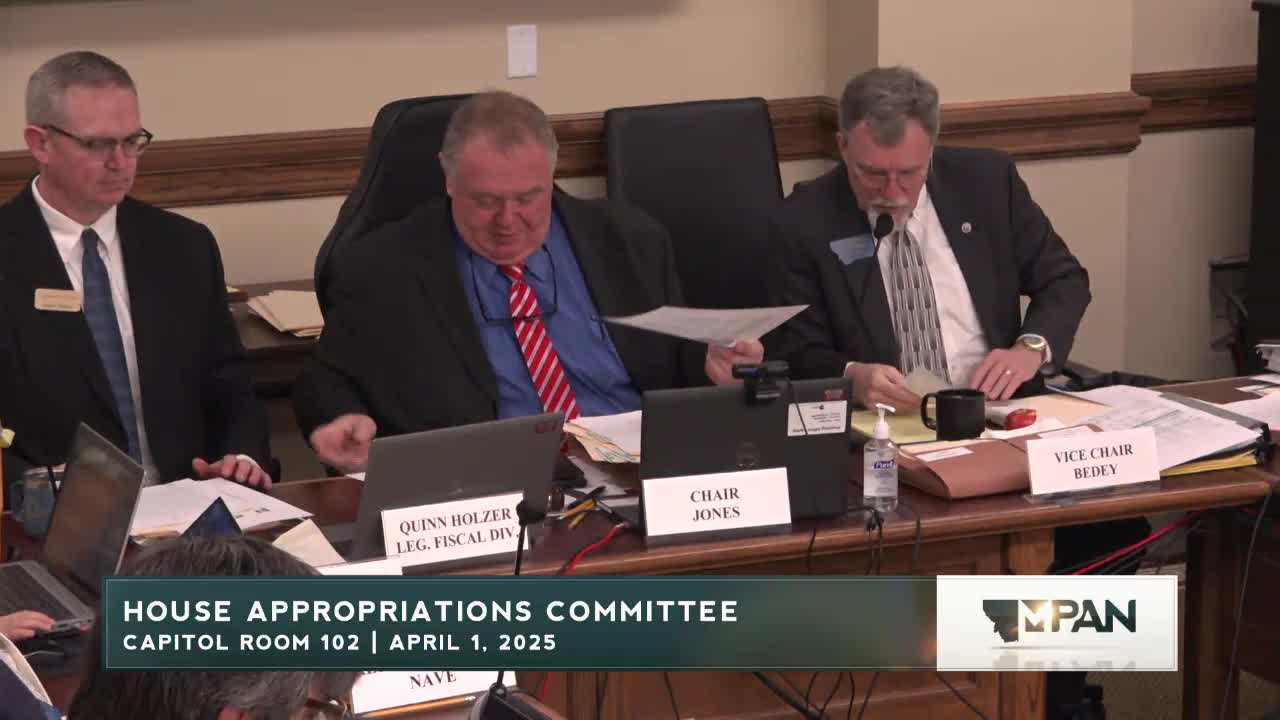
Montana lawmakers hear proposal for new ‘Gold Trust’ to capture volatile revenue for long-term priorities
Summary
Representative Lou Jones told the House Appropriations Committee he wants to create a Montana Growth and Opportunity Trust, a new fund seeded by one‑time surplus and a share of “volatile” revenue such as capital gains, to pay for housing, bridges, water projects, disaster resiliency and a $300 million pension stabilization account.
Representative Lou Jones, R., opened the hearing on House Bill 924 by proposing a Montana Growth and Opportunity Trust (the “Gold Trust”) to capture a share of volatile revenue — chiefly capital gains and other uneven receipts — and use earnings and capped distributions to pay for housing, bridges, water projects, disaster resiliency, tax relief and a $300 million seed for pension stabilization. “It begins operation in 2025…we have an initial one‑time surplus,” Jones said, pointing committee members to a handout that projects the trust rising from about $578 million to roughly $1.8 billion by 2029 under the forecast included with the bill.
Proponents framed the trust as a way to stop spending short‑term revenue on ongoing programs. William Hollahan, executive director of the Montana Public Employees’ Retirement Administration, supported the pension provisions, describing section 10 as creating a permanent pension account inside the trust and providing a $300 million general‑fund appropriation into that account. He said the bill would permit up to $75 million per year, under conditions spelled out in the bill, to offset market losses and reduce pension liabilities if the retirement board certifies long‑term returns have fallen below actuarial assumptions. “With that additional revenue we’d cut down our amortization period,” Hollahan testified.
Jim Malizia, chief counsel for the Teachers’ Retirement System, called the pension language “relatively straightforward” and said an added 0.2 percentage‑point annual employer contribution over 10 years would shorten TRS amortization by roughly two years in the actuary’s forecast.
County officials and local governments also supported the trust as a source for infrastructure. Representatives of the Montana Association of Counties urged the committee to fund disaster resiliency and local bridge needs, noting last session’s $80 million for off‑system bridges was nearly all spent. Trout Unlimited and the Montana Stockgrowers Association testified for the bill’s water storage and stewardship sections.
Budget analysts and policy groups raised timing and formula concerns. Heather O’Loughlin of the Montana Budget & Policy Center said the bill’s large transfers — roughly $679 million in FY2025 and $409 million in FY2026 per the fiscal sheet discussed — increase near‑term risk because the state’s revenue outlook is uncertain. She recommended calculating “volatile revenue” using actual collections from the prior fiscal year rather than the forecasted HD2 estimate and suggested using a rolling average for the baseline used to subtract a low‑year amount. “By tying the definition to the estimate rather than actual revenue, you run the risk that the starting point could be artificially high,” O’Loughlin said.
Amy Carlson, legislative fiscal analyst, walked the committee through the bill’s math and the handout graphic. She said transfers into the trust are split 50/50 between reinvestment and distributions: half is reinvested in the corpus and half is available as interest for capped appropriations to the named uses. Carlson explained the bill assigns $10 million OTO (one‑time only) jump‑start amounts to several distribution pipes and a $50 million OTO for bridges in year one, plus the $300 million into the pension portion and a $50 million housing jump‑start. She also described triggers that let the budget director reduce transfers if the projected ending general‑fund balance falls, and pointed to existing statute (17‑71‑40) that imposes a higher “big trigger” process for deeper cuts.
Supporters urged the committee to accept technical fixes the sponsor planned. Jones said he expected technical amendments to address drafting gaps and to add caps and access rules for different subaccounts, and he emphasized that the trust is intended to give the state a longer‑term funding tool that can later be adjusted, potentially by the voters, to permit equity investing.
Members pressed on several details: how the bill’s definition of volatile revenue would be computed, whether the executive branch could creatively reduce the transfer in a downturn, and how soon the trust would be able to make meaningful distributions. Jones and analysts said the bill includes caps so future legislatures must make affirmative choices before distributions exceed fixed appropriation ceilings.
The hearing record includes a range of technical and policy questions that the sponsor expects to address in forthcoming amendments and in coordination with the executive branch and legislative fiscal staff.