Get Full Government Meeting Transcripts, Videos, & Alerts Forever!
Get email alerts on the Curriculum Science topic
No spam. Unsubscribe anytime.
District begins multi-year rollout of OpenSciEd curriculum, seeks grants for kits; high school to update textbooks
Summary
Canton Public Schools’ science program review recommended adopting OpenSciEd for K–8 with phased kit purchase funded partly by grants; high school will update aging textbooks and expand Project Lead The Way offerings.
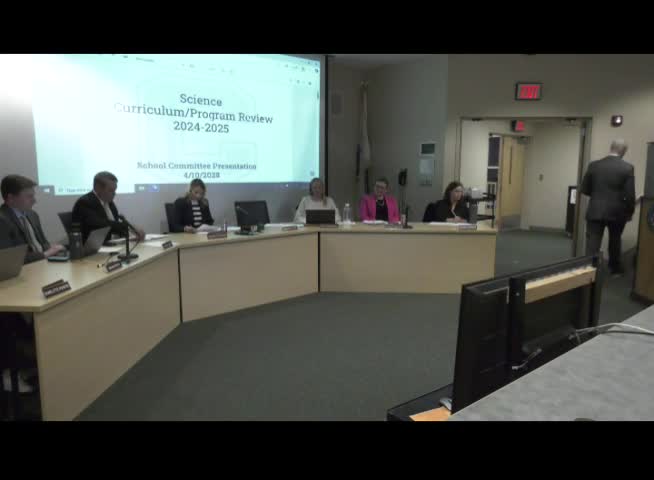
Canton Public Schools’ administration presented findings from a multi-level science program review April 10 and described plans to phase in the OpenSciEd curriculum at elementary and middle grades, update high-school texts and expand Project Lead The Way (PLTW) offerings.
District staff said the review focused on aligning instruction to the state and national frameworks, prioritizing science-and-engineering practices, and addressing subgroup performance gaps for multilingual learners and students with disabilities. For elementary grades the review team piloted multiple curricula and recommended OpenSciEd after classroom trials and teacher feedback. The district has applied for state training and is participating in a multi-day, train-the-trainer session; staff said they intend to build in in-house professional development so grade-level teams can be trained during department PD days.
At the middle school the district piloted units from OpenSciEd and reported strong student engagement and teacher support for the inquiry-based, phenomenon-driven model. A private grant (noted in the presentation) was awarded to support middle-school implementation; presenters said the grant will supply two unit kits next year and that the district will phase in additional kits over subsequent years (two kits per year in the grant rollout at GMS) to manage costs and teacher learning time.
At the high school administrators reported that current textbooks were outdated (some texts dated to the early 2000s) and recommended updated textbooks and digital licenses as supplements to teacher-created courses. The high school will continue to refine its home-grown curriculum while purchasing updated materials to ensure access for diverse learners.
Presenters also described Project Lead The Way (PLTW) pathway growth: PLTW courses at middle and high school provide applied, project-based learning, and the district is pursuing expansion of computer science courses and a capstone, using previously-awarded grant funds when enrollment supports additional sections. District leaders said successful PLTW students may be eligible for college transcripted credit at partner institutions and for internship and scholarship opportunities.
Teachers and committee members praised the curriculum work, asked about kit costs and storage, and discussed staggered rollouts to allow teacher training. District staff said the elementary OpenSciEd materials are open-source and field-tested; vendors may package the materials in paid platforms. Staff estimated the cost of kits and classroom materials as substantial and said they will seek grants to reduce the district’s capital outlay.
Implementation will be phased: elementary teacher training and limited kit purchases next year, two middle-school kits next year under the awarded grant, and continued piloting at the high school with updated textbooks purchased as needed.