Get Full Government Meeting Transcripts, Videos, & Alerts Forever!
Get email alerts on the Food Waste topic
No spam. Unsubscribe anytime.
Pierce County proclaims April 7–13 Food Waste Prevention Week as local groups outline rescue efforts
Summary
The Pierce County Council and executive declared April 7–13 Food Waste Prevention Week and heard presentations from local food-rescue partners who described programs that capture surplus fresh food for people in need and redirect produce from landfills.
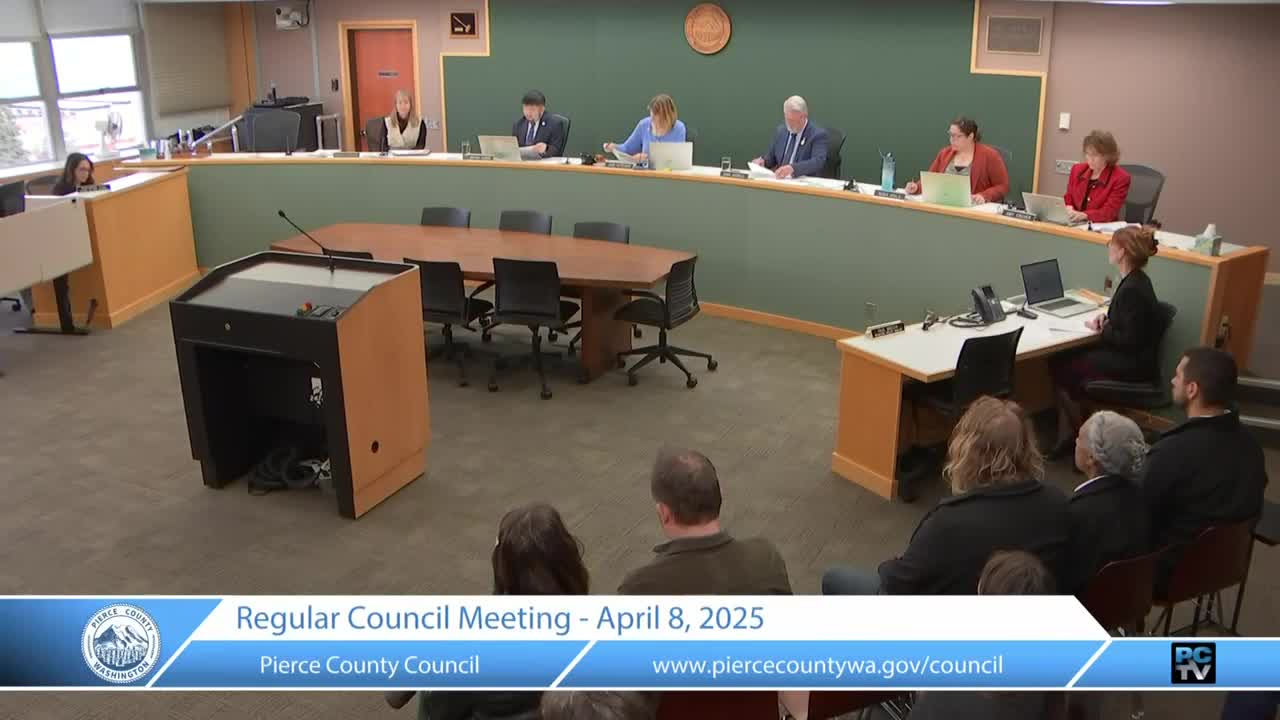
Pierce County Council members and the executive proclaimed April 7–13, 2025, as Food Waste Prevention Week and received presentations from local food-rescue and culinary partners describing how surplus produce and donated food are being redirected to people in need.
Council member Murrell read the proclamation into the record, noting national and state figures included in the text: the proclamation cites that roughly 40% of food grown in the United States is not eaten and that Washington residents visited food banks more than 13 million times in 2024. The proclamation also references Pierce County’s Sustainability 2030 plan and local programs such as Harvest Pierce County and GoodRoots Northwest.
During the presentation, Chef Eliza Charbonneau, Pierce County Skills Center Culinary Arts Program director, said the program rescues “hundreds of pounds of local food” each week and uses it to prepare ready-to-heat meals distributed through GoodRoots Northwest’s locker network. “With additional culinary arts staff, we’ve doubled our meal production for the food bank without sacrificing safety or quality,” Charbonneau said.
Kelly Fremont, operations director at GoodRoots Northwest, described how partnerships link food aggregators, schools and distributors: she recounted receiving a text from an aggregator notifying her of short‑dated meat and coordinating logistics so students could process the product into prepared meals. Fremont said the program also produced a cookbook featuring student recipes and reflections.
Jeremy Vrablick, owner of Cascadia Produce, said his cold‑storage warehouse accepts large truckloads of produce—sometimes product rejected by retailers—and either sells at low cost or donates it. “Today we received a little over 40,000 pounds of product,” Vrablick said, describing examples when a pallet tipped over at a retail delivery and otherwise would have been discarded.
Angel Swanson, executive director of Feeding Feasible Feasts, described multi‑county rescue routes and on‑demand food hubs. Swanson said her group operates roughly 16 rescue routes and reported rescuing 55,000 pounds of food on a single route in January; she said rescued items are distributed immediately—often without entering a warehouse—so partner agencies can give fresh product to participants the same day.
A representative from the Pierce Conservation District, who manages Harvest Pierce County’s gleaning project, told the council the program has rescued about 500,000 pounds of produce by gleaning backyard trees, partnering with farmers and converting some inedible material into value‑added products for local small businesses.
Council members thanked presenters and highlighted the range of partnerships—schools, nonprofits, aggregators and government—that make local rescue possible. Murrell, Yambe and others called the coordinated approach a model for reducing landfill methane and improving food access.
The proclamation and the presentations emphasized two recurrent messages: a) large quantities of fresh food that are still safe and nutritious can be redirected through coordinated systems; and b) expanding capacity—refrigerated warehousing, rescue routes, culinary processing and locker distribution—helps move fresh food from potential waste to households in need.
The council scheduled a photo with presenters and handed out the Skills Center cookbook; no formal action beyond the proclamation was taken at the meeting.