Get Full Government Meeting Transcripts, Videos, & Alerts Forever!
Get email alerts on the Wetlands Protection topic
No spam. Unsubscribe anytime.
Environmental advocates urge Island County to use best available science in Clinton subarea wetlands mapping
Summary
An environmental advocate asked Island County commissioners to incorporate wetland delineations and best‑available science in the Clinton subarea plan and to avoid treating wetlands as an afterthought; commissioners said the plan and surface‑water report will be discussed at upcoming work sessions.
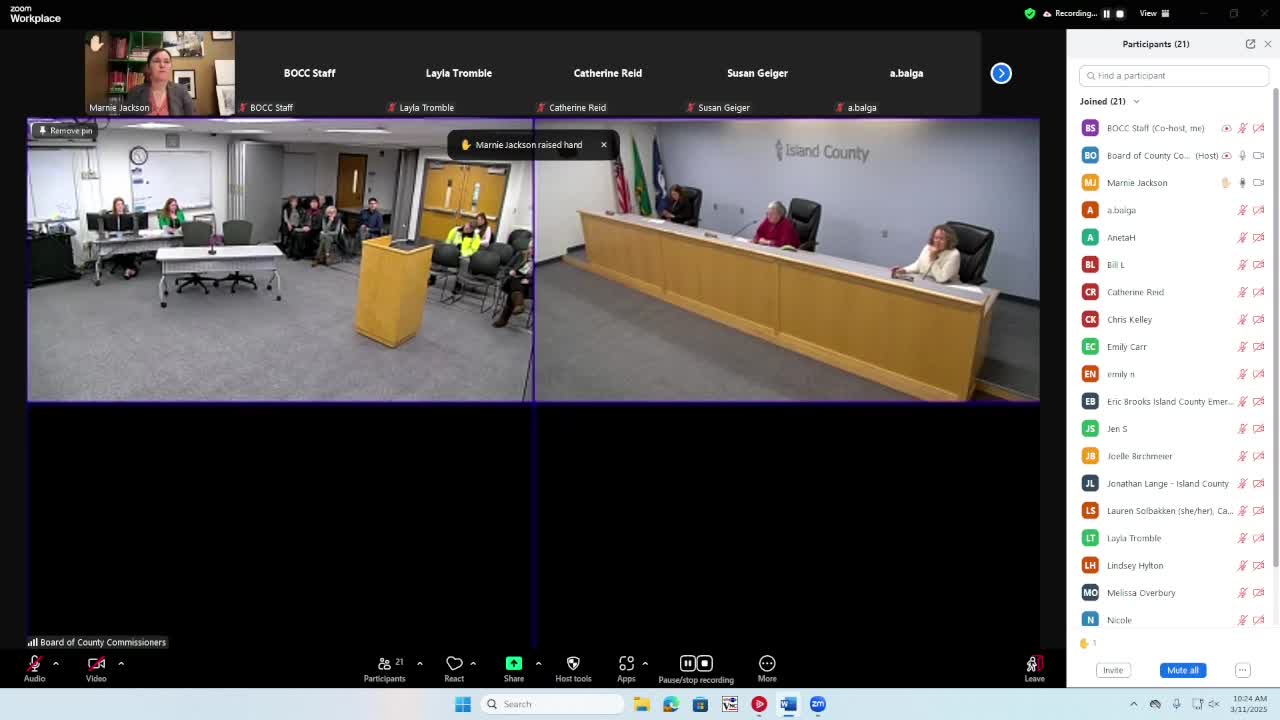
Marnie Jackson of Langley, representing the Environmental Action Network, told the Island County Board of Commissioners on March 11 that the Clinton subarea element draft underestimates wetland presence and urged the county to use best available science when protecting critical areas.
Jackson cited the Growth Management Act requirement to use best available science, referencing RCW 36.70A.172, and quoted WAC sections as she urged additional on‑the‑ground research and incorporation of wetland delineation reports into county mapping. "We must not make wetlands an afterthought, but center their care and restoration in our plans for community vitality because they are tied to our own health," she said.
Jackson noted the county's 2020 surface water quality report, which showed only seven of 16 monitored streams met water quality standards, and said that the Clinton subarea draft's statement that wetlands are "relatively limited" may be contradicted by existing delineations and site observations.
Commissioners acknowledged the comment and said the Clinton subarea plan and the surface water quality report will be considered in upcoming work sessions. One commissioner asked Jackson to send her detailed remarks by email for staff review. No formal action was taken at the March 11 meeting.
Jackson asked the board to gather more data, add details from critical‑areas assessments and wetland delineations to the county's map layers, and act in compliance with state law requiring precaution where scientific uncertainty exists for critical areas.