Get Full Government Meeting Transcripts, Videos, & Alerts Forever!
Get email alerts on the Community Recognition topic
No spam. Unsubscribe anytime.
King County Council proclaims Vaisakhi Day and recognizes 50th anniversary of Khmer Rouge genocide
Summary
On April 15 the Metropolitan King County Council proclaimed April 13, 2025, as Vaisakhi Day in King County and issued a recognition of the fiftieth anniversary of the Khmer Rouge seizure of Phnom Penh and subsequent genocide, with community speakers sharing history and calls for remembrance and resilience.
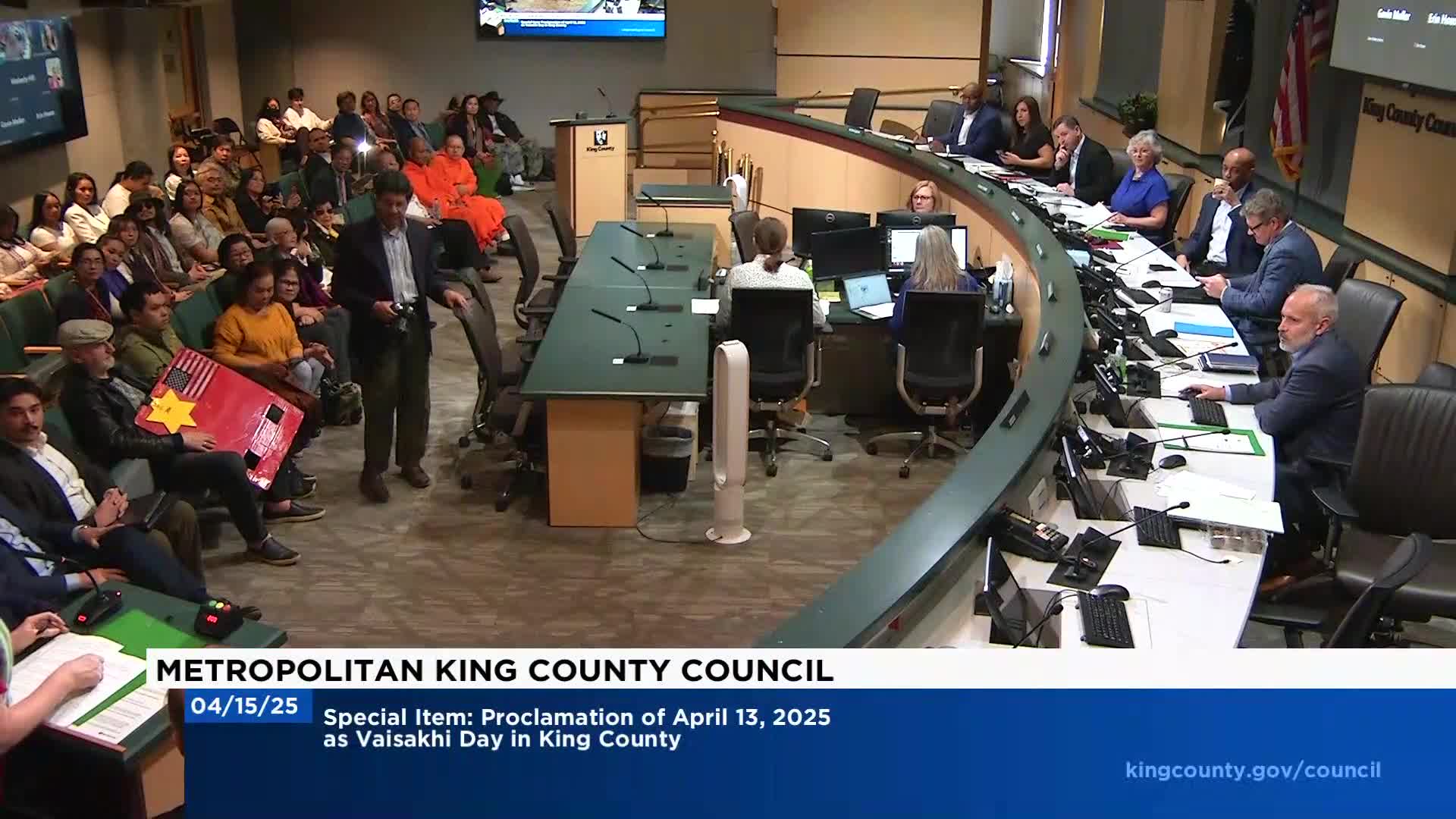
The Metropolitan King County Council used the start of its April 15, 2025 meeting to present two proclamations and invite community speakers to the dais.
Vaisakhi proclamation: Councilmembers Jeanne von Reichbauer and Cathy Balducci presented a proclamation recognizing April 13, 2025, as Vaisakhi Day in King County. Speakers noted that Washington state hosts one of the nation’s largest Sikh communities and described Vaisakhi as a major Sikh celebration marking both the harvest festival and the founding of the Khalsa in 1699 by Guru Gobind Singh Ji. Chirag Singh addressed the council, explaining Sikh tenets including equality, service and the practice of keeping uncut hair as an element of living authentically. The council invited members of the Sikh community to join for a group photograph.
Khmer Rouge genocide recognition: Councilmembers Girmiza Zahilay, Teresa Mosqueda and Councilmember Quinn (presenting with Mosqueda and Baron) presented a proclamation recognizing the fiftieth anniversary of the Khmer Rouge seizure of Phnom Penh on April 17, 1975. Councilmember Mosqueda noted the genocide resulted in about two million deaths over four years and acknowledged the Cambodian American community in King County (the transcript states the county has one of the highest concentrations of Cambodian Americans in the United States). Several Cambodian American community leaders and survivors addressed the council, described personal memories and trauma, and urged remembrance and continued cultural support. Speakers included Chandara Sa (Cambodian American Community Council of Washington), Bong Tai Chim (Khmer anti-deportation advocacy), Sophia Som (Cambodian Cultural Alliance of Washington), Ron Ross (Cambodian American Friendship Foundation) and others. A White Center street festival and other community events were announced.
Why it matters: Both proclamations were ceremonial recognitions requested by community members and presented in the council chambers to acknowledge cultural heritage, survivor testimony and community resilience. Speakers emphasized education, cultural preservation and the need to support immigrant and refugee communities.
Ending: Councilmembers and community participants posed for photographs after the presentations; the proclamations were entered into the record.