Get Full Government Meeting Transcripts, Videos, & Alerts Forever!
Get email alerts on the Fireworks Policy topic
No spam. Unsubscribe anytime.
South Whidbey advocates ask Island County to let voters weigh fireworks restrictions; commissioners consider next steps
Summary
Residents and advocacy groups urged Island County commissioners to place an advisory vote on the 2025 ballot for South Whidbey, ban sale of mortar fireworks countywide, and add fireworks to the list of items prohibited during a level 1 burn ban. Commissioners discussed enforcement limits and next steps, including possible work‑session review.
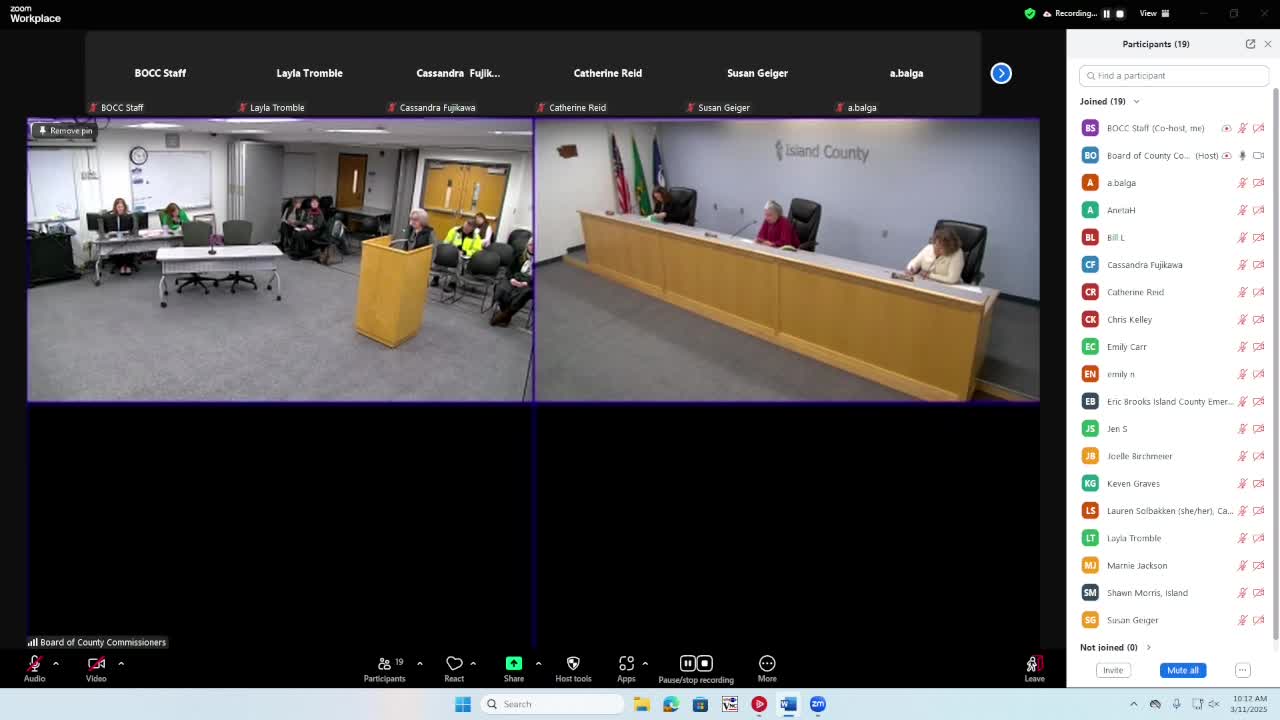
South Whidbey residents and advocacy groups urged the Island County Board of Commissioners on March 11 to let local voters decide whether to establish a no‑consumer‑fireworks zone on South Whidbey and to pursue several related code changes.
At the meeting, Jackie Lassiter of Freeland, speaking for Citizens for Safe and Humane Fireworks, asked the board to "let the citizens of South Whidbey decide," and requested three actions: place an advisory vote on the 2025 ballot to let South Whidbey residents consider a no‑consumer‑fireworks zone (including a prohibition on sales there); amend county code to prohibit sale of mortar fireworks in unincorporated Island County; and add fireworks to the list of prohibited fire uses during a level 1 burn ban (fireworks are already prohibited during a level 2 burn ban, she said).
The request drew several supporting public comments. Trish Barnett, a resident, described fireworks as a local wildfire risk and said the community must reduce ignition sources. Janice O'Mahoney, a Freeland resident and psychiatric social worker, told the commissioners that veterans and others with PTSD can be triggered by fireworks: "fireworks trigger can frequently trigger PTSD for our veterans," she said. Other residents, including Angela Gunter and Leslie Flor, described personal experiences with fireworks‑related fires and concerns about limited local firefighting resources.
Commissioners responded with a mix of procedural and policy notes. Commissioner Johnson said the board has already discussed fireworks and enforcement limits and cautioned that budget and enforcement capacity affect what the county can implement. "You got a response. You didn't like the response. That's not the same as not getting a response," he said, adding that implementation of some measures is delayed by state law and enforcement capacity.
Commissioner St. Clair noted the board's prior action: "We did ban the mortars and reduce the days allowed for fireworks last year," and said that RCW timing requirements mean some changes are not yet in force. He recommended petitioners consult the county auditor about the logistics and cost of a geographically limited advisory vote.
Commissioner Jones said he would not place an advisory vote on a work session agenda unless at least two commissioners were open to the conversation, but he expressed interest in exploring one of the petitioners' requests: "I think that I would be interested in bringing that to a conversation with the board on a work session," he said, referring to adding fireworks to the list of items prohibited during a level 1 burn ban.
No formal county action on the fireworks requests was taken at the March 11 meeting. Commissioners directed staff and each other to consider next steps: consultation with the auditor on a possible South Whidbey ballot measure and a potential work session item on prohibiting fireworks during a level 1 burn ban.
Upcoming steps noted at the meeting include follow‑up meetings with fire chiefs and, if two commissioners agree, a board work session to discuss adding fireworks to the level 1 burn ban and other code changes.