Get Full Government Meeting Transcripts, Videos, & Alerts Forever!
Get email alerts on the Public Comment And Bylaws topic
No spam. Unsubscribe anytime.
Charter reviewers split over bylaw language aimed at protecting public commenters
Summary
The Charter Review Commission’s bylaws committee proposed language asking commissioners to refrain from identifying public commenters; the committee circulated the language to the county prosecutor, public testimony was heavy and the full commission deadlocked on whether to adopt the wording now or send it back for revision.
The Charter Review Commission spent several hours debating a proposed bylaw that would ask commissioners to refrain from identifying members of the public who speak at meetings.
The proposal originated in the bylaws committee after public testimony that some speakers felt targeted online after speaking at a CRC meeting. Commissioner Susan Fish, chair of the bylaws committee, said the draft had been sent to the county prosecutor for review and that the committee voted to “encourage the public to provide public comments” and to “refrain from identifying public commenters” in public statements.
The draft committee language followed legal advice from the prosecutor’s office stating that wording framed as a mandate (for example, “shall” or “should”) could raise First Amendment concerns and recommending the gentler verb “encourage.” The commission’s discussion reflected that advice: some commissioners urged a nonbinding code of conduct, while others said the change was unnecessary or risked restricting normal civic discourse.
Public commenters urged different outcomes. Merilee Smith of Port Angeles argued that constitutional protections for speech are strong and cautioned against government restrictions: “The government may not regulate free speech because of its message, its ideas, its subject matter, or its content,” she said. Bonnie Blaszanish of District 1 told commissioners that public comment is “one way input” to elected officials and urged that commissioners model courtesy and remove barriers to public participation.
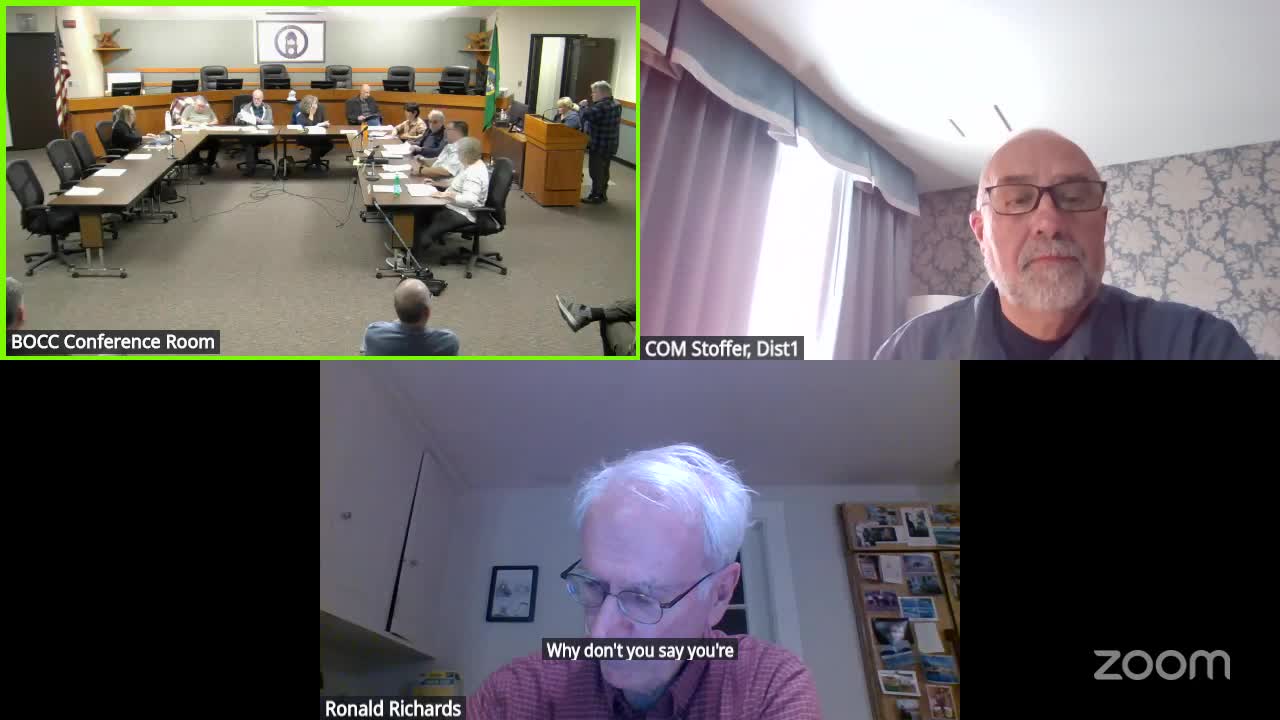
Commissioners disagreed about next steps and about the factual record underlying the committee’s proposal. Commissioner Ron Richards raised procedural concerns about how the committee had operated and whether the committee had given adequate notice for parts of its discussion. Commissioner Peter Noble said the proposal sought only to improve civility when commissioners discuss public commenters outside of meetings.
When the full commission voted on a motion to adopt the committee’s suggested language (recast with the recommended word “encourage”), the roll call produced a tie; under the body’s rules the tie meant the motion failed to carry. A separate motion to send the proposal back to the bylaws committee for revised wording also failed to obtain a majority. The commission instead directed that the committee’s work and the prosecutor’s written guidance be circulated to commissioners and that the matter be revisited at a later meeting.
The debate drew an unusually large public turnout and dozens of written submissions, including a letter from a national free-speech advocacy group filed with the commission during the meeting. Commissioners and members of the public repeatedly asked the clerk and legal staff for copies of the correspondence and the prosecutor’s written opinion.
The commission did not adopt an enforceable rule. Commissioners left the meeting with differing expectations about whether a nonbinding code of conduct will return to the agenda after the committee redrafts the language and after staff makes the prosecutor’s written guidance available.