Get Full Government Meeting Transcripts, Videos, & Alerts Forever!
Get email alerts on the Homelessness Case Management topic
No spam. Unsubscribe anytime.
Coastal Community Action presenter urges Medicaid-funded intensive case management to improve housing exits
Summary
At a Clallam County Homelessness Task Force meeting, the CEO of Coastal Community Action Program described a model that pairs Medicaid-billable intensive case management with coordinated entry, saying the approach raised exits to permanent housing in his service area and recommending other counties consider the model.
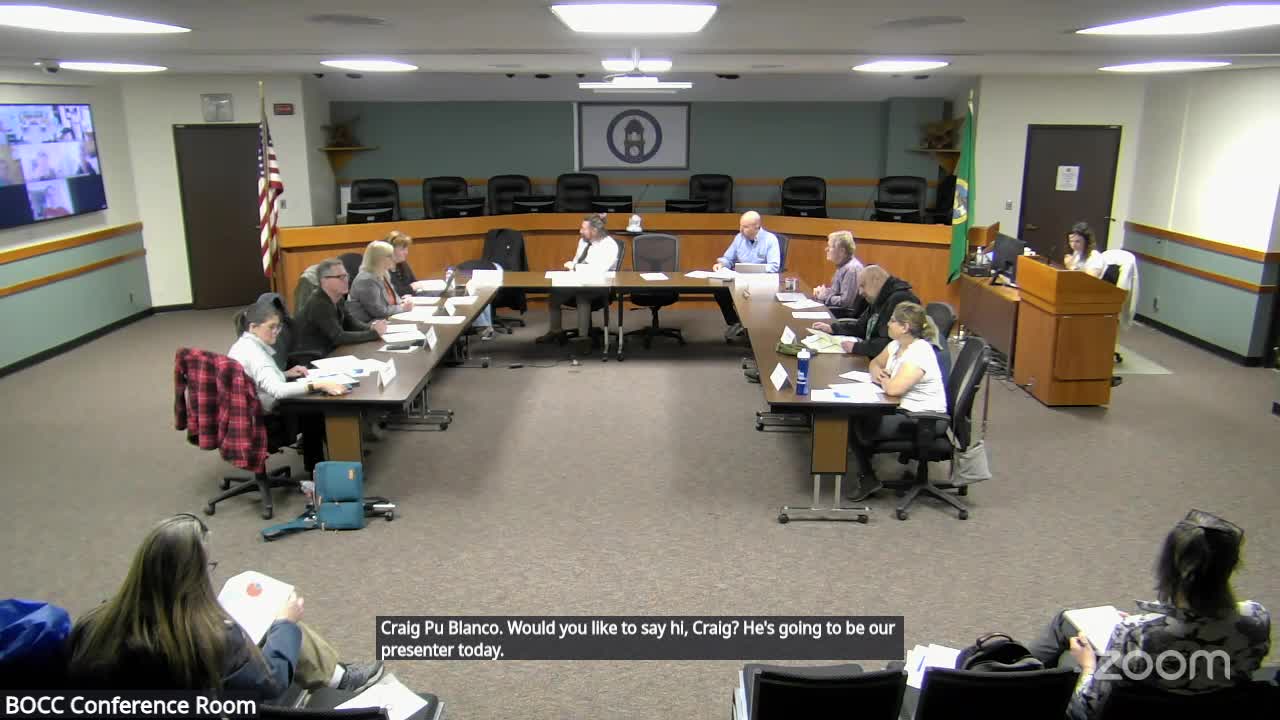
Craig Reblanco, CEO of Coastal Community Action Program, told the Clallam County Homelessness Task Force that his agency’s shift to Medicaid-funded, intensive case management has substantially increased exits to permanent housing in the communities it serves.
Reblanco said the agency rebuilt its homeless-services system after a 2018 fire and paired a fee-for-service, Medicaid-billable case-management model (Foundational Community Supports, or FCS) with coordinated entry and available rental assistance. “We are the number 1 biller of Medicaid in this foundational community supports program in the state of Washington,” he said, adding that his agency bills “to the tune of 3 or $4 million a year for case management.”
The presentation focused on a three-legged approach Reblanco described as necessary for system success: housing units, rental assistance, and intensive, relationship-based case management. He told the task force that, in his agency’s experience, outcomes rose sharply after deploying that combination: when a client had a rental subsidy plus the intensive case management, Reblanco said exits to permanent housing ran about 85 percent; for clients who did not receive rental subsidy but did receive the intensive case management, he said exits ran about 55–60 percent.
Nut graf: The discussion matters because Clallam County — like other Washington counties represented in the presentation — has limited rental-subsidy slots through coordinated entry. Reblanco argued that offering intensive, Medicaid-funded case management to everyone who reaches coordinated entry (not only the roughly 25 percent who receive a rental-assistance slot) can improve outcomes for those who would otherwise be placed on wait lists.
Reblanco described coordinated entry as the system’s access point, saying roughly 25 percent of people who complete coordinated entry receive a rental-assistance slot in his region. He characterized that slot as “Willy Wonka’s golden ticket,” and noted that the statewide statistic often cited (43 percent exit to permanent housing) applies only to people who actually received a subsidy, not to everyone who goes through coordinated entry. Using the statewide numbers he presented, he calculated that 11.8 percent of everyone who enters coordinated entry ends up in permanent housing when intensive case management is not provided to the remainder.
During a question-and-answer period, task force members asked about operational hurdles. Reblanco acknowledged challenges with FCS enrollment freezes that temporarily stopped new clients in some places, and he described a state-level approval process that allowed his agency to braid FCS with other funding streams. He said his agency keeps clients on service and reauthorizes FCS as needed, and that the billing model produced revenue sufficient to fund care coordinators and related billing infrastructure.
Task force members raised practical concerns about staff wellbeing, documentation and billing burdens under Medicaid, eligibility rules (including HUD’s chronic homelessness documentation), caseload size and reimbursement rules, and how coordinated entry providers and local partners would integrate with a scaled FCS approach. Reblanco and other participants described cross-training, lower caseloads and recruitment of staff with lived experience as elements that supported the model.
Ending: Reblanco offered to share contact information and materials with task force members. Task force staff agreed to circulate his email and consider follow-up conversations; members asked for technical details about reimbursement rates and authorization limits so local providers could assess feasibility.