Get Full Government Meeting Transcripts, Videos, & Alerts Forever!
Get email alerts on the Land Use Permits topic
No spam. Unsubscribe anytime.
Clallam County shortens permit review timelines to match state law; commissioners adopt wording change
Summary
The board adopted an ordinance to amend the consolidated development permit process to align local timelines with Senate Bill 5290 and RCW 36.70B; the planning commission had recommended approval 7-0 and the board edited a phrasing change from "should" to "shall."
CLALLAM COUNTY, Wash. — The Board of Clallam County Commissioners on April 8 adopted an ordinance amending the county's consolidated development permit process to align processing timelines with state changes to the Local Project Review Act.
The ordinance revises Chapter 26.10 of county code to shorten review times for certain permit types and to remove some exceptions that had been counted toward processing times. County staff said the amendments respond to the state Legislature's changes under Senate Bill 5290 and revisions to chapter 36.70B of the Revised Code of Washington.
Why it matters: Shorter statutory timelines affect how quickly boundary-line adjustments, short plats and other land-use permits must be decided. The change affects applicants who rely on local permits for property development and subdivision.
What changed
- Type 1 permits: The county will reduce the final-decision processing timeline from 120 days to 65 days for Type 1 permits, per staff description during the hearing.
- Type 2 permits: The timeline will move from 120 days to 100 days for certain Type 2 permits, such as short plats.
- Type 3 permits: Although state law allows increased time for some Type 3 permits, county staff and commissioners agreed to retain a 120-day processing expectation for those permits in county code to preserve consistency.
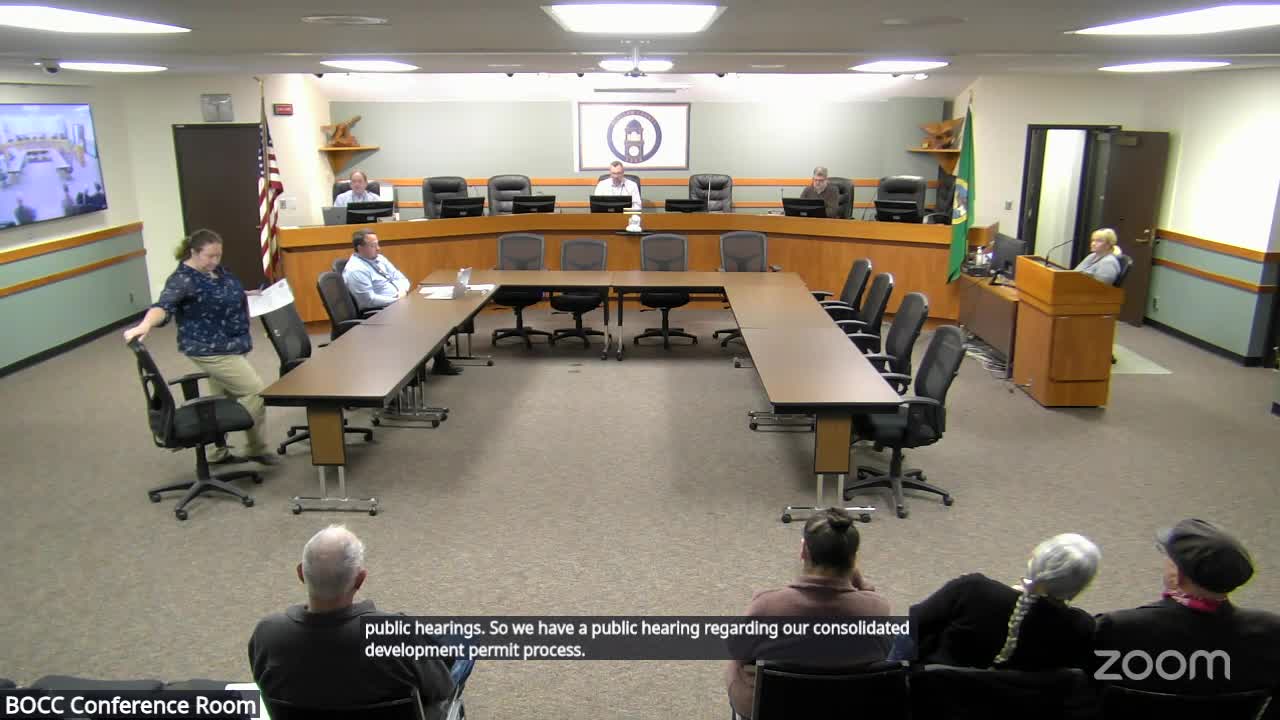
Public process and wording change: The Planning Commission held a public hearing and recommended the ordinance 7-0. During the county's public hearing, commenters raised concerns about the ordinance's draft wording; one commenter and a separate speaker urged replacing the term "should" with the mandatory term "shall." Principal planner Nonyla Clark confirmed the county would revise the matrix to read "shall," and the board approved the ordinance with that change.
Outcome: The board opened and closed the public hearing, accepted the Planning Commission's recommendation, directed the wording change from "should" to "shall" in subsection 26.10.540(4), and approved the ordinance by voice vote.
Next steps: County staff will publish the amended code language and apply the new timelines to future consolidated development permit applications.