Get Full Government Meeting Transcripts, Videos, & Alerts Forever!
Get email alerts on the County Contracts Health Public Safety topic
No spam. Unsubscribe anytime.
Clallam County approves multiple public-health, public-safety and weed-control contract amendments
Summary
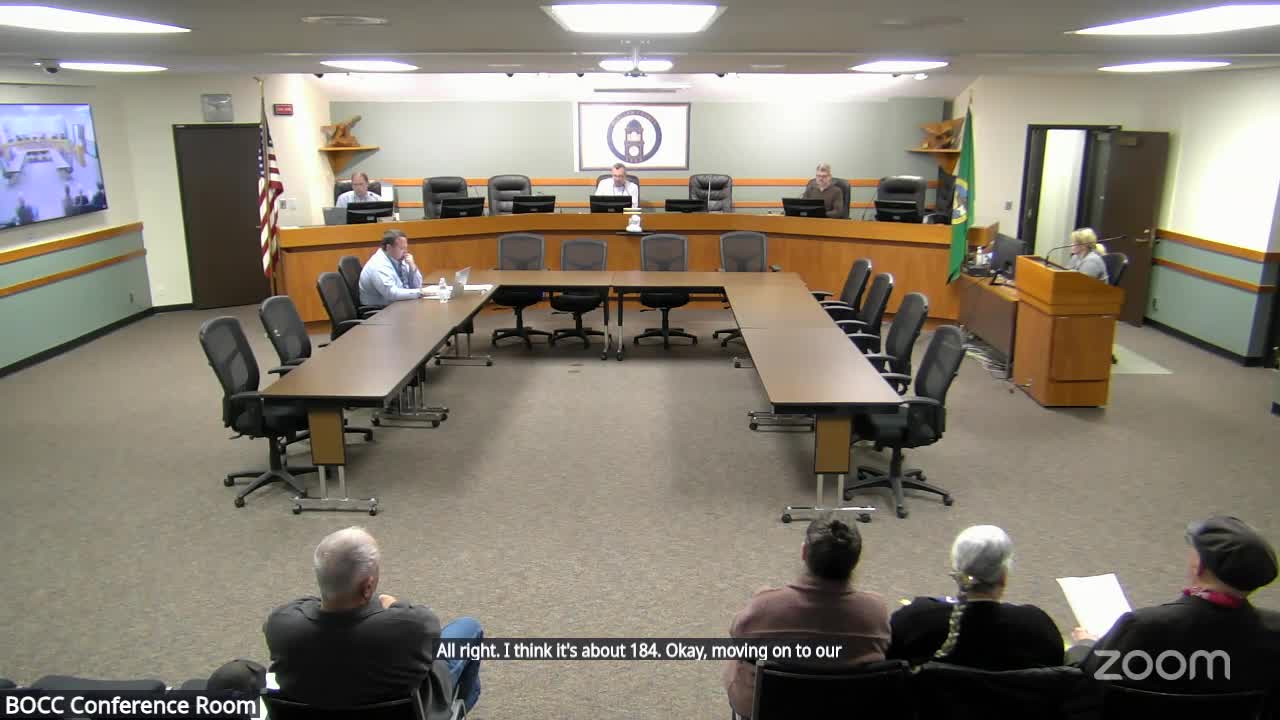
At its April 8 meeting, the Board of Clallam County Commissioners approved contract amendments and agreements with the Washington State Department of Health, Washington State Patrol, the Department of Agriculture and a managed-care plan to fund public health programs, a fingerprinting machine and noxious-weed work.
CLALLAM COUNTY, Wash. — The Board of Clallam County Commissioners approved a set of contract amendments and agreements at its April 8 meeting that add funding for local public-health programs, replace fingerprinting equipment at the jail and return unused weed-control grant money to the state.
The actions included two separate consolidated contract amendments with the Washington State Department of Health, a federal-pass-through grant administered by the Washington State Patrol for the Clallam County Sheriff's Office, an amendment to a noxious-weed grant from the Washington State Department of Agriculture and an amended agreement with a managed-care organization.
Why it matters: The changes affect local public-health programming (including WIC services and emergency-preparedness work), the sheriff's office operations and the county's noxious-weed program. The county will also expand billing relationships with a managed-care plan that pays for behavioral-health and other services.
Key details
- Department of Health, Consolidated Contract Amendment No. 2: The amendment covers three elements: one-time funding for public-health workforce development ($81,628); a beach environmental assessment and communications program to monitor marine swimming beaches ($5,850); and the Women, Infants and Children nutrition program (WIC) ($84,438). The county stated the total for this amendment is $171,916. The board voted to approve the amendment.
- Department of Health, Consolidated Contract Amendment No. 3: Amendment 3 adjusts grant amounts for three programs: the Public Health Infrastructure Grant (PHIG) for workforce ($140,932); Public Health Emergency Preparedness (PHEP) ($6,000); and an on-site-sewage/system program focused on septic compliance in the marine recovery area ($45,672). The county stated the combined amount is $192,604. The board voted to approve the amendment.
- Washington State Patrol pass-through grant (National Criminal History Improvement Program): The county accepted a $21,728 reimbursable award to purchase a new live-scan fingerprint machine to replace an older unit used in booking and for background checks and concealed-weapons permit processing. The agreement was approved. The transcript notes no local match was required.
- Washington State Department of Agriculture, Noxious Weed Control Board amendment: Because of 2023 staffing shortfalls the county will return $6,000 of unused grant funds to the department. County staff told the commissioners they are working to have the funds reallocated back to the county to intensify weed-control efforts; the amendment was approved.
- Agreement amendment with Community Health Plan of Washington: The county amended agreements with a local managed-care organization to broaden reimbursement for behavioral-health services and additional medical services for people served under those contracts. The commissioners approved the change.
What commissioners and staff said: County staff described the DOH amendments as targeted to workforce, beach monitoring and nutrition programs and explained the Washington State Patrol award would replace aging equipment. Commissioners moved, seconded and voted to approve each item during the meeting; votes were recorded by voice.
Next steps: County staff will execute the approved amendments and manage the awarded funds. For the noxious-weed funds, staff said they were seeking reallocation of unused money to restore planned treatments.