Get Full Government Meeting Transcripts, Videos, & Alerts Forever!
Get email alerts on the Public Works Infrastructure topic
No spam. Unsubscribe anytime.
Public works director tells study commission county maintains infrastructure for 90,000 with funding for 35,000
Summary
Public Works Director Mark Neary told the Butte-Silver Bow Study Commission his department maintains infrastructure sized for 90,000 people while operating on funding levels intended for about 35,000, and outlined challenges on procurement thresholds, aging pipes, stormwater funding and ordinance enforcement.
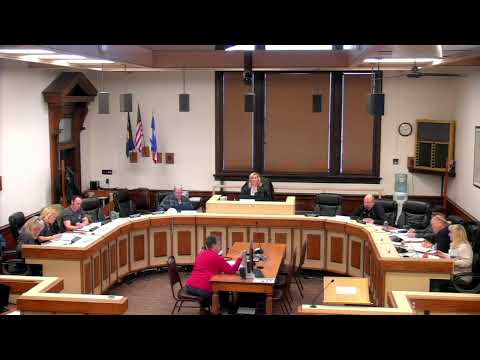
Public Works Director Mark Neary told the Butte-Silver Bow Study Commission that the county’s infrastructure was built for a far larger population than it currently budgets for, and described several operational and regulatory challenges his department is addressing.
"We have an infrastructure for about 90,000 people, but we're maintaining it with the funds from 35,000," Mark Neary, Public Works Director, said during the commission's meeting. He said the department oversees water, sewer, roads, landfill, transit, parks and other services and that most of the work is maintenance of existing systems rather than new construction.
The discrepancy matters because it affects how the county prioritizes repairs and capital projects, and because the commission is considering charter and structural options that could change how departments are organized.
Neary gave a detailed rundown of his staffing and operations: he said his office includes roughly 15 nonunion staff (project manager, compliance inspector, pretreatment coordinator, transit manager, civil engineering tech and interns) and numerous union positions spread across multiple crews and sections. He described ongoing programs for road overlays and mill-and-fill projects, and said the department contracts out 10,000–15,000 tons of paving material annually while also completing multimillion-dollar reconstruction projects when funds are available.
On procurement, Neary said small-bid limits slow project delivery. "Between 5,000 and 80, we have to get quotes. And over 80, we have to go out to bid," he said, and recommended increasing local purchasing thresholds so routine items could be bought more quickly. Commissioners noted those thresholds may be set by state law.
Neary described changes in road repair technique: "We do not patch anywhere. We use the Dura Patch, which is oil and chips," he said, adding that the county performs Durapatch work year-round and has also completed large asphalt resurfacing across many blocks. He said crews now focus mill-and-fill work where underlying water and sewer infrastructure has already been replaced to avoid repeated digging.
On water infrastructure, Neary said a previous Natural Resource Damage (NRD) program replaced roughly 17,000 feet of water main per year above Front Street for about 15 years. Butte‑Silver Bow crews now do about 10,000 feet a year and are targeting problem areas on the flats, where many 2-inch lines remain. He said about 33,000 feet above Front Street still need replacement.
Neary described the county’s multiyear effort to meet federal wastewater rules: "EPA came down It was about probably 4 or 5 years ago where they started, you know, wanting industrial users to pretreat their sewage before sending it to our, treatment plants," he said. The county hired a pretreatment coordinator, adopted a pretreatment ordinance, and is working through compliance schedules with industrial and restaurant users.
On stormwater, Neary said there is a shortfall of dedicated funding and limited capacity to collect or route additional stormwater on the flats: he said fee-based approaches are hard to implement when the infrastructure to convey or treat additional runoff does not exist.
Neary also described recent work at Basin Creek reservoir and the Basin Creek dam rehabilitation. "Most of the funding came from grant funds and ARPA on Basin Creek, the dam rehabilitation," he said, describing core testing, engineering designs and an ARPA-funded project to repair the dam. He credited additional grant-funded forest-thinning and fuels-reduction work around the reservoir; he warned that a major wildfire would have threatened the county’s water supply, noting, "A fire would have devastated the reservoir. The treatment plant isn't designed to take ash out of the water. It would have shut Basin Creek down and we get 60% of our water from Basin Creek, all gravity."
Commissioners pressed on organizational questions. Commissioner Shaw pointed to the charter language listing parks and recreation among public works duties and suggested the study commission could clarify whether parks should remain under public works or be a standalone department. Commissioner Dennehy and others raised the point that parks, festivals and Superfund-era investments could expand parks' budgetary role and merited consideration as a separate department.
On enforcement and local rules, Neary said the department has been systematically updating ordinances that previously "had no teeth," covering items such as snow removal and landfill rules. He said ordinance reform is slow and resource-intensive but necessary for proactive enforcement.
Neary addressed fees and utilities: he said water rates were "fine" for current needs but that the county had a shortfall on stormwater funding and that the county recently approved an increase for Metro sewer rates. He said larger cities typically raise utility rates annually and suggested periodic adjustments could be prudent.
Public comment included a brief statement from a resident who praised Neary's performance on rural maintenance: "I think he's doing great. And, he's taken care of the stuff that we have out in the rural area, at least in my in my area," the resident said.
Votes at a glance
- Approval of minutes, March 3: Motion to approve by Commissioner Shaw; second by Mr. Thielen; outcome: approved. (Motion recorded at the start of the meeting.)
- Adjournment: Motion to adjourn by Mr. Thielen; second by Commissioner Shaw; outcome: approved.
Ending
The study commission will continue its series of department interviews as it develops recommendations for charter or structural changes; commissioners said they may invite Neary back if specific organizational or charter recommendations implicate public works.