Get Full Government Meeting Transcripts, Videos, & Alerts Forever!
Get email alerts on the Judicial topic
No spam. Unsubscribe anytime.
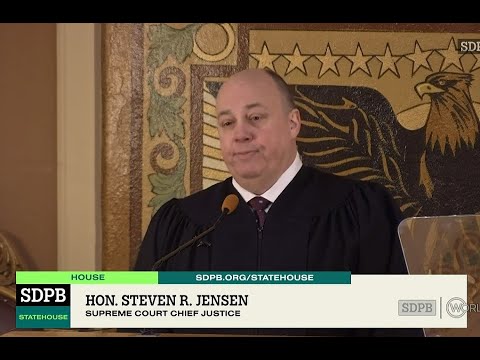
Chief Justice Steven R. Jensen outlines plan to expand indigent defense, boost access and courthouse security in 2025 State of the Judiciary
Summary
In his 2025 State of the Judiciary address, Chief Justice Steven R. Jensen described steps to create a statewide indigent defense office, improve access for self-represented litigants, pilot pretrial services, expand treatment courts and continue courthouse security upgrades funded by prior legislative appropriations.
Chief Justice Steven R. Jensen delivered the 2025 State of the Judiciary address to a joint session of the South Dakota Legislature, outlining plans to expand indigent defense services, increase access for unrepresented civil litigants, pilot pretrial supervision and continue courthouse security improvements.
Jensen said the work is aimed at ensuring due process and public trust in state courts. "I'm honored to deliver my 2025 state of the judiciary message to you," he said, adding that "Trust is the foundation upon which the legitimacy of our judiciary rests."
The address summarized several near-term and planned changes. Jensen said the Legislature enacted legislation this past session to create a Commission on Indigent Legal Services and provided $1,400,000 in ongoing funding to establish an Office of Indigent Legal Services. The commission has selected Neil Fulton, dean of the USD Knudson School of Law, to chair, and hired Chris Miles as the office's chief defender. Jensen said the office will initially handle court-appointed criminal services and appeals, habeas corpus petitions and child abuse-and-neglect matters at the appellate level, with a plan to expand regional full-time public defenders to the trial-court level pending statutory authorization and funding agreements with counties.
Jensen projected administrative savings from centralizing indigent defense work and said the office's efficiencies could save about $600,000 per year compared with the prior ad hoc county-funded model, with counties cumulatively realizing more than $2,100,000 in annual savings. The Legislature also provided a one-time $3,000,000 appropriation to counties to help defray transition costs, he said.
Access to civil courts was another focus. Jensen noted national and state trends showing many civil cases involve at least one self-represented party and described a new court rule adopted in February that created a Commission on Access to the Courts. He said the 11-member commission will recommend process improvements, develop forms, expand legal-aid resources and propose rule changes to help unrepresented litigants and court staff.
Jensen described pretrial services as a potential new tool for courts. He said some larger counties already operate limited pretrial programs and that the UJS is conducting site visits to jurisdictions in other states. Because South Dakota's judiciary currently lacks statutory authority to monitor adults before conviction, Jensen said the branch expects to offer legislation to authorize statewide pretrial supervision and will continue coordinating with counties, state attorneys, public defenders and community partners on design and pilot funding.
On probation and treatment programs, Jensen provided fiscal-year statistics: UJS court services supervised 7,469 adults and 1,490 juveniles on probation during fiscal 2024, and 1,780 adults and 1,038 juveniles were discharged successfully. He highlighted treatment courts (drug, DUI, veterans and mental health), noting South Dakota operates 17 treatment courts and that they have served 2,684 participants since inception with a roughly 57% graduation rate. The UJS exceeded admissions projections in fiscal 2024 by serving 809 participants, a 21% increase over fiscal 2023.
To illustrate outcomes, Jensen recounted three participant stories presented to the Legislature: "Danica," who speaks at treatment centers about recovery and told the audience, "It's not about where you've been. It's about where you're going;" "Corrine," who credited a highway patrol trooper and a CSO with helping her rebuild her life and presented each a star quilt; and "Chris," a formerly high-risk juvenile who later served in the U.S. armed forces and is studying to be an electrician.
Courthouse and judicial security remain priorities. Jensen reported 56 threats or incidents against UJS judges and employees in the past year and said the UJS has formed local courthouse security committees in 51 of 63 counties, completed 56 security site assessments with Homeland Security and the U.S. Marshals Service, and is using grant funding from a one-time $5,000,000 legislative appropriation to pay 75% of approved courthouse security upgrades. He said nearly $900,000 in security projects were approved statewide this past year and named projects including an access-control system for Pennington County Courthouse doors and elevators and a new security checkpoint at the Brown County Courthouse.
Jensen closed by acknowledging court staff and judges, noting he began a new four-year term as chief justice and that he reappointed seven presiding circuit judges: Cheryl Gehring, Robin Howman, Greg Stoltenberg, Mike Day, Greg McGarragh, Christina Klinger and Robert Gesinski.
Votes at a glance: The legislative session offered a brief procedural motion at the start of the program to invite Chief Justice Jensen to the rostrum; the motion was carried by voice vote (aye/ny). No other formal legislative votes on bills were reported in the transcript of the address.
Sources: Chief Justice Steven R. Jensen's 2025 State of the Judiciary address to the South Dakota Legislature (transcript).