Get Full Government Meeting Transcripts, Videos, & Alerts Forever!
Get email alerts on the Teen Volunteers topic
No spam. Unsubscribe anytime.
State Library of Iowa consultant outlines best practices for teen volunteers in libraries
Summary
Janae Jackson Dorey, youth services consultant at the State Library of Iowa, told library staff how to recruit, orient, supervise and reward teen volunteers and recommended age limits, liability checks and specific tasks libraries can safely assign.
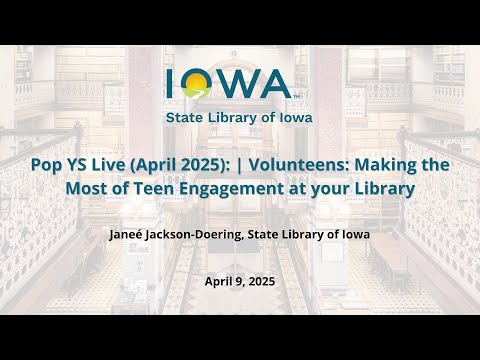
Janae Jackson Dorey, youth services consultant with the State Library of Iowa, told webinar attendees that libraries should actively recruit, orient and supervise teen volunteers to support summer reading and year-round programs.
Dorey said teen volunteers provide essential help — from signing kids up for summer reading and preparing craft materials to shelving picture books and serving as event counters — while gaining workplace skills and community experience. "Teens see the library as a safe, welcoming space," she said.
Dorey framed the guidance around practical steps: where to recruit (middle and high schools, English teachers, service clubs, homeschool networks and social media), application elements and background checks, orientation and scheduling, appropriate tasks by age and maturity, behavior management, and ways to recognize service at the end of a season.
Why it matters: Dorey argued that volunteer experiences benefit both libraries and youth. She cited research-based tools such as the Search Institute's "40 developmental assets" and professional guidance from YALSA (Young Adult Library Services Association) to underscore how service promotes responsibility, communication skills and future library support.
On recruitment and applications, Dorey recommended including contact information, availability windows and emergency contacts on volunteer forms and said forms commonly ask whether an applicant is 18, list references, and note special skills or food allergies. She described Washington Free Public Library and Des Moines Public Library volunteer forms shown in the webinar and urged attendees to consider a liability waiver and a search of Iowa's "SOR" (offender registry) prior to interviews. "It is important to do this," she said, adding that doing due diligence is preferable despite discomfort.
Age and capacity: Dorey recommended a written policy setting age limits and suggested an age window of 12–18 as a common practice; she advised not to make ad hoc exceptions. She described a staffing cap she encountered at a Des Moines branch — "they had to cap it to 30" volunteers — and said libraries should decide their own capacity limits.
Orientation, scheduling and expectations: Dorey recommended a short orientation that includes a library tour, introductions to staff, clear shift and attendance expectations and distribution of schedules in advance. She told attendees to give teens a phone or email contact for last-minute absences and to use name tags and a dress code to ensure volunteers represent the library.
Suggested tasks: Dorey listed practical, supervised tasks suitable for teens, including sign-ups and prize distribution at summer reading tables, craft prep, measuring materials for programs, cleaning toys and tables with gloves, dusting shelves, checking and shelving picture and board books, maintaining book displays and writing short teen book recommendations for shelf talkers. She also suggested trained teens could supervise activity stations, serve as costume wearers with a tap-out sign for water breaks, or act as head counters and runners for busy programs.
Managing behavior and documentation: Dorey advised staff to address problems privately, explain why a behavior is inappropriate, give teens a chance to correct it, issue warnings, document incidents (date, time, staff involved), and, if necessary, revoke volunteer privileges. "Document, document, document," she emphasized. She also cautioned that allowing volunteers behind circulation desks may raise legal issues and reiterated that volunteers are not employees.
Recognition and retention: To reward volunteers, Dorey suggested asking teens what they want for a thank-you event, offering on-shift reading time when tasks are complete, mailing certificates for those who cannot attend a party, and providing small tokens such as stationery or themed bags. She said many teens who volunteer develop into adult supporters of the library and sometimes into paid library pages or staff.
Examples and resources: Dorey shared examples of successful teen volunteers she worked with — Ellie Hildebrandt, Cassidy Kelly and others — and cited resources including the Search Institute's 40 developmental assets, a School Library Journal article, a YALSA blog on engaging teens through service, and YALSA's summer reading teen intern toolkit. She closed with announcements of upcoming Pop YS Live sessions and invited attendees to contact her by phone, text or email.
Dorey concluded with a reminder that teen volunteer programs require clear policies, careful supervision and meaningful roles that both serve the library and support teen development: "Teens are looking for ways to give back to their community, meaningful ways."