Get Full Government Meeting Transcripts, Videos, & Alerts Forever!
Get email alerts on the Elections Polling Places topic
No spam. Unsubscribe anytime.
Randall County Commissioners adopt resolution opposing bills to end countywide polling places
Summary
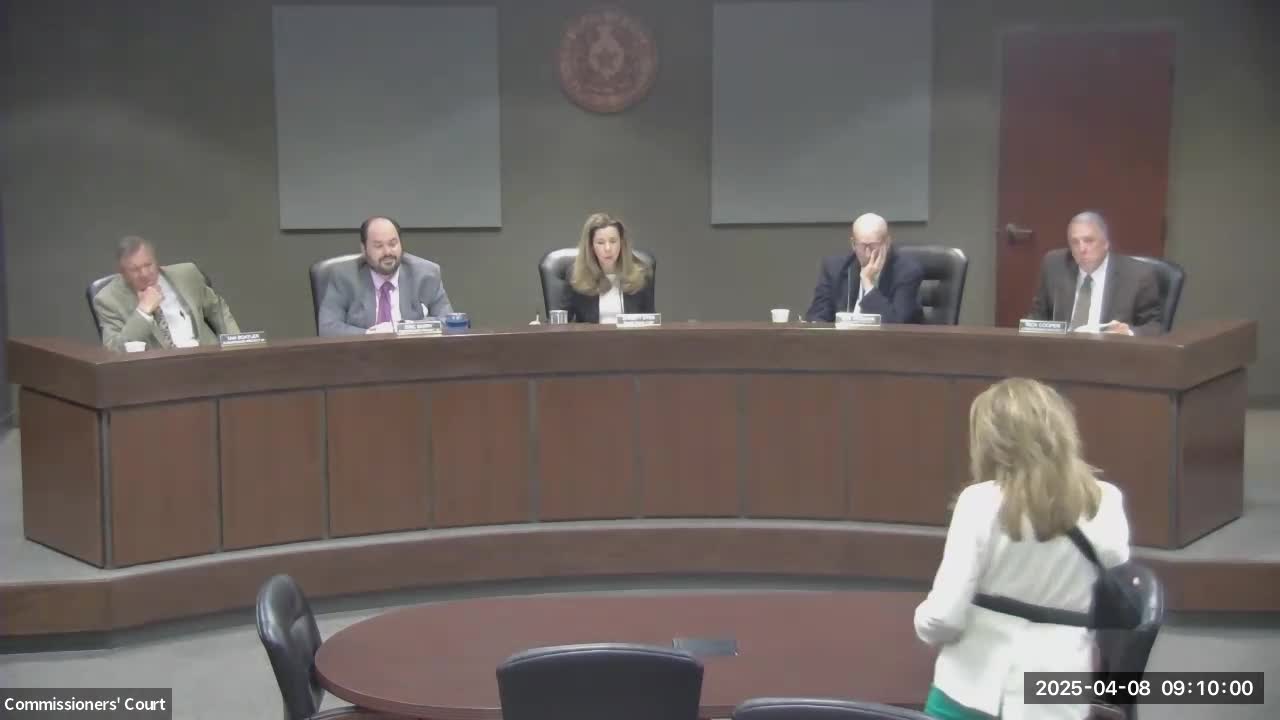
The Randall County Commissioners Court voted 5-0 April 8 to adopt a resolution opposing state bills that would eliminate countywide polling places, citing voter confusion, equipment and staffing burdens and risks during outages.
The Randall County Commissioners Court on April 8 adopted a resolution opposing proposed state legislation that would eliminate countywide polling places and return Texas to precinct-based voting, the court announced during its regular meeting.
The resolution, offered by the county elections administrator, passed on a 5-0 voice vote after a discussion that centered on voter convenience, equipment needs and contingency planning for outages.
Shannon, the Randall County elections administrator and current president of the Texas Association of County Election Officials, told the court that several bills filed this legislative session would eliminate the countywide polling-place program Randall County uses and that about 70 counties had adopted similar resolutions. “This is a bill that I am fully prepared to fall on a sword to prevent passage, and I would appreciate your support,” she said. She told commissioners Randall County has conducted more than 30 elections under the countywide system and that the county’s experience shows the approach reduces long lines and allows voters to choose locations convenient to work or errands.
Shannon also warned that some draft bills would eliminate electronic poll books and return to paper-based precinct lists, which she said would in practice require voters to go to a specific table at a building rather than any county polling site. She said one draft would eliminate early voting and compress voting into eight consecutive days in assigned precincts, and that in the event of a full power outage “those people would not have a place to be able to cast a ballot, period.” She said the bills have been heard in the Senate State Affairs Committee and that local control and continuity of voter access were primary concerns.
Commissioners expressed unanimous support for keeping the countywide approach. Commissioner Cooper said he had “great confidence” in Shannon and her office. Commissioner Robinson and others described scenarios — commuter voters who cast ballots near work, facilities that could lose power, and long-established voter habits at locations such as the annex — that would complicate a return to strict precinct voting.
The court directed staff to finalize and sign the resolution after the meeting. The resolution will be sent to relevant state legislators, including Senator Sparks and Representative Smithy, and filed in the county record.
Votes at the meeting were unanimous: the motion to adopt carried 5-0.
The county’s elections administrator provided additional statistics during the discussion: Randall County recorded about 965 child-interview cases handled by a local center in the previous year (presented elsewhere on the agenda), and Shannon said statewide about 83% of Texas voters use a countywide polling-place model. She also referenced that the Texas Department of Public Safety and other state entities process many reports in related areas. Those numbers were given in the meeting for context and were not part of the resolution language.
The court’s resolution does not change state law; it records the county’s formal opposition and asks state legislators to consider local impacts if the bills advance.