Get Full Government Meeting Transcripts, Videos, & Alerts Forever!
Get email alerts on the Election Precincts topic
No spam. Unsubscribe anytime.
Smith County elections administrator outlines precinct redraw and renumbering plan; no vote today
Summary
Elections Administrator Michelle Alcon presented proposed changes to Smith County election precinct boundaries, proposed renumbering and reductions in the number of precincts and polling places. The court was asked to review the plan; Alcon will return in two weeks with a request for formal action.
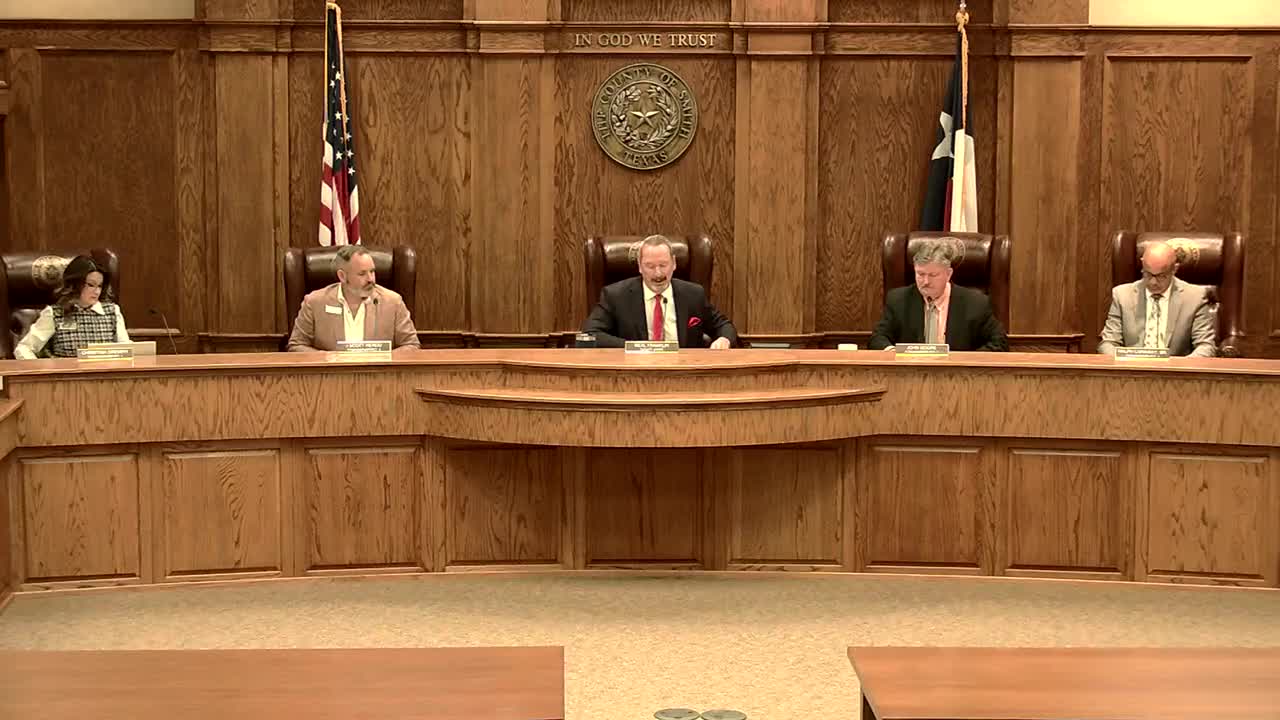
Michelle Alcon, Smith County elections administrator, presented a multi-part plan on April 15, 2025, to redraw, merge and renumber the county's election precincts and to reduce the number of precincts and certain polling locations. Alcon told the Commissioner's Court she was "asking you to hear what I'm proposing" and that "there is no motion to accept any changes or not accept any changes today." She said she would return in two weeks with a formal request for the court to vote on the changes.
The changes are proposed under provisions of the Texas Election Code. Alcon said Texas Election Code sections 42.002, 42.005, 42.006 and 42.007 set the timing and technical requirements for precinct review, and that any changes the court approves must be voted on before May 1 of an odd-numbered year and would take effect Jan. 1 of the following even-numbered year (Jan. 1, 2026 for the changes discussed).
Alcon described the primary constraints used to redraw lines: precincts must not cross the county's "Big 6" major districts (federal and state legislative districts and other major offices), active-registered-voter population thresholds, and incorporated vs. unincorporated territory rules in certain cities (notably the city of Tyler under Sec. 42.007). She said Smith County currently has 75 election precincts and 38 polling places and that her proposal would reduce precincts to 66 and could reduce required polling locations in low-turnout elections from 38 to 33.
On population targets, Alcon said she generally considers splitting precincts when active-registered-voter rolls reach roughly 4,200–4,500 and that her goal when merging is to move precincts toward about 6,000 active voters when feasible. She explained that precincts also can be merged or split to preserve party-ratio balance; using ballot returns from the 2022 gubernatorial race she reported the county is currently about 21% Democratic and 79% Republican. Her full proposal would change that estimate to roughly 21.2% Democratic and 78.8% Republican; a minimal set of changes would move the estimate to about 20.5% Democratic and 79.5% Republican.
Alcon identified specific precinct-level adjustments she is recommending, including splits for Precincts 19, 42 and 71 because of growth; merges such as Precincts 17 and 62; and a series of reconfigurations within Tyler and other commissioner precincts (examples cited in her presentation included precincts 1, 2, 20, 43, 50, 54, 74, 75 and others). She also proposed a renumbering scheme so precinct numbers start with the commissioner precinct number, which she said would make precincts easier for voters and party officials to locate on maps.
Alcon cited operational considerations: countywide voting gives flexibility on polling-place siting but the county must still have at least one polling place for every two election precincts; changes could require adding polling sites, finding buildings, and recruiting judges and clerks. She said higher registered-voter counts per precinct reduce the chance that an individual ballot can be identified in small-turnout or low-absentee contests, a ballot-secrecy concern she said her proposal would help mitigate.
Commissioners and staff asked questions about specific boundaries and local polling availability in growth areas; Alcon agreed to revisit the southern portion of Precinct 42 to consider shifting lines to add registered voters to a new sub-precinct and said she would "bring it back in 2 weeks" with the refined proposal for a vote. She also noted plans to provide updated maps, street indexes and an online interactive map for party chairs and the public ahead of filing and the effective date.
Why it matters: approved precinct changes will affect where voters receive ballots, which polling locations are open in smaller elections, and which precinct-chair contests appear on particular ballots. Alcon stressed that most contests on voters' ballots (commissioner, JP, state legislative races) would not change; precinct-chair races are the primary item affected on voters' ballots.
Next steps: Alcon will work with county GIS staff and return to the Commissioner's Court in approximately two weeks with the version of the maps and lines the court will be asked to approve.