Get Full Government Meeting Transcripts, Videos, & Alerts Forever!
Get email alerts on the Local Comprehensive Plan topic
No spam. Unsubscribe anytime.
Yarmouth Planning Board finalizes hybrid format for Jan. 29 Local Comprehensive Plan engagement
Summary
At its Jan. 15 meeting the Yarmouth Planning Board approved a hybrid public engagement format for the Local Comprehensive Plan (LCP) “middle” session, keeping the meeting high-level while using breakout groups, live polling and worksheets to gather public input on economy, housing, climate resiliency and land use.
YARMOUTH, Mass. — The Yarmouth Planning Board on Jan. 15 agreed on a hybrid format and outreach plan for a Jan. 29 public engagement session tied to the town’s Local Comprehensive Plan (LCP), aiming to use short presentations, live polling and facilitated breakout tables to gather community priorities that will help shape the growth policy.
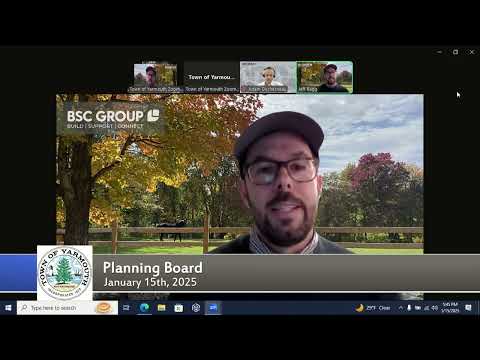
Board Chair Joanne Crowley opened the session and invited consultant staff from BSC Group to describe logistics for what the materials repeatedly called the “20-ninth” meeting. Jeff of BSC Group said the team plans to “go full steam ahead with the hybrid mode of meetings,” bringing consultants and board members into the hearing room while connecting online participants via Zoom and live polling software.
The meeting is meant to be an interactive mid‑process engagement rather than a detailed final hearing: consultants proposed a brief presentation followed by facilitated breakout discussions at three in‑room tables and parallel online breakout rooms. The plan calls for a projected slide presentation, a one‑page facilitator worksheet at each table, and a Menti survey to capture both in‑room and remote responses in real time.
Kathy, a town staff member coordinating publicity, told the board she would request RSVPs to lcp@yarmouth.ma.us to estimate in‑person turnout and noted the open house previously drew about 40 sign‑ins. “So what I'm going to do when I'm publicizing it, I'm gonna request that people RSVP to the lcp@yarmouth.ma.us just to help give us a head count,” she said.
Consultants and board members hashed out the session’s focal topics. The board and BSC Group narrowed planned breakout topics to economy, housing (including ADUs and workforce housing distinct from the town’s Housing Production Plan), climate resiliency and land use/community character. The board agreed land‑use discussion should include reference to the zoning map and existing districts so participants can react to what is currently permissible.
Adam of BSC Group advised a concise presentation and said facilitator experience suggests targeted breakout time will produce the best input: “I think 20 minutes might be the time frame you wanna shoot for” for breakouts, he said, while acknowledging final timing could be longer depending on turnout.
Board members emphasized two objectives: (1) keep the presentation high level and direct participants to existing, more detailed resources (for example, the town’s Vision Plan and Housing Production Plan), and (2) use the breakout worksheets to produce usable input for shaping the growth policy and possible action items. Several members recommended using base maps or zoning maps on the tables so participants could indicate where different housing types or mixed uses might be appropriate.
Consultants said they will supply a facilitator guide and worksheets and asked planning board members to staff tables and virtual breakout rooms where possible. BSC Group indicated it will have three staff in person to help run the room and two staff to manage Zoom breakout rooms.
Board members and staff also discussed coordination with smaller, topic‑specific outreach already under way for the Mattakee’s/Mattakees property (variously referenced in the meeting). Staff said multiple subcommittees and the Mattaquees Utilization Committee (MUC) are conducting parallel outreach and surveys; the board agreed the Jan. 29 session should treat Mattakee’s as a land‑use item and refer interested residents to the MUC’s more detailed meetings.
The board and staff reviewed publicity plans: code‑red alerts, school communications, reader boards and traditional social media were discussed as distribution channels. Consultants said they will provide a draft session outline to staff (Kathy) within days for refinement and finalization of questions and logistics prior to the public session.
Votes at a glance: - Motion to accept the meeting minutes of Jan. 8: moved and seconded; chair called for the vote and members responded “Aye.” The motion passed by voice vote. (No roll‑call tally was recorded.) - Motion to adjourn the Jan. 15 meeting: moved, seconded and approved by voice vote.
What this means: The Jan. 29 session is planned as the LCP’s “middle” engagement—a broadly public, hybrid workshop intended to collect priorities and site‑level input the consultants and staff will use to draft action items and help define the town’s growth policy. The board expects a concise presentation (about 15–30 minutes) and facilitated breakout discussions that produce targeted, documentable feedback. Staff and consultants will circulate the facilitator guide and worksheet to board members for review before the session.
Next steps and follow‑ups: consultants will circulate a refined session plan and the worksheet to Kathy and the board; staff will publicize the session and ask residents to RSVP to lcp@yarmouth.ma.us. Residents interested in the Mattakee’s property were advised there are separate, ongoing MUC meetings and surveys where site‑specific input can be provided.