Get Full Government Meeting Transcripts, Videos, & Alerts Forever!
Get email alerts on the Affordable Housing topic
No spam. Unsubscribe anytime.
Yarmouth committee brainstorms mixed housing options for large town-owned site, preserves gym and auditorium
Summary
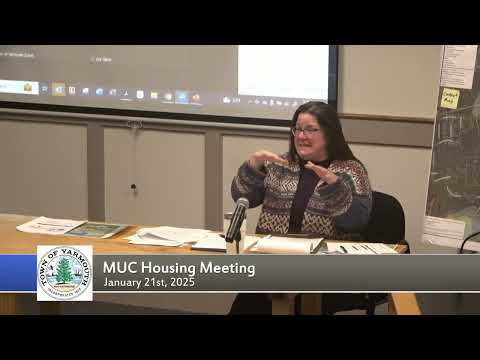
A hybrid meeting of the Town of Yarmouth Community Housing Committee and the Affordable Housing Trust on Jan. 21, 2025, assembled municipal staff, housing providers and consultants to brainstorm uses for the large town-owned property commonly referred to in the meeting as the Mattakee site. Attendees emphasized mixed housing types, workforce and senior needs, and retaining the gymnasium and auditorium while exploring rentals, ownership models and potential partnerships.
A hybrid meeting of the Town of Yarmouth Community Housing Committee and the Affordable Housing Trust on Jan. 21, 2025, assembled municipal staff, housing providers and consultants to brainstorm uses for the large town-owned property commonly referred to in the meeting as the Mattakee site. Attendees emphasized mixed housing types, workforce and senior needs, and retaining the gymnasium and auditorium while exploring rentals, ownership models and potential partnerships.
The meeting, facilitated by Barrett Planning Group, was framed as an unconstrained “brainstorming” session to gather ideas and identify which concepts should be studied in more detail. Alexis Lanzalata of Barrett Planning told the group the intent: “we're really just trying to keep things broad and open right now.” Participants repeatedly urged balancing housing types (multifamily, duplexes, single-family with accessory dwelling units), targeting different income bands, and protecting environmentally sensitive portions of the parcel.
Why it matters: the site is one of the largest contiguous town-owned parcels in Yarmouth and could help address local workforce shortages, senior housing gaps and veteran housing needs. Committee members flagged the site’s environmental and regulatory constraints — wetlands, a ground-mounted solar array on a long-term lease, and location within a Zone 2 aquifer protection district — as factors that will shape feasible options. Bill Scott, assistant town administrator, urged the group to “think as if you have the run of the site” while the consultants complete a condition report to inform feasibility work.
Discussion highlights
- Preserving civic uses: Multiple members said the gymnasium and auditorium are heavily used and should be retained if possible. John Barr, chair of the Community Housing Committee, recommended creating a “village center” that could include a community center, daycare, transportation stop and shops while placing housing nearby.
- Mixed housing types and incomes: Participants repeatedly proposed a mix of housing types to meet the town’s Housing Production Plan goals. Suggestions included multifamily rental buildings, town-employee housing (short-term transitional units and longer-term options), clustered single-family ownership with ADUs, mixed-income rental developments, and specific low-income units managed by the Yarmouth Housing Authority.
- Partnerships and models: Speakers proposed partnering with established providers: Habitat for Humanity for affordable homeownership, the Yarmouth Housing Authority for deed-restricted rental units, and nonprofits such as Soldier On for veteran housing. Kathy Williams (Town Planner) and others noted Low-Income Housing Tax Credit and Chapter 40B/40R tools as possible funding or regulatory pathways.
- Environmental and infrastructure constraints: Barrett Planning reviewed key site conditions in the packet: wetland areas, designated critical natural landscape and core habitat, and Zone 2 well protection. The consultants and staff emphasized the need to consider wastewater capacity, aquifer protections, and the ground-mounted and rooftop solar installations when evaluating placement and density.
- Feasibility, funding and SHI implications: Participants asked whether various project types would count on the state Subsidized Housing Inventory (SHI). The group heard that projects with deed-restricted affordable shares (for example, typical rental projects with a minimum percentage of restricted units) can place units on the SHI, but eligibility depends on program rules and deed restrictions. Staff and Barrett Planning will research which scenarios would contribute to Yarmouth’s 10% SHI goal and what funding streams could apply.
Next steps and timing
Consultants and staff will compile the ideas into a matrix that pairs building type, target populations and likely funding/permitting pathways. Bill Scott said a condition report on the building should be available in January (staff/consultant timeline in packet) to inform design constraints; Barrett Planning will also document meeting input and perform follow-up homework between meetings. The committee set two follow-up dates for continued work: Feb. 24, 2025 (3:00 p.m.) and March 17, 2025 (2:00 p.m.).
Votes at a glance
- Motion to approve minutes of the Affordable Housing Trust (01/06/2025): approved by roll call (record shows Myra: Aye; Robert Rittenauer: Aye; motion recorded as unanimous). Minutes approval was handled at the start of the meeting and recorded as approved.
- Motion to approve minutes of the Community Housing Committee (date in packet): approved by roll call (multiple members recorded as Aye in transcript). Specific tallies beyond the roll calls recorded in the transcript were not fully enumerated in the available record.
What remains uncertain
No formal decisions were taken on a preferred development program, and the meeting produced a list of candidate ideas rather than a single recommended plan. Several items remain to be clarified by staff and consultants before the committee narrows options: exact costs (site remediation and building rehabilitation), wastewater feasibility and capacity, how existing solar leases would affect development options, and which project structures would place units on the SHI. A rehabilitation estimate mentioned in discussion — an approximate $50,000,000 figure for fully restoring the building as an educational facility — was described as a prior estimate and will need confirmation.
The committee will reconvene after Barrett Planning and staff complete the requested research and produce a summarized matrix of ideas, funding pathways and permitting constraints.