Get Full Government Meeting Transcripts, Videos, & Alerts Forever!
Get email alerts on the Local Comprehensive Plan topic
No spam. Unsubscribe anytime.
Yarmouth holds second public meeting on local comprehensive plan; residents weigh wastewater, housing, Route 28 and coastal resiliency
Summary
Town Planner Cathy Williams and consultant Jeff Bagg led a second public meeting on the Town of Yarmouth’s local comprehensive plan update, reviewing water resources, wastewater construction, housing pressures, Route 28 redevelopment and coastal resilience and asking residents for input and priorities ahead of a draft due in May.
The Town of Yarmouth held a second public meeting on its local comprehensive plan update, led by Town Planner Cathy Williams and consultant Jeff Bagg of BSC Group. The meeting, held in person at the Yarmouth Senior Center with an online Zoom option, reviewed key issues including the municipal wastewater program, water quality and PFAS treatment, housing shortages and second‑home pressures, Route 28 redevelopment and coastal resiliency, and invited facilitated small‑group feedback on priorities and a growth policy.
The meeting matters because the local comprehensive plan (LCP) will guide Yarmouth’s decisions on capital projects, land use policies and priorities over the next decade and must be adopted at town meeting and certified by the Cape Cod Commission to guide regional coordination. Jeff Bagg said the LCP process is important because the town has already done a great deal of preparatory work and now needs public input on priorities: "We had about 38 seats set out in this room, so we have a packed house," he said, noting both in‑person and online participation.
Presenters walked through existing conditions and near‑term actions. Cathy Williams summarized water resources concerns — contamination from septic systems, stormwater and fertilizer; PFAS levels at multiple wells; and the need for effluent discharge sites as the town proceeds with a phased municipal wastewater program. Williams said the town is under construction on phase 1 of an eight‑phase wastewater program, that two wells already have PFAS treatment and designs are underway for treatment at two additional wells, and that locating and funding effluent discharge sites (including study of Bayberry Hills Golf Course) remains a priority.
Discussion of natural resources covered wetlands, invasive species, salt marsh migration and restoration needs. Williams noted ongoing invasive species management at town parks and work with the Friends of Bass River on culvert replacements and wetland restoration. She also described a vulnerability assessment of municipal facilities and a Packet Landing marine resiliency project in design to protect public safety boat infrastructure.
Built systems and land use were a central focus. Presenters and table discussions repeatedly identified Route 28 as the town’s main commercial corridor and a target for design improvements, mixed‑use redevelopment and multimodal connections. Attendees and online groups suggested concentrated nodes or village centers, reinvestment in blighted parcels, and incentives to encourage mixed‑use redevelopment that pairs commercial activity with market‑rate housing. Several tables recommended better pedestrian and bicycle connections, a trolley or shuttle concept to link hotels and attractions, and enhanced wayfinding to promote Yarmouth as a base for Cape Cod visits.
Housing emerged as a crosscutting issue. Williams and respondents noted a constrained housing supply, rising costs across housing types, a large share of second homes (noted at 32% of housing stock), and growing short‑term rental use. The town’s Housing Production Plan was cited as a key resource; Williams noted the town’s goal of reaching 10% affordable housing on the subsidized housing inventory and that the current share is about 5%. The town is participating in a UMass Dartmouth study of short‑term rentals and discussed incentives and partnerships (for example, with nonprofit developers) to expand workforce and year‑round housing.
Transportation and safety topics included MassDOT‑led projects on Route 28 and Route 6A, a planned replacement of the Bass River bridge and a Station Avenue corridor study. Williams said multiple intersections are on the region’s high‑crash list and that MassDOT projects include multimodal elements and shared‑use pathways. Participants raised concerns about commuter traffic, off‑Cape workers, and the need for better year‑round transit and walkability to reduce car dependence.
Coastal resiliency and climate issues drew attention to shoreline erosion, dredging and storm impacts. The town has a dredging permit and a Seaport grant for upper‑Bass River dredging feasibility, a hazard mitigation plan update with an ongoing survey, and specific studies of low‑lying roads and culverts. Attendees discussed the availability and cost of flood insurance, policies for rebuilding on filled wetlands, and the potential to relocate or reconfigure beach parking and pavements to support beach nourishment and natural features.
Economic development and tourism feedback stressed shoulder‑season strategies. Online and in‑room groups proposed expanded arts, cultural and sports events, tournament hosting to fill hotels in off months, a centralized family‑oriented interpretive center, and greater marketing coordination across town departments and the chamber. Participants also cited the need to support businesses during wastewater construction impacts on commercial corridors.
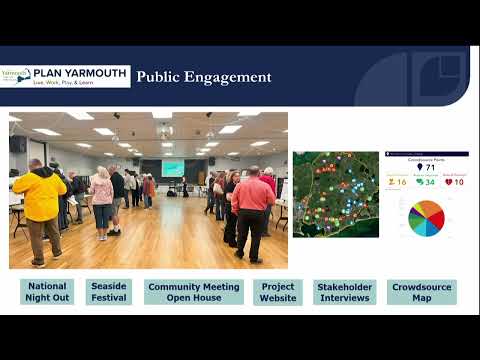
Public engagement and next steps: presenters summarized past outreach — a 2020–21 visioning process, about 800 survey responses, a September open house with roughly 40 attendees, stakeholder interviews and a crowdsource map on the project website. The project timeline presented calls for a full draft LCP by May, a townwide survey in June or July, a formal Planning Board public hearing in late summer, adoption at fall town meeting and final certification by the Cape Cod Commission. Jeff Bagg closed by asking attendees to sign up for notifications and participate in the upcoming survey and town meeting votes.
Attendees asked for clarification on funding and sequencing for future wastewater phases, detailed projections of demographic changes over 10 years to inform housing targets, and more explicit coordination between the town, MassDOT and property owners for Route 28 improvements. Several tables emphasized permitting predictability, incentives for mixed‑use redevelopment and stronger marketing of Yarmouth’s non‑beach assets.
The town is accepting further comments via the project website and plans additional engagement while staff and consultants refine a targeted action plan for review before the Planning Board public hearing.