Get Full Government Meeting Transcripts, Videos, & Alerts Forever!
Get email alerts on the Housing Site Mattakees topic
No spam. Unsubscribe anytime.
Yarmouth committees brainstorm mixed housing, retain gym and auditorium at large former school site
Summary
The Town of Yarmouth’s Community Housing Committee and Affordable Housing Trust met Jan. 21, 2025, to brainstorm housing and mixed‑use concepts for the large former school property (referred to in meeting materials as the Mattiquis/Mattakees site), with Barrett Planning Group facilitating a wide‑open discussion of rental, ownership and mixed‑use models.
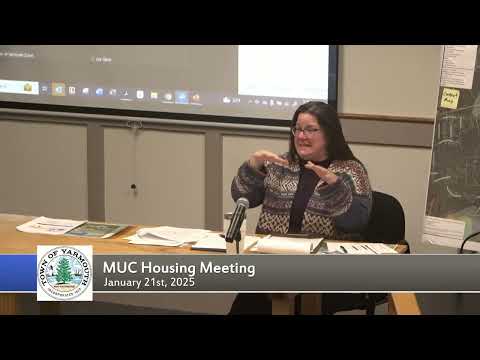
YARMOUTH, Mass. — The Town of Yarmouth’s Community Housing Committee and Affordable Housing Trust met Jan. 21, 2025, at Yarmouth Town Hall and by Zoom to brainstorm housing and site‑use options for the large former school property (referred to in meeting materials as the Mattiquis/Mattakees site). The meeting was facilitated by the Barrett Planning Group and attended by town staff, housing advocates and representatives from the Yarmouth Housing Authority, veterans’ outreach and regional nonprofits.
The session’s purpose was to collect ideas without eliminating options, Alexis Lanzalata, principal with Barrett Planning Group, told the group: “this meeting is meant to be where we run amok where all of the ideas [are] possible without… limiting yourselves,” she said. The consultants and town staff said they will do follow‑up feasibility work between meetings and return with more analysis.
Why it matters: The site is one of the largest remaining Town‑owned parcels in Yarmouth and could address multiple local shortages identified in the town’s recent Housing Production Plan (HPP), including workforce rental housing, senior units and deeply affordable housing. Committee members and attendees repeatedly flagged workforce retention (town employees, public safety, teachers and health‑care workers), veterans, seniors and very low‑income households as priority populations for any future development.
Key proposals and recurring themes
- Mixed housing typologies: Multiple participants proposed combining multifamily rental buildings with smaller single‑family or clustered homeownership units and accessory dwelling units (ADUs). Kathy Williams, town planner, said planners had considered both smaller and larger scales: “A smaller scale project might be 70 to 100 units on 6 to 8 acres. A larger scale might be 120 to 150 units on 10 to 12 acres.”
- Housing for municipal employees and first responders: Several speakers urged reserving short‑term and/or longer‑term units for municipal staff and public safety employees to help with recruitment and retention. Joe Glynn (Yarmouth Housing Authority, on Zoom) and Chief Lennon (public safety concerns raised during note taking) were cited by staff as stakeholders highlighting that need. Josh Trott (Community Housing Committee; Housing Assistance Corporation) cautioned about tying long‑term housing to a job and suggested short‑term accommodations (three to six months) as a lower‑risk option.
- Affordable and mixed‑income rental: Town staff and trustees emphasized the HPP’s suggested emphasis on rental housing (the plan’s illustrative split targeted about 80% rental, 20% ownership for units produced under the plan). Robert Rittenauer, town administrator and chair of the Affordable Housing Trust, called for mixed‑income rental and stressed retaining community uses such as the gymnasium and auditorium.
- Partnerships and delivery models: Speakers proposed a range of delivery partners, including the Yarmouth Housing Authority (several trustees urged collaborating on or relocating housing authority units to the site), Habitat for Humanity for ownership models, and veteran‑serving groups such as Soldier On for targeted veteran units. Drew Krause (Yarmouth Housing Authority representative) specifically suggested housing for veterans at risk of homelessness.
- Preserve high‑use municipal spaces: Several committee members who toured the building reported heavy ongoing use of the gym and surrounding rooms. John Barr, chair of the Community Housing Committee, summarized a common thread: consider housing while “saving the auditorium and the gymnasium” to preserve community programming.
Constraints and technical considerations
Barrett Planning and town staff repeatedly asked participants to treat the site as broadly available for ideas while noting constraints that will shape feasibility work:
- Environmental and water resources: Consultants noted mapped wetlands, priority habitat and that the entire site lies within Zone 2 for multiple drinking‑water wells. These features will limit where development can be placed and require protective design.
- Existing solar lease: Bill Scott, assistant town administrator, said the site includes ground‑mounted solar and rooftop solar and that the town had leases: “I think there’s, we’ve been into 12 years and a 20 year lease,” he said, adding that “everything is on the table” for planning but that consultants should be aware of the solar infrastructure.
- Zoning and permitting: The site is in an R40 district and in the Aquifer Protection District; uses allowed by right and by special permit were summarized for the committee. Barrett Planning reminded the group that larger projects could trigger additional review such as Cape Cod Commission review as a Development of Regional Impact and that Chapter 40B/40R and local rezoning options are possible paths.
- Funding and program eligibility: Staff and trustees discussed how different funding sources shape project form. Barrett Planning and town staff said feasibility homework between meetings will explore state and federal funding avenues, tax‑credit programs (Low‑Income Housing Tax Credit/LITC was discussed in general terms) and whether particular proposals would produce units eligible for the state’s Subsidized Housing Inventory (SHI).
Next steps and schedule
Barrett Planning will synthesize this meeting’s ideas, check specific regulatory and funding constraints, and return with focused options at upcoming meetings. The committee set follow‑up dates: Feb. 24 (working session) and March 17 (afternoon session) to narrow proposals and identify three concepts for deeper feasibility work. Bill Scott said the consultant condition report should be available by January (he said: “We should have the report done by the January”).
Votes and formal actions
The committees completed routine business at the start of the meeting and at adjournment. The Affordable Housing Trust approved minutes from Jan. 6, 2025 (motion moved and seconded; outcome recorded as unanimous in the meeting). The Community Housing Committee approved its minutes as amended (roll call vote; outcome approved). Both bodies then adjourned by roll call.
What the meeting did not decide
No formal decisions about disposing of the parcel, selecting a developer, or adopting a single master plan were taken; the meeting was structured as an open brainstorming session. Consultants and staff emphasized that the next meeting(s) will examine feasibility and funding constraints before the committees advance specific recommendations.
Ending
Barrett Planning and town staff closed the meeting by asking members to submit any written idea forms and to expect a synthesis of ideas and homework results before the Feb. 24 follow‑up. John Barr and Robert Rittenauer thanked participants and the meeting adjourned by roll call.