Get Full Government Meeting Transcripts, Videos, & Alerts Forever!
Get email alerts on the Education Budget topic
No spam. Unsubscribe anytime.
Cape Cod Tech superintendent presents FY26 budget; Yarmouth assessment to rise about $3.83 million
Summary
Superintendent presented a $5.68% FY26 budget increase driven by transportation, materials/services and insurance; Yarmouth’s share of the district assessment was presented as $3,830,574. Committee discussed enrollment, OPEB, electric-bus contract and out‑of‑district special-education costs.
The Yarmouth Finance Committee on Feb. 19 reviewed Cape Cod Regional Technical High School’s proposed FY26 budget, which Superintendent Dr. Robert Sam Warren described as a 5.68% increase over FY25 that adds roughly $993,000 to the district budget.
The proposed FY26 operating plan is driven by three main cost increases — materials and services, transportation and insurance — and would raise assessments to member towns. Dr. Warren told the committee “this budget is a 5.68% increase over FY '25, dollars 993,000 in total.” He said several one-time and ongoing factors combined to produce the rise.
Why it matters: The finance committee emphasized that the committee’s role is review and recommendation before the select board and town meeting consider assessments. The budget’s drivers — a large short-term transportation jump, insurance and higher materials/service costs — would raise Yarmouth’s FY26 assessment. At the meeting Dr. Warren presented the town of Yarmouth’s combined assessment for operating and debt as $3,830,574.
Most important facts first: enrollment, revenue sources and drivers
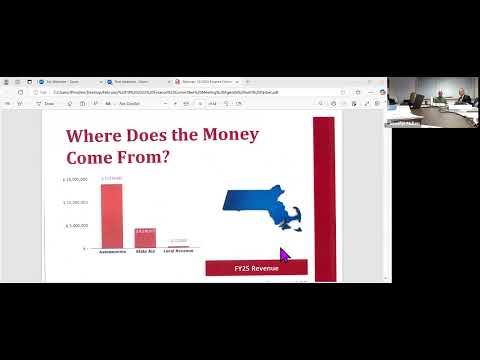
Dr. Warren reported a net 19‑student increase in the Cape Tech district overall but noted that “the town of Yarmouth has decreased by 5 students this particular year,” which affects both the operating and capital assessments for Yarmouth. He said the FY26 proposal relies on three revenue sources: assessments to the 12 member towns (the largest share), about $4.3 million in state aid (Chapter 70/71 and transportation reimbursement) and local revenue; he added that the district has drawn down its E&D (free cash) over recent years.
The superintendent identified four major FY26 cost drivers: materials and services (up nearly 12%), a one-year transportation cost spike (about 19% this year, after negotiating a five‑year fixed contract), utilities and a roughly 35% increase in general property/liability insurance. To hold the overall increase to 5.68%, the district trimmed building improvement capital spending slightly.
Transportation and electric buses
Asked about buses, Dr. Warren said the district’s buses are operated by a third‑party vendor and that the winning bidder, Cape Destinations, secured grant funding for electric buses and associated charging stations. The district pays a fixed contract based on 11 routes and will be subject to a fuel escalation clause if diesel costs spike. On the bus transition he said they will maintain diesel backups initially and that “They will start to phase those out as they inevitably, there's gonna be bumps in the road with with electric buses.” He emphasized that the grant for charging infrastructure is tied to the vendor and that Cape Tech is the host site for the charging stations.
OPEB, debt and capital
Dr. Warren walked the committee through the district’s OPEB (other post‑employment benefits) funding: the district’s most recent audit showed an accrued OPEB liability of about $17 million and the district holds roughly $3.1 million in the Plymouth County OPEB trust. The FY26 budget reduces the district’s contribution to the trust from a previously planned $300,000 to $90,000 in FY26; Dr. Warren said that decision was taken to avoid larger staffing impacts and because investment returns had temporarily strengthened the reserve position.
The district is in year seven of debt service on the building project; district‑wide debt service this year was presented around $2,073,000, with Yarmouth’s portion of current debt and operating assessment shown in the materials as $3,830,574.
Special education and out‑of‑district costs
Committee members and district leaders discussed rising out‑of‑district special‑education tuition and transportation costs. Dr. Warren said some placements off Cape and associated transportation have become substantially more expensive and are a material budget pressure. Committee discussion referenced an example figure discussed during the meeting: roughly 45 out‑of‑district placements associated with several million dollars in tuition and transportation costs (figures discussed in the meeting were presented as example totals rather than a single formal line item).
Staffing, programming and enrollment trends
Dr. Warren and staff described the district’s staffing model, in which about 35% of the operating budget funds teacher salaries and other fixed personnel costs account for much of the remainder. The presentation noted the district currently employs about 127 staff (roughly 70 teachers) and that technical programs require specialized equipment renewals (for example, robotics equipment, technology devices and shop equipment). The district reported roughly 700 students in the Cape Tech program and said a wait list remains; expansion would require additional facilities and capital.
What the committee directed and next steps
Committee members had detailed line‑item questions and asked for follow‑up on warranties, outstanding punch list items from the building project (including field drainage), and the MSBA closeout and reimbursement timing. The finance committee will continue review and present a recommendation at the public hearing before the select board and school committee on March 4. Dr. Warren and staff provided supplemental detail for committee review and invited members for on‑site tours where useful.
Ending
The finance committee did not take a final vote on the budget at the Feb. 19 meeting; the committee continued line‑by‑line review and scheduled further consideration at the March 4 public hearing and subsequent meetings. Committee members thanked the superintendent and staff for the presentation and supporting materials.