Get Full Government Meeting Transcripts, Videos, & Alerts Forever!
Get email alerts on the Climate Policy And Historic Preservation topic
No spam. Unsubscribe anytime.
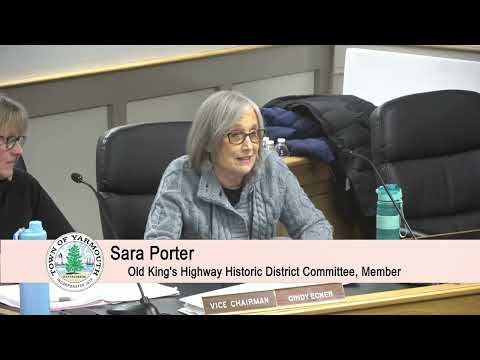
Old Kings Highway Committee and public weigh implications of Massachusetts climate law for historic-district reviews
Summary
Committee members and public commenters discussed Chapter 239 (2024) climate-and-energy legislation and how its 'substantial weight' requirement for solar decisions may affect Old Kings Highway review practice; the committee asked for clarification and signaled a cautious, case-by-case approach.
During new business at the Feb. 24 meeting, the Old Kings Highway Committee and members of the public discussed recent Massachusetts climate-and-energy legislation and its implications for historic-district review of solar energy systems and energy-efficiency measures.
Committee counsel James R. Wilson’s January letter (read aloud at the meeting) cited two changes created by the law: (1) a statutory definition of “solar energy system,” and (2) an instruction that committees “give substantial weight to the threat posed by climate change and the Commonwealth’s obligation to meet greenhouse gas emission limits” when ruling on applications for solar energy systems. The letter recommended that committees explicitly address the new criterion in deliberations and, when denying a solar application, “record in the written denial the specific overriding factors that support the denial decision.”
Chair and committee members discussed how the added statutory language will change their practice. One committee member summarized the effect as requiring “very good reasons” to deny solar projects and urged caution: the committee’s deliberations, he said, will need stronger documentation of overriding factors for denials. The committee agreed the new phrase “substantial weight” has legal significance but is currently imprecise in its practical application; members expect further guidance from state authorities and said they will handle cases on an individual, case-by-case basis.
Public commenters urged attention to real-world impacts. Liz Argo, a member of the Yarmouth Select Board and former Old Kings Highway Committee member, told the committee there is a pending test case involving a resident (referred to at the meeting as Susan Starkey) whose proposed panels would be minimally visible from the public way; Argo said those determinations will be critical for the committee. She also noted the bill’s broader focus beyond solar panels, and encouraged the committee to consider energy-efficiency measures and equity provisions that appear in the statute.
Committee members and members of the public discussed practical questions that will recur in future hearings: how the committee should weigh a small number of panels that affect system output (for example, whether permitting 15 of 20 panels but denying five changes the project’s climate benefit), whether economic or equity considerations play a role, and how to record the committee’s rationale for denial decisions given the new statutory language. One committee member noted the commission has been approving the large majority of solar applications in recent years and observed the committee’s own record of approvals would inform future decisions.
The committee did not adopt any formal policy or template during the meeting. Members requested that staff and counsel track the new law and any forthcoming guidance, and they signaled that the committee will seek to balance its preservation charge with the legislature’s directive to give substantial weight to climate and greenhouse-gas limits. The committee invited public input and said it would treat solar applications individually while awaiting more detailed legal interpretation.
Selected quotes and references from the meeting
- Attorney James R. Wilson, administrative counsel, in a letter read at the meeting: “the committee shall give substantial weight to the threat posed by climate change and the Commonwealth statewide obligation to meet greenhouse gas emission limits ... when ruling on applications for certificates of appropriateness for solar energy systems.” - Liz Argo, member of the Yarmouth Select Board: she highlighted an upcoming case she described as a likely test and urged the committee to prepare clear, documented criteria for denials so that residents are not required to litigate to obtain a final ruling.
What the committee asked staff to do
Committee members asked staff to: track legal guidance and decisions that interpret the “substantial weight” phrase; circulate the letter from administrative counsel to members; and notify the committee when a case likely to test the new standard is scheduled so members and interested public can prepare. The committee also encouraged applicants to provide detailed visibility studies and alternatives when proposing solar systems that may be partially visible from public ways.
The committee will continue discussion of the law’s practical impact at future meetings as state guidance and case law develop.