Get Full Government Meeting Transcripts, Videos, & Alerts Forever!
Get email alerts on the Veterans Benefits topic
No spam. Unsubscribe anytime.
Select Board agrees to consider HERO Act veteran tax-exemption at town meeting after veterans office outlines costs and beneficiaries
Summary
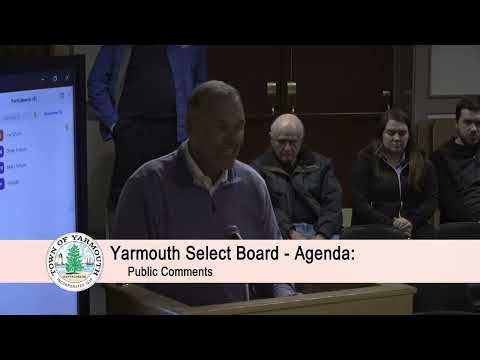
After public comments and a briefing from the Barnstable District director of veteran services, Yarmouth Select Board agreed to place a placeholder HERO Act item on the March 4 agenda to consider options for implementing newly expanded veteran property-tax exemptions locally.
The Yarmouth Select Board on Feb. 25 agreed to add a placeholder town-meeting article and return March 4 to discuss implementing portions of the state's HERO Act that expand veteran property-tax exemptions.
Greg Quilty, district director for the Massachusetts Department of Veterans' Services (Barnstable District), told the board the HERO Act expands eligibility and benefits for veterans and widows but that the statutory changes are unfunded at the municipal level. Quilty said Yarmouth veterans collected about $9.69 million in VA disability compensation last year and the town distributed about $110,686 in chapter 115 (local) benefits in 2024; he said 497 Yarmouth residents received VA disability compensation last year and that the chapter 115 program serves the lowest-income veterans and widows.
Quilty described how the state's highest disability tier (100% service-connected) triggers several benefits that are not strictly need-based, including a higher local tax exemption and a state annuity. He also noted that chapter 115 applicants are means-tested with low income and asset caps, and said the HERO Act did little to change that need-tested program.
Town staff gave the board an estimate of the local fiscal impact of the most-discussed option in the HERO Act debate: doubling the current exemptions tied to VA disability bands. The administration advised that immediately doubling the town's existing exemptions could cost roughly $150,000 annually in foregone property tax revenue; a phased-in 50% raise would cost about $75,000 in the first year of implementation, the administration said. Board members asked for time to review the numbers and to consider phased approaches and targeted exemptions.
After the briefing the board voted unanimously to place a HERO Act placeholder on the March 4 agenda so members could deliberate and decide whether to place a formal home-rule or town-meeting article before voters. No final policy decision was made Feb. 25.
Board members and the veterans-district director emphasized competing goals: honoring veterans' service and the town's responsibility to finance municipal services. Several Select Board members said they supported further discussion and exploration of phased or targeted options that would limit impacts on taxpayers while increasing benefits for low-income veterans and widows.
The board directed staff to prepare detailed fiscal scenarios and ordinance text options for the March 4 meeting so the Select Board and members of the public could compare phased versus immediate implementations and possible eligibility carve-outs.