Get Full Government Meeting Transcripts, Videos, & Alerts Forever!
Get email alerts on the Education topic
No spam. Unsubscribe anytime.
Dennis-Yarmouth superintendent outlines 4.5% proposed budget increase, urges early town engagement on MSBA feasibility work
Summary
Superintendent Dr. Mark Smith presented a 4.49% operating budget proposal for the Dennis–Yarmouth Regional School District, described rising special-education and transportation costs and urged towns to act on the district's MSBA feasibility eligibility process beginning April 1.
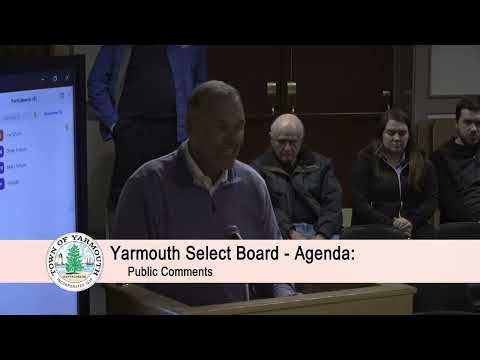
Dr. Mark Smith, superintendent of the Dennis–Yarmouth Regional School District, told the Yarmouth Select Board on Feb. 25 that the district's proposed operating budget for 2025 is up 4.49 percent and is built around a newly adopted strategic plan and stable collective-bargaining settlements.
Smith said the district's revenue picture remained uncertain until the governor's January aid numbers arrived and that the biggest expenditure pressures are rising out-of-district special-education tuition and associated transportation, plus healthcare and benefits.
The superintendent and his staff walked the board through staffing trends, enrollment and the district's changing demographics. Enrollment this year is about 1,120 students; the superintendent noted that the district's October-count “foundation” enrollment used for assessments differs from headcount and that enrollment has risen roughly 100 students in recent years. High-need students' share -- a state metric that combines special education, English-language learners and economic-disadvantage -- has grown, Smith said, driven by increases in first-language-not-English and active English learners.
Smith flagged a sharp rise in out-of-district tuition and in private-provider transportation costs, which he said have increased both because of rate changes and because many providers operate long-distance routes. Those costs are a major driver of the district's special-education budget and create year-to-year uncertainty.
On revenue, Smith credited the Student Opportunity Act and chapter 70 funding for a sizable state aid increase the district received this year but warned the aid is part of a multi-year rollout whose future trajectory is not guaranteed. He laid out how the regional assessment is calculated and said differences in each town's minimum required contribution from the state can change the split in ways beyond local control. He presented sample scenarios showing the same district budget producing different percentage increases for Dennis and Yarmouth depending on how the state-set minimum contributions changed; the district's presentation shows a 4.49% operating-budget increase overall but assessments varied in illustrative scenarios by town.
Smith also reviewed capital and debt-service items tied to the new high school and interim bond anticipation notes, and said the district is preparing for the MSBA eligibility window that opens April 1. He described the first steps the district will take if invited into the MSBA process: forming a school building committee with municipal representatives and community members, submitting an educational profile and enrollment data and securing local commitments to fund the feasibility study, owner's project manager and schematic design before the eligibility period closes.
The board and several members asked detailed questions about special-education spending, McKinney-Vento transportation for unhoused students, and the district's excess-and-deficiency position (the district reported roughly $3.2 million in E&D and was using $250,000 this year). The Select Board thanked Smith for engaging the towns early in the budget process and for outlining the MSBA timetable.
The district's school committee is scheduled to take a final vote on the budget at its next meeting; the regional agreement requires that action be completed by the statutory deadline for assessments.
Looking ahead, Smith asked the towns to coordinate on the MSBA timetable and on securing the local funding authorization necessary to enter the feasibility phase so project costs for the feasibility study and schematic design can be eligible for MSBA reimbursement.
The Select Board accepted the presentation and asked to be kept apprised as the district moves through the MSBA eligibility and feasibility timeline. The board did not take a formal vote on the district's budget at the meeting.