Get Full Government Meeting Transcripts, Videos, & Alerts Forever!
Get email alerts on the Muc Site Planning topic
No spam. Unsubscribe anytime.
Yarmouth committee hears Barrett Planning findings for MUC site; school parcel, sewer needs and retrofit costs flagged
Summary
The Town of Yarmouth Community Housing Committee reviewed consultant feedback on the MUC site, discussed mixed-use housing options, confirmed an 8–10 acre school reservation scenario, and flagged sewer and renovation cost constraints during its March 10 meeting.
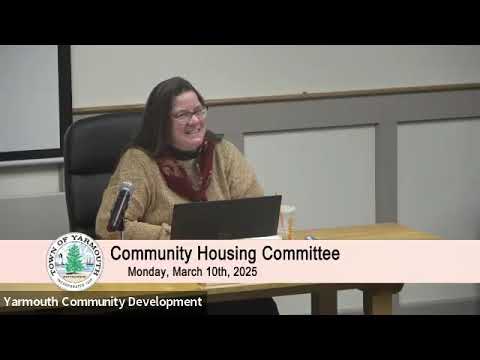
YARMOUTH, Mass. — The Town of Yarmouth Community Housing Committee on March 10 reviewed consultant work from Barrett Planning on the MUC site and discussed how housing, school planning and infrastructure needs might fit together as the town moves toward three alternate design proposals.
Karen Green, director of community development, told the committee Barrett Planning weighed public responses and will present options at the next MUC meeting, including “elevated” and “moderate” versions of proposals that mix housing with other uses. She said the consultant heard strong public interest in housing diversity and “senior‑friendly” units and that supportive housing or partnerships with nonprofit providers may be part of a final concept. “They’re definitely gonna say something like, yes. They’re gonna ask you, you definitely want housing here. You guys are gonna have to say yes,” Green said.
The committee heard that one of the three alternatives to be delivered to the Board of Selectmen will reserve approximately 8 to 10 acres for an elementary school. Committee members and staff discussed sequencing: if the school stays in its current building while a replacement is built, that will delay redevelopment of some parcels and affect grant timing for off‑site infrastructure.
Consultants and staff reported the consultant team has concluded that retrofitting the existing classrooms into apartments would be costly. Committee members were told the building’s construction materials and existing utilities make individual unit conversions expensive; in some scenarios demolition and new construction may be less costly than retrofit.
Infrastructure and environmental constraints were a recurring theme. Staff said the site sits near multiple wells and that state well protection zones are being mapped conservatively for planning—staff said they are using a larger, roughly 1,000‑foot buffer in initial planning even though Zone I by statute is typically smaller. That mapping, together with anticipated high occupant counts for some uses, makes sewer extension likely for several development options.
Committee members also raised solar and parking design questions. Bill Scott, assistant town administrator, attended the discussion in a staff role; Robert Rittenauer, town administrator, was invited to provide policy guidance to the consultant team. Staff reported the existing solar contract for town land associated with the project remains in place through 2027.
Barrett Planning will present a charted set of options at the next MUC meeting on March 17 at 2 p.m.; the committee agreed to continue refining a two‑level (elevated/moderate) concept and to coordinate with other town committees so individual proposals account for recreation, economic development and natural resource priorities.
Votes at a glance
• Approve minutes of Jan. 21 meeting as amended — Passed (roll‑call: Greg, Drew, Myra, John, Lee, Josh — all voted yes). Motion recorded and approved.
• Adjourn meeting — Passed (roll‑call: Greg, Drew, Myra, John, Lee, Josh — all voted yes).
Why it matters
The MUC planning process will shape how Yarmouth balances school needs, housing supply and infrastructure investments on a constrained site. Early decisions about whether to reserve land for a new school and how to stage construction affect which grants and off‑site work the town can pursue and the sequence in which development could happen.
What’s next
Barrett Planning will return with more detailed alternatives at the March 17 meeting. Staff said they will post committee feedback and the consultant’s materials to the MUC project page on the town website; staff expected to post committee group inputs by the Wednesday following the March 10 meeting.
(Reporting notes: Discussion occurred during the MUC agenda item; consultant and staff remarks quoted above come from Karen Green, director of community development. No final land‑use decisions were taken at this meeting.)