Get Full Government Meeting Transcripts, Videos, & Alerts Forever!
Get email alerts on the Vector Control topic
No spam. Unsubscribe anytime.
Cape Cod Mosquito Control project briefs Yarmouth board on larval control, surveillance and disease risk
Summary
Gabrielle Sokolsky, superintendent at Cape Cod Mosquito Control, told the board the district focuses on larval control (BTI bacteria), ditch maintenance and surveillance rather than adult truck spraying, and outlined last year's trap results for Yarmouth.
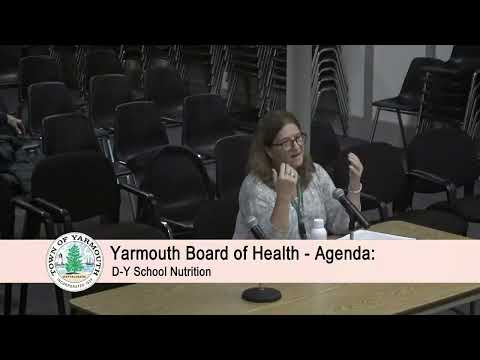
Gabrielle "Gabby" Sokolsky, entomologist and superintendent at the Cape Cod Mosquito Control Project, briefed the Yarmouth Board of Health on March 17 about the agency's year-round larval-control and surveillance approach and the local risk of mosquito-borne disease.
Sokolsky emphasized Cape Cod's approach avoids routine truck spraying for adult mosquitoes. "We don't do any of that here on Cape Cod. No spraying for adult mosquitoes here," she told the board, noting the district instead uses water-management, ditch clearing and larval surveillance to treat mosquito development sites early in the season.
She described the larvicide commonly used on Cape Cod: Bacillus thuringiensis israelensis (BTI), a bacterium that the mosquito larvae ingest. "When we put that bacteria in the water, the mosquitoes pick it up... The bacteria creates a toxin in the mosquitoes that kill the mosquito larvae," she said, adding that BTI is short-lived in the environment and acts specifically on mosquito larvae.
Sokolsky described surveillance and testing for West Nile virus (WNV) and Eastern Equine Encephalitis (EEE). She stated the district collected more than 3,000 adult mosquitoes in Yarmouth traps last year; 26 samples were submitted from Yarmouth, zero returned positive for EEE and three pools tested positive for WNV.
She said the district maintains an inventory of sites it has inspected for water management and larval control and that crews will shift operations to larval monitoring and treatment when water temperatures reach about 50°F. The district also sets trap sites for adult surveillance and submits weekly samples to the Massachusetts Department of Public Health's arbovirus testing program.
Sokolsky urged residents to reduce standing water around homes, clean bird baths weekly, and use EPA-registered repellents according to label instructions. She described salt-marsh and container-breeding mosquito species and noted that some species bite during daylight while others are most active from dusk to dawn.
Board members and residents asked about bats, sterilization and predators; Sokolsky said bats are not a practical mosquito-control strategy and that sterile-male release and Wolbachia programs have been used elsewhere but are not routine Cape Cod programs.
Ending: Sokolsky encouraged residents to call the district with mosquito complaints; she said the district will inspect problem sites to find larval sources and prioritize water management and larval treatments.