Get Full Government Meeting Transcripts, Videos, & Alerts Forever!
Get email alerts on the Habitat Project topic
No spam. Unsubscribe anytime.
Habitat for Humanity outlines 6‑unit Route 28 project and timeline to Yarmouth committee
Summary
Habitat for Humanity presented a preliminary plan for six permanently affordable homes at 1121 Route 28 South Yarmouth, describing unit mix, affordability targets, permitting steps and fundraising and requesting local preference in state application processes.
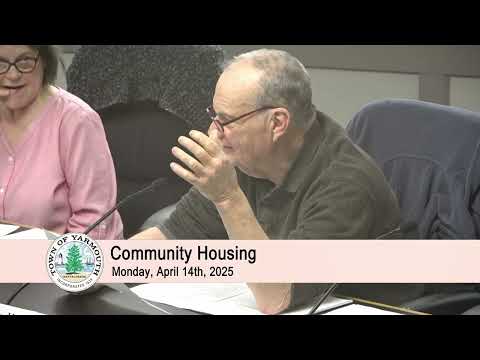
Representatives from Habitat for Humanity told the Town of Yarmouth Community Housing Committee on April 14 that they plan a six‑unit affordable homeownership development at 1121 Route 28 South (near the Wood Road intersection), and outlined the permitting steps, timeline and financing background.
Noreen (new Habitat representative) said the proposal as drafted includes six homes — a mix of one‑, two‑ and three‑bedroom units, combining cape and ranch styles — with full basements where site conditions allow. The homes are planned for households at roughly 60–80% of area median income, and Habitat will seek a local preference and “better preference” for one unit as part of the state Local Initiative Program (LIP) and comprehensive permit processes.
Noreen described Habitat’s usual program details: a longer applicant screening and interview process, a sweat‑equity requirement (roughly 250 hours for a single applicant, about 300 hours for two adults), and home visits to verify housing need. She said Habitat generally designs to meet and often exceed LEED standards but does not pursue formal LEED certification for cost reasons. Habitat also intends to include solar panels where site conditions allow.
Permitting, funding and outreach
Habitat said it is updating engineering plans to show a future sewer connection; the project currently anticipates sewer access later in the town’s schedule (the committee noted a townwide sewer timeline that will reach parts of this area in coming years). Noreen asked the committee for preliminary sign‑offs and said she will submit a live application once plans and engineering are finalized; the state’s EOHLC (or equivalent site review) would set a site review meeting and then the project could proceed to a comprehensive permit hearing before the Zoning Board of Appeals.
The committee was informed that the Affordable Housing Trust provided acquisition funding for the parcel — nearly $500,000 — from Community Preservation Act resources. Committee members and Habitat staff discussed fencing and streetscape design on Route 28, sustainable/native landscaping, traffic calmed access and neighborhood outreach; Habitat said it attempted two neighbor meetings (one in‑person, one virtual) with little attendance but will continue outreach as permitting advances.
Accessibility and selection process
Habitat confirmed that, if an applicant selected through the lottery needs accessible housing, the organization would aim to assign a ranch unit to meet mobility needs and make other reasonable accommodations. Noreen explained the longer Habitat application process, which includes home visits and verification of housing need, as well as the sweat‑equity requirement and sponsor fundraising for individual homes.
Timeline and next steps
Habitat indicated a permitting timeline that could allow permitting activity this summer and infra work as early as late fall or next spring, depending on pipeline constraints and sewer timing. The project team asked the committee for the usual preliminary reviews (local initiative application assistance, advance briefings to departmental reviewers) so that the comprehensive permit filing can be accompanied by departmental comments where possible, which can speed the ZBA process.
Who spoke
Noreen represented Habitat for Humanity; Mary (chair) and other committee members asked questions about accessibility, fencing, landscaping and the permitting sequence. Committee staff confirmed steps that typically occur for local initiative/comprehensive permit applications: an internal 30‑day departmental comment period followed by ZBA review and a state site review step.
Why it matters
If it proceeds as outlined, the project would add six permanently affordable homeownership units in Yarmouth and use local trust funds already allocated for acquisition. The project also serves as a test case for the town’s role in coordinating infrastructure timing, local preference language and neighborhood outreach in future affordable housing projects.