Get Full Government Meeting Transcripts, Videos, & Alerts Forever!
Get email alerts on the Coastal‑shoreline‑protection topic
No spam. Unsubscribe anytime.
Property owner to replace River Street seawall; commission presses for lower-impact alternatives
Summary
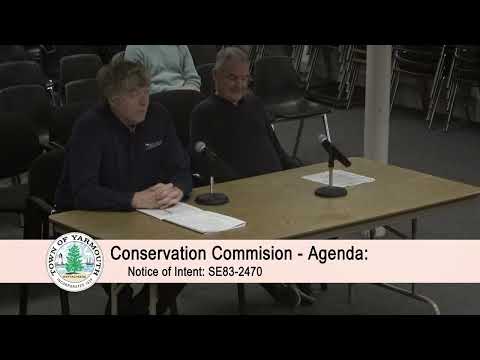
The Yarmouth Conservation Commission on April 3 heard a detailed proposal to replace and raise an existing wooden seawall at 104 River Street and continued the item to allow the applicant to produce additional analysis and a revised plan.
The Yarmouth Conservation Commission on April 3 heard a detailed proposal to replace and raise an existing wooden seawall at 104 River Street and continued the item to allow the applicant to produce additional analysis and a revised plan.
The applicant, property owner Billy Grama, represented by land surveyor Kieran Healy of BSC Group, proposed removing the existing wall, excavating to install buried “dead‑men” anchors, backfilling, replacing stone against the wall, and creating a 3‑foot gravel buffer strip with plantings behind it. Healy said the plan also calls for replacing removed trees “in kind” and planting bushes where trees are removed. He told the commission the wall would be raised roughly two feet and that separate Chapter 91 permitting is pending for the site.
The commission’s discussion centered on construction impacts and whether a lower‑impact anchoring method—helical (screw) anchors—should be required or analyzed as the preferred alternative. Several commissioners questioned the amount of excavation the proposed dead‑men system would require and whether that excavation would force removal of trees that might be saved with helicals. Kieran Healy said helicals had pros and cons and that at this site the existing ground conditions and elevation made dead men more straightforward; he also said some trees had to be removed because excavation for the anchors would disturb them.
Commission staff and members pressed for a clearer alternatives analysis. Conservation Agent Brittney (last name not provided in the record) asked the applicant to include a helical‑pile option or a written justification explaining why helicals are infeasible. Brittney also asked that the entire area disturbed by excavation be replanted or covered with groundcover rather than leaving backfilled or bare areas. Healy agreed to expand the planting area, said he was open to showing helicals as an alternative, and proposed returning with a revised plan. He also said the applicant can add trees elsewhere on the lot to keep the total tree count similar if trees must be removed near the anchors.
Commissioners asked technical questions about constructability, barges, seasonal constraints and soils; Healy said soil testing on the subject parcel had not been done but referenced tests on a nearby lot showing medium sand. He noted the applicant had sought permission for a nearby pier and that the two projects were intended to proceed together.
Action: The commission voted to continue the notice of intent to the meeting on April 17 so the applicant can provide the requested alternatives analysis and revised planting plan. The continuance was requested by the applicant.
Why it matters: The project is in multiple coastal resource areas (coastal bank, riverfront, velocity flood zone and buffer zones) and will alter the upland edge of the shoreline. Commission members framed the debate around minimizing excavation impact while ensuring a structurally stable, longer‑lasting seawall.