Get Full Government Meeting Transcripts, Videos, & Alerts Forever!
Get email alerts on the Municipal Budget topic
No spam. Unsubscribe anytime.
Troy City presents FY2025–26 budget; council questions funding, water rates, library bond
Summary
City staff presented a proposed fiscal year 2025–26 budget that prioritizes public safety, roads and quality-of-life projects. Council members pressed staff on capital shortfalls, a proposed library bond, and an expected combined 9% water-and-sewer rate increase.
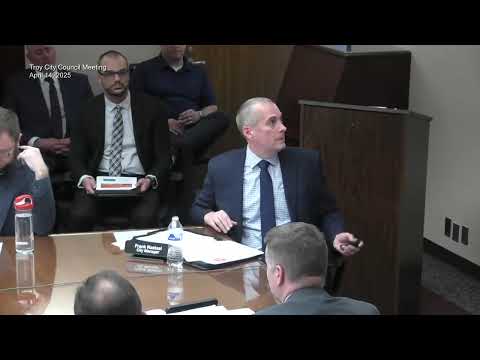
Troy City Council on April 14 reviewed the proposed fiscal year 2025–26 budget in a special meeting focused on capital needs, water and sewer rates, and the library bond proposal.
Frank (City manager) told the council the budget centers on three priorities: “preserving public safety, investing in infrastructure, and delivering quality of life.” He said 58% of the general fund is allocated to public safety and staff included more than $3,000,000 in capital investments for public safety projects, including an urgent roof repair project budgeted at about $1,800,000.
The budget allocates $11,800,000 for major and local road work, moves the Aquatic Center from an enterprise fund into the general fund (increasing charges-for-service revenue by roughly $600,000), and anticipates a 4.5% increase in citywide revenues driven by taxable value growth. Staff reported that taxes account for about 38% of total city revenue, grants about 15% and charges for services about 34%.
Bob Bruner (staff member) walked the council through long-term tax and taxable-value trends and said the city keeps roughly 27.8% of each tax dollar collected for Troy programs, passing the remainder to other jurisdictions. He emphasized that Troy’s taxable-value growth has slowed compared with past decades and that redevelopment now is primarily infill rather than large subdivisions.
Budget details and fund balances prompted extended council questions. Rob (staff member) said the general fund is projected to increase 5.3% this year and that unassigned fund balance is projected at about 29.9% of expenditures for the current year; staff said the city’s policy target range runs roughly between 20% and 30% and the proposed budget projects an unassigned balance near the top of that range. Staff noted the city has used fund balance in past years for one-time needs (for example, COVID-related revenue shortfalls and VFIP payouts).
Kyle (staff member) and others briefed the council on capital and debt. Kyle said the capital fund balance is projected to be about $1.7 million at the end of FY26 after planned spending and cautioned the council that deferred projects and unplanned facility repairs could rapidly exhaust that balance.
On water and sewer matters, Kurt (staff member) said the city is proposing a combined roughly 9% rate increase for water and sewer next year to cover fixed costs charged by the Great Lakes Water Authority and to offset falling consumption. Kurt said Troy’s quarterly average residential bill under the proposed rates would be about $217 for a typical four-person household and explained the city’s revenue risk from lower commodity sales: “we're predicting at the end of this year to just sell over 400 MCFs, which is just the lowest amount of water we've ever sold,” he said. He discussed options including a fixed monthly fee, issuing debt to spread capital costs, or continuing to rely on commodity-based charges.
Council members asked about specific items and contingency assumptions: Scott Finley (via staff presentation) said the city continues to include contingency (about 30% on some projects) in its road estimates and that recent bids have come in below those conservative estimates. Councilmembers also asked about pending grants: Kyle said a federal community project funding grant for a building generator was delayed into 2026 and that a FEMA program tied to the Lane Drain project appears to be discontinued.
Library funding and the proposed bond were a recurring topic. Staff confirmed the FY26 capital budget includes no library capital because the city is anticipating a bond package; council members asked what would happen if a bond fails. Rob (staff member) said the library would draw from its existing fund balance to address immediate needs and staff would develop an alternate plan if the bond does not pass.
Council also asked about EMS funding; staff said $1.2 million was included to address EMS needs and that an RFP process is expected soon to clarify service options and costs. Staff reported other enterprise fund items, including continued advances to Sanctuary Lake golf course (about $11 million total across funds) that will not be repaid until related course bonds are retired around 2028.
Council discussion emphasized two recurring themes: (1) Troy has comparatively low city tax rates for the services it provides, and (2) capital needs outpace predictable, annual revenue growth from taxable value. Multiple councilmembers urged clear public communications ahead of any bond referendum and noted that a small number of voters typically decide municipal elections.
No formal votes were taken at the April 14 special meeting; the session was a presentation and question-and-answer review of the proposed FY2025–26 budget. The council scheduled follow-up discussions on capital and the potential bond in subsequent meetings.
The full proposed budget and presentation slides are available on the city website at troymi.gov/budget.