Get Full Government Meeting Transcripts, Videos, & Alerts Forever!
Get email alerts on the Education Jrotc topic
No spam. Unsubscribe anytime.
Cadets, instructors and parents urge board to preserve Air Force JROTC program
Summary
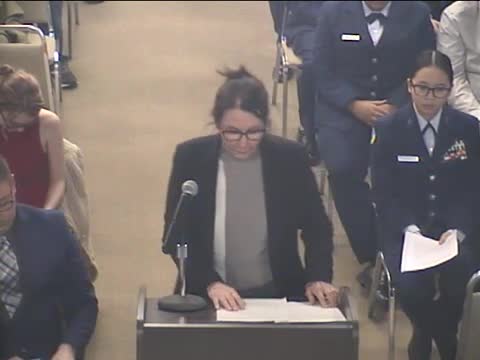
Dozens of cadets, instructors and parents told the Sioux City Community School District board on March 24 that the Air Force Junior ROTC program provides leadership, training and opportunities; speakers urged the board to resolve scheduling, transportation and instructor-waiver issues rather than end the program.
Dozens of cadets, parents and instructors addressed the Sioux City Community School District board on March 24 to ask that the district retain its Air Force Junior ROTC (AFJROTC) program and to press district and Air Force headquarters to resolve scheduling, recruitment and staffing issues.
Speakers described the program as a leadership and character-building course that gives students vocational opportunities, travel, community-service experience and scholarships. Chief Master Sergeant Catherine Roby, an AFJROTC instructor who said she has 30 years of active-duty experience and 15 years instructing, described staff workload and said the Air Force pays 50% of the minimum instructor pay under the title 10 memorandum of agreement.
“We serve two chains of responsibility,” Roby told the board, noting the instructor role includes nonteaching duties such as uniform inventories, event planning and program management. She said the program had been placed on “probation” for enrollment thresholds but that a policy change in 2025 lowered the minimum enrollment from 100 to 50, which affected the district’s standing with headquarters.
Nut graf: Cadets, parents and instructors asked the school board to keep the AFJROTC program and to press for administrative fixes — a staffing waiver, clear recruitment access to feeder middle schools and district support for transportation and practice space — rather than eliminate the program amid scheduling and enrollment shortfalls.
Multiple cadets described how AFJROTC shaped them. Cadet Major Haviland, a junior at East High, said transportation agreements with Girls Inc. and district help have been inconsistent and that denying access to feeder middle schools harmed freshman recruitment. “When the district lets us in, eighth graders actually learn about our program’s existence,” Haviland said. Cadet Chief Master Sergeant Brenton Bunch said the program offers life opportunities and noted scholarships and flight academy experiences available to cadets.
Parent speakers explained that the program’s long hours and community-service contributions are meaningful: Grant Hovland said his son routinely rose before dawn for cadet duties and credited the program with discipline and community service. Cadet lieutenant colonel Wynn and other cadets outlined space and scheduling problems; they said the program lost drill practice space and that moving the program’s meeting day to a single “B day” limited class access and harmed enrollment.
District staff and board members asked clarifying questions. One board member confirmed with Roby that a waiver had been submitted to Air Force headquarters and that a decision had not yet been received. Roby and another instructor, Andrew Johnson, described that instructors are required by the MOA to prioritize AFJROTC responsibilities and that, even where instructors hold teaching certificates, the Air Force treats them as military science instructors and restricts some assignments.
Speakers also requested better district promotion of accomplishments; cadets reported regional trophies and thousands of community-service hours and asked the board to recognize their achievements publicly. Several cadets and parents described recruiting challenges caused by uncertainty about whether the program would run this year and by counselors’ assumptions that the class would not be offered.
Ending: Board members thanked speakers for their testimonies and acknowledged the issue will require continued coordination between the district and Air Force headquarters. No formal board action on the program’s future was taken during the March 24 meeting.