Get Full Government Meeting Transcripts, Videos, & Alerts Forever!
Get email alerts on the Budget topic
No spam. Unsubscribe anytime.
Sioux City Board certifies FY2026 budget, sets maximum tax rate at $12.38 per $1,000
Summary
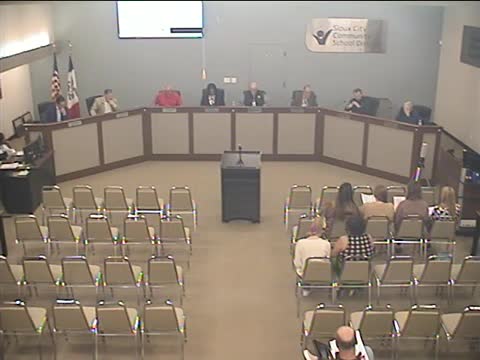
The Sioux City Community School District Board of Directors certified the district's fiscal year 2026 budget and authorized submission to the Department of Management, approving a maximum tax rate of $12.38 per $1,000 and an income surtax of 4%; the motion passed 5-2.
The Sioux City Community School District Board of Directors voted April 14 to certify the district's fiscal year 2026 budget and submit it to the Iowa Department of Management, approving a maximum property tax rate of $12.38 per $1,000 of assessed value and an income surtax of 4%.
The vote to certify the FY2026 budget passed 5-2. Patty Blankenship, the district's finance presenter, told the board the adopted budget will be submitted electronically to the Department of Management and delivered to the county.
Blankenship told the board the district's estimated FY2026 expenditures are $202,800,000; the board certified a slightly higher figure of $203,500,000 to account for items not yet removed from published totals. She said the proposed property tax rate remains essentially unchanged from the prior year at $12.38 per $1,000, and that the district expects to carry over an income surtax at 4%.
Nut graf: The board acted after a public notice and budget hearing were published and held; the decision formalizes the district's spending plan for FY2026 and sets the ceiling for property tax revenue the district may request while signaling how the district plans to use reserves and spending authority amid limited state aid increases.
Blankenship said the district expects to use roughly $5,000,000 of general-fund reserves in cash, and about $1,400,000 of spending-authority reserves, noting special education and English-language-learner (ELL) costs create timing differences between spending authority and cash flows. She said supplemental state aid (SSA) from the legislature was increased by 2%, which she characterized as low relative to inflation and district expense growth; Director Greenwell asked for confirmation that those figures produced an approximate $4.9 million general-fund deficit before reserves.
Board members discussed the district's planning measures over prior years designed to soften what some called an expected funding "cliff." Directors praised prior fiscal planning even as they noted continuing budget pressures tied to special education and ELL costs.
The board recorded that the certified budget cannot exceed the published amounts and that the district will submit the certified budget to the state and file the adopted documents with the county as required by statute and Department of Management practice.
Ending: Blankenship and board members said staff will proceed with the electronic submission and county delivery; no additional citizen input was recorded at the budget vote.