Get Full Government Meeting Transcripts, Videos, & Alerts Forever!
Get email alerts on the School Budget And Staffing topic
No spam. Unsubscribe anytime.
Tigard‑Tualatin SD 23J projects $10.7 million shortfall, proposes staff reductions and notifications under union timelines
Summary
District finance leaders presented a $10.7 million reduction plan driven by declining enrollment, rising PERS and insurance costs and lower operating revenue; the plan relies mainly on staffing reductions (about 64 licensed FTE) and will require union notice timelines to be met.
Tigard‑Tualatin SD 23J finance staff told the school board at a work session that the district faces a projected budget gap of about $10,700,000 for upcoming years and is proposing a reduction plan that relies primarily on staff realignment and layoffs.
District staff said the shortfall stems from declining enrollment, constrained state school funding and rising personnel and nonpayroll costs, including higher Public Employees Retirement System (PERS) employer rates and insurance premiums. The district’s forecast incorporates the governor’s recommended state school fund allocation of $11,360,000,000 and assumes 49% recognition of that revenue in the first year; estimated total operating revenue for the next year is roughly $178.5 million.
The reduction plan presented to the board would close the gap largely through staffing adjustments. The district projects a reduction of about 64.02 licensed full‑time equivalents (FTE), of which 38 are instructional FTE derived by applying existing class‑size ratios to current enrollment; a net classified reduction of about 11.99 FTE (estimated savings $940,000); and a net change in administration/management (reduce 3, add 1) yielding about $550,000. The licensed group savings figure shown in board materials was approximately $7,600,000. Nonpayroll spending reductions are also included: most schools and support services were asked to reduce nonpayroll budgets by 15%, and staff flagged specific contract reductions, including $75,000 from some mental‑health contracts and $110,000 from certain professional‑development contracts.
District staff walked the board through reserve assumptions and policy context. Board policy DBDB specifies a 12% reserve target divided into a 5% ending fund balance, a 5% rainy‑day reserve and a 2% operating contingency; the forecast shown to the board projects a 7% ending fund balance for planning purposes (5% ending fund + 2% contingency). Staff noted the district has drawn down reserves in recent years (a peak general‑fund reserve drawdown of about $34,000,000 since 2021) and budgeted to end the 2025 school year at about an 8% ending fund balance.
Staff described other cost assumptions included in the forecast: a PERS contribution change that increases the effective cost line (reported as about a 15% increase on that line once new rates are applied), an assumed 20% increase for insurance premiums (staff said they were told to expect at least 17% and used 20% to be conservative), and a 5% utility cost increase. The district also noted one‑time service credits and lower surplus cash have reduced investment income compared with prior years.
District leaders said they prefer presenting a single, comprehensive reduction plan rather than repeating smaller reduction proposals, so the board can take a one‑time realignment over the summer. Staff emphasized some reductions reflect aligning staffing to current enrollment (not changing class‑size ratios) and that a small amount of attrition or realignment is expected to cover part of the 2026–27 adjustments.
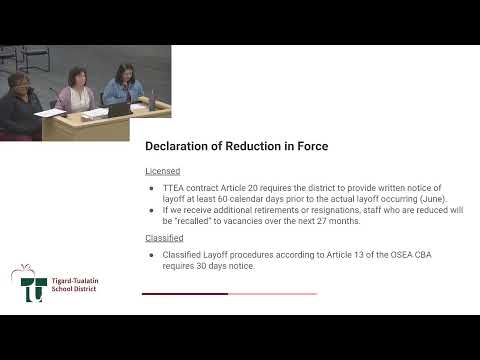
The work session contained no formal board vote. Staff said a declaration of reduction in force will be presented during the general business session later the same evening. District officials noted contractual notice timelines: the TTEA teacher contract requires 60 days’ written notice (placing that deadline at April 30 under the district’s timeline), and classified staff require 30 days’ notice (staff said that notice would need to occur by May, date not specified in the materials shown). Staff also said the district is in negotiations with OSEA and modeled a “me‑too” assumption for OSEA (a 4% COLA and a 3.4% health‑insurance increase) when estimating salary/benefit costs.
Board members and administrators acknowledged the difficulty of the process and the prior work to identify investments to protect. No formal motions or votes were recorded in the work session; staff will present the formal RIF declaration and any required layoff notices during the subsequent general business meeting.
Next steps noted in the session: staff will bring an abbreviated summary to the general business session, present a formal RIF declaration for the board’s consideration, and issue layoff notices to affected employees consistent with contract timelines.