Get Full Government Meeting Transcripts, Videos, & Alerts Forever!
Get email alerts on the Student Body Funds Audit topic
No spam. Unsubscribe anytime.
Audit committee presses district staff for clearer documentation when recommendations are deferred
Summary
At a May audit committee meeting, members discussed seven recommendations from last year’s student body funds audit and asked staff to develop a formal way to document when the district agrees with an audit recommendation but cannot implement it, including a plan to revisit those items.
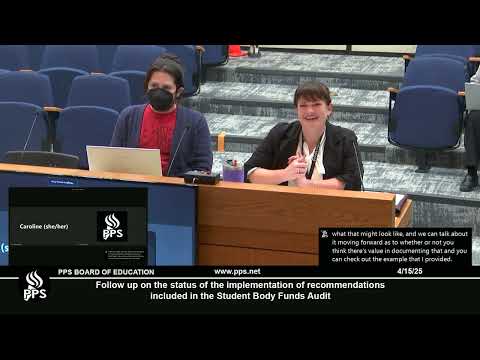
Portland Public Schools Audit Committee Chair Patty Sullivan opened discussion on the status of recommendations from last year’s student body funds audit and asked staff to clarify how the district will document instances where it agrees to a recommendation but says it cannot implement it.
Internal auditor Janice, director of the Office of Internal Performance Audit, told the committee the audit report included seven recommendations and that audit staff performed spot checks to confirm implementation status. "Risk acceptance letters are not common practice, but they are the way in which we could formally close that loop of just the department saying, yes, we agree with the recommendation and here's why we can't implement it," Janice said.
The committee focused on Recommendation 3, which asks that the district strengthen internal controls to ensure student body fund transactions are for allowable purposes and are supported by required documentation. Janice said the district agreed with that recommendation but marked it “unable to implement” in its implementation plan and cited staffing levels as a reason.
Committee member Eddie Wong said he would like a risk assessment rather than paperwork for its own sake. "If it's something where there isn't any risk, personally I'm fine with the way it's documented now," Wong said. Other members asked that whatever mechanism is chosen include a plan to revisit the item rather than letting it remain open indefinitely.
The audit staff gave examples of reasons a recommendation might be deferred. Janice noted that Recommendation 7 — on athletics pass-throughs into student body fund accounts — is tied to a new athletics point-of-sale system, so implementation is planned for 2026 to align with that system deployment. The committee asked for clearer, item-level documentation showing what controls or compensating procedures the district will use until full implementation is possible.
Action and next steps: Janice agreed to work with Jay Cooper, student body funds accounting analyst, to draft a proposal for a middle-ground approach (less formal than a full risk acceptance letter but more than a single spreadsheet column). That proposal will include a reconsideration date and be returned to the audit committee at a future meeting. The committee directed staff to include more explicit documentation of compensating controls or attestations by transaction submitters when possible.
Committee members said they want the solution to be risk-based and to avoid creating paperwork without purpose. The committee did not adopt a formal policy at the meeting but reached consensus that the matter needs additional documentation and a scheduled revisit.
The committee also discussed the underlying documentation issue the audit found: missing supporting receipts or invoices (for example, Amazon charges that do not identify purchased items), which prevented auditors from determining whether expenses were allowable.
Ending: Janice will circulate a proposed template and a staff recommendation before the next meeting; Janice and Jay will bring the draft back for committee review and to set a formal revisit date for the items the district is accepting as not currently implementable.